O. Voyachek
M. Golovushkina
Penza State
University, Russia
The image of modern Englishman a according to the
opinion of Russian students
Language is both an expression of culture and an instrument of
communication. A common language for communication is indispensable both for
individuals and for the society in which they live. Language is thus a
precondition for effective participation in society. On the other hand the
mother tongue and native culture are core components of a person’s cultural
identity.
Each nation has its own views of the world around us, peoples, another
cultures. Certain stereotypes appear in every community – concerning people
themselves, about their behavior and traditions in their cultural space also
about representatives of another language and cultural space.
The aim
of our investigation is to find out the notion of stereotype in Russian and
English languages, to show the peculiarities of reflection of national culture
in stereotypes, to disclose how stereotyped perception of English nation by
modern Russian students.
There are several definitions of the word stereotype:
1. A stereotype is a thought
that may be adopted about specific types of individuals or certain ways of
doing things, but that belief may or may not accurately reflect reality.
However, this is only a fundamental psychological definition of a stereotype
Within and across different psychology disciplines, there are different
concepts and theories of stereotyping that provide their own expanded
definition. Some of these definitions share commonalities, though each one may
also harbor unique aspects that may complement or contradict the others.
2. A stereotype: « a very firm and simple idea about what a particular type of person or thing is like; fixed mental impression»
Russian dictionaries
give the analog definition :
«Стереотип – это относительно устойчивый,
обобщающий образ или ряд характеристик (нередко ложных), которые, по мнению
большинства людей, свойственны представителям своего собственного культурного и
языкового пространства, или представителям других наций.»
Both in
Russian and English languages the word combination “the national character” has
the similar meaning. National character – the qualities that people from
particular country are believed to have. He
understood so much about our national character.
For our research we
have used ideas of modern English anthropologist K. Forks. He includes into his
notion of mentality three communication stereotypes which have in their
background social dis-ease : 1)humour, moderation, hypocrisy;
2)empirisism, Eeyorishness, moaning, class-consciousness; 3)fair play, courtesy,
modesty.
All these
behavioural communication stereotypes are aimed at reduction of communical
need. Perhaps the sense of social dis-ease can be explained by unconscious wish to correspond with gentleman
code of conduct though democratized and simplified.
For our investigation we took into consideration ideas about the
following stereotypes: punctuality, law-abidingness, dry sense
of humor, businesslike character, self-control, accuracy, spirit of enterprise,
politeness, scrupulousness, independence, diligence. The main method of
investigation was chosen the method of multiply choice. Students were supposed
to select the most typical English traits of character according to their
opinion.
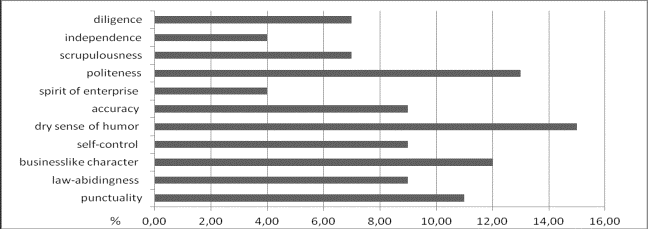
The
results of the survey were to the following effect:
punctuality
- 11%, law-abidingness - 9%, dry sense of humor – 15 %, businesslike character
– 12%, self-control – 9%, accuracy – 9%, spirit of enterprise – 4%, politeness
– 13%, scrupulousness – 7%, independence – 4%, diligence – 7%.
So the image of
gentleman with all his inherent good qualities didn’t lose its historical
meaning, according to the view of Russian students it exists in behavioural
communication stereotypes.
The vast majority
of respondents (13%) underlined the fact that Englishmen are very polite. However,
K. Forks points out that English politeness is connected not only with the
desire to make pleasure to the communicator but firs of all with the wish to
prevent interrogation into “privacy”. That is why they use a lot of fine words:
‘Excuse me, sorry, but you couldn’t possibly pass the marmelade, could you?’,
‘Excuse me, I’m terribly sorry but you seem to be standing on my foot’.
Thus, the majority
of Russian students mix up different historic prejudices,
ancient traditions with new developing traits of character such as spirit of
enterprise and independence, politeness and dry sense of humor, individual
freedom and law-abidingness.
So according to the
perception of Englishmen by Russian students there are many traditional stereotypes,
narrow-mindedness, prejudice. They speak to the way we perceive the nature of
the world, the nature of national character, and our power to intervene and
transform modern society. But our perceptions are not constant. They are
changing, developing and enriching while interfering into another culture. At
its core, the process of penetrating into another culture is believed to
improve today and create a better tomorrow.
Reference list
1. Фокс,
К.Образ в стереотипах современных англичан
// http://www.vekperevoda.org/articles/obraz-v-stereotipah-sovremennih-anglichan.html.
2.
Oxford Dictionary of Current English / Под ред. Catherine Soanes, Sara Hawker, Julia Elliott - Oxford
University Press, 2006. – 1104 с.