UDC 538.9:621.785.6
Features
the mechanical properties of dispersion-hardening alloy 47HNM by quenching and
aging
Mukazhanov Ye.B.1
Telebayev Ye.Ye.2
Takenova G.D.3
Tynaliev Bauyrzhan4
1 Doctoral
Student, PhD, Associate Professor, Academy of Economics and Law, Zhetysu State
University. I.Zhansugurov, Taldykorgan, Kazakhstan
Taldykorgan
Polytechnic College
2 Taldykorgan
Polytechnic College
3 PhD, Associate Professor, Taldykorgan Polytechnic College
4 Taldykorgan
Polytechnic College
Taldykorgan,
Kazakhstan
Introduction
Austenitic
nickel-chromium alloy 47HNM has high corrosion resistance, low temperature
coefficient, elastic modulus, non-magnetic, low hysteresis and elastic
springback, high fatigue strength and is used in industry, not only as a spring
material [1], but also as an element of the design of nuclear and fusion
reactors [2].
Earlier [3]
discussed in detail the effect of temperature quenching, the holding time for
quenching and cooling rate on the phase-structural state of the alloy 47HNM.
Problem posed
in this paper, was not only in the study of structural phase transitions and
properties of alloy 47HNM, but also to show concrete ways of implementing the
results to improve the process of plasticity and strength characteristics of
the material.
Experiment
The object of
study is the alloy 47HNM industrial manufacturing and standard chemical
composition (47%-Cr, 5%-Mo, rest. - Ni).
Mechanical
testing of samples at room temperature uniaxial tensile carried out on the
installation of the "Glade" by the standard method according to GOST
1497-84. The diagrams were calculated tensile yield strength and durability, as
well as determine the elongation of the samples after the break.
Structural-phase state of the samples was investigated by optical (NEOPHOT-21)
and electron (EM 125K) microscopes. Thin sections for metallographic studies
polished and etched electrolytically in 10% strength acetic chlorine
electrolyte. The samples for electron microscopy in the form of discs were
prepared by jet electropolishing and by thinning of the foils.
Results and Discussion
After
quenching in the temperature range 900-1300 ºC 47HNM alloy structure is
two-phase, consisting of grains of γ-matrix and α-phase particles on
the basis of Cr, which has a bcc lattice (Fig. 1,a). With increasing exposure
time is set for hardening solution hardening α-phase grain growth of the
matrix alloy and increase assorted changes in the nature of the grain
boundaries. Grain growth in the alloy 47HNM very depressed because of the
presence of excess α-phase, which inhibits the migration of boundaries
during recrystallization.
Figure 2
shows the dependence of ductility and resistance to deformation of the alloy
47HNM temperature quenching. It is seen that with increasing temperature
ductility of the alloy hardening increases and the flow stress (σ0, 1 -
yield stress, σ1 - voltage residual strain of 1%, σB - strength) is
monotonically decreasing. Increase in ductility with temperature hardening due
not only to the dissolution, but also the processes of coalescence and
sferoidezatsii excess α-phase.

a b
c d
Figure 1. 47HNM microstructure
of a - hardening of 1250°C, 1 min, x8500,
b - aging at 6000, 10, x6500, c - aging at
700°C, 10h, x8500, d - aging at 1000°C, 1h, x8500
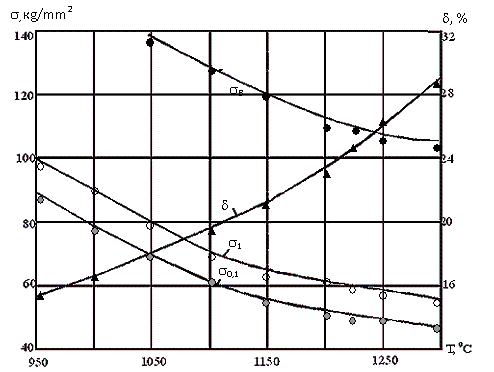
Figure 2 Dependence of ductility and resistance to deformation of the alloy 47HNM
quenching temperature
Analysis of the dependence of the mechanical properties of the holding time at 1300 ° C and 1225 ° C shows that with increasing duration of
heat flow stress drops,
there is a growth of plasticity. Decrease the resistance to deformation,
and increased ductility of the alloy
due to the dissolution of excess α-phase. The process starts with the dissolution of dispersed particles, and with increasing exposure time dissolve and larger particles,
enriching alloying component solid solution matrix. Growth
plasticity with increasing time of homogenization at 1300 ° C occurs up to 30 minutes, inclusive, after which the curve reaches
saturation.
The nature of changes in the mechanical properties as a
function of exposure time at 1250 ° C and 1225
° C subject to the same laws
as at 1300 ° C, but is diminished.
After quenching from 1200 ° C yield strength and
tensile strength of the samples is
higher by more than 10 kg/mm2
over temperature range 1300-1250 ° C. Nature of the change of plasticity at 1200
° C tempering changes
dramatically, the expected growth of plasticity with increasing heating time observed her
fall. The reason for this phenomenon
has not been established, although the nature
of the structural studies of fracture
patterns in cross-section show the presence of the so-called structure of the "slate" kink.
It is considered that the "slate"
of the structure is not a marriage
of heat treatment, but it is possible
that this may be one of the reasons why the ductility and toughness
of the alloy.
Should point to a rather large variations in
the ductility
and strength testing samples quenched from 1200 ° C. Apparently, the spread of values affects
not only the
heterogeneity structure, but also the
partial melting
of the α-phase particles located at the grain
boundaries and the
presence of non-dissolving particles, which
are stress
concentrators. All these factors
lead to the
formation of
micro-cracks, reducing the ductility and toughness of the alloy.
Because, precipitation-hardening alloys used
mainly after
treatment, which includes quenching and
aging, further
interest research the effects of
aging on the structure
and mechanical properties of the alloy 47HNM.
During aging at 600 ° C 47HNM hardened alloy with increasing aging time is a slight
increase in the
strength properties (Fig. 3). Comparing the data of structural studies (Fig. 1b) with the change of the strength properties (Figure 3), we can draw some conclusions, namely the contribution to the strengthening of the alloy, apparently due only to collapse in the excess phase, but as the volume fraction of the phase is small (5-10%), and the amount
of emissions in these particles is from 15 to 40 Å, the increment of hardening is very small. Within the
matrix of any
structural changes
from hardened material occurs (up to 10 hours of age) (Fig. 1, b), and therefore its contribution to
the strengthening of the alloy can be
neglected. A drop of plasticity is likely due to formation
of segregations of alloying
elements on grain
boundaries.
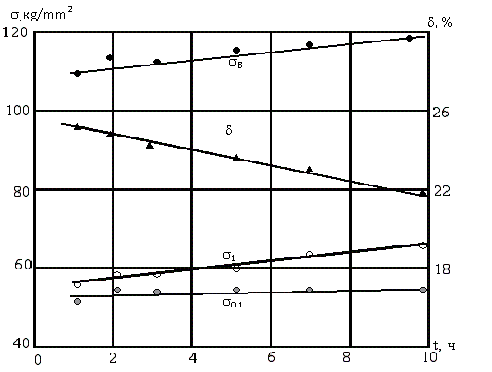
Figure 3: Mechanical properties of
the alloy as a
function of aging
time at 600°C, previously quenched from 1250°C, 2 min.
In Fig. 4 shows the kinetics of hardening of the alloy at 700 ° C, pre-tempered at 1250 ° C. In the initial stages of aging is already marked increase in
resistance to small
plastic deformation, the value of
which increases
sharply with
further increase in aging time. The observed increase in hardening stage of
decomposition is
responsible, resulting in rapidly developing intermittent decay, emitting incoherent α-phase (Fig. 1, c).
Electron microscopic study of the
structure and
metallography showed
that intermittent decay starts at the grain
boundaries, and ends after 5-10 hours after the onset of aging (Figure 1, c),
and the volume fraction of the decay is 75-85%, which corresponds to
the maximum hardening. Nature hardening at this
temperature aging is caused by
inhibition of
dislocations, the
separated particles intermittently α-phase.
Ductility of the alloy with increasing aging time decreases
monotonically decreases
to 5% within 10 hours of aging, while for the quenched
alloy was 25%. This decline is
understandable, given the sharp increase
in strength. In
addition, it
should be noted that the
sensors are
working in the
elastic region with a very low residual deformation and therefore such a reserve of plasticity is sufficient for proper function.
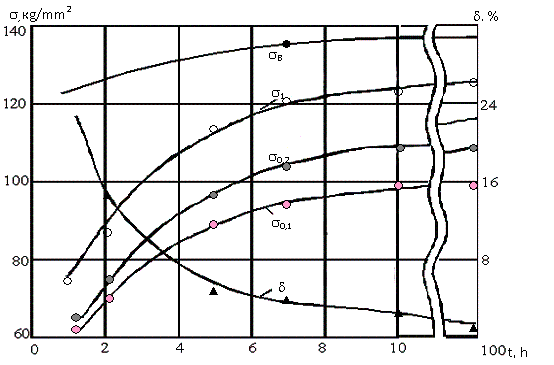
Figure
4: The
mechanical properties
of the alloy 47HNM depending on the aging time 700 º C, pre-hardened from 1250 º C, 2 min.
With further increase of the aging
temperature, a change in the behavior of the strength properties of the alloy on the length of aging. In Fig. 4 presents data on the effect of aging time at 800 ° C on the microplastic deformation resistance, deforming stress and ductility of the alloy 47 HNM. First of all, it should be
noted that in
the initial
stages of the flow
stress of aging, especially the yield stress has a value not inferior to the properties of the alloy, aged at 700 ° C. Therefore, this mode is recommended
for the
production of
elastic sensors, as this significantly
reduces the time
of the heat
treatment.
With increasing aging time the yield stress
and other flow stress, including tensile strength decreases, due to the beginning of the
coagulation process in the cells of the intermittent collapse, at 100 hours aging sferoidezatsy slats α-phase. At the same time there is a
growth of
plasticity, ie dislocation that occurred
during deformation, it becomes easier to
overcome obstacles in the idea of large coagulated particles of α-phase. Thus, the
reduction of
strength properties and increased ductility perestarenii alloy caused by the
increase of
distances between
the previously formed precipitates due to their coagulation, reducing the
number of particles
per unit volume of the matrix and decrease the
voltage required to bypass the particles dislocations.
The intensity of coagulation increases with increasing
temperature of
aging, such as at 900 ° C or 1000 ° C, while also there is a
decline of
strength properties. Why spend the final heat treatment - aging in this
temperature range is unreasonable.
Findings
With the increase of the heating time for
hardening flow stress drops, there is a growth of
plasticity, which is
associated with the
dissolution of excess α-phase.
In samples
quenched from 1200 ° C, the
variation of
plasticity changes
dramatically, the
expected growth of plasticity with increasing heating time observed her
fall. It is
assumed that this is
caused by the
presence in the structure of the "slate" kink.
Hardened alloy 47HNM spending below 1225 º C is not
advisable, as it is the deformation leads to the
formation of
micro-cracks, reducing the ductility and toughness of the alloy.
Temperature
increase over
1300 ° C leads to a sharp drop in ductility, melting due to α-phase particles on the basis of Cr and a spreading of the liquid phase at the grain
boundaries.
During aging at
600°C 47HNM hardened alloy with increasing aging time is a slight increase in
the strength properties, due to the collapse in α-phase.
When the aging
temperature of the
alloy to 700 ° C in the initial stages of aging there is an
increase of
resistance to small
plastic deformation, the value of
which increases
sharply with
further increase in aging time. Hardening caused
by intermittent release of α-phase in g-matrix.
At a temperature
of 800 ° C aging time increases the strength
properties of aging are reduced, due to the beginning of the
coagulation process in the cells of the intermittent collapse, at 100 hours aging sferoidezatsiey slats α-phase.
Thus, for high strength with minimal elastic
imperfections heat
treatment of the
alloy must be
conducted in the
temperature range 650-750 º C, and the aging
time must be
between 8 to 20
hours, depending
on the aging
temperature.
Literature
1.
Rahshtadt A.G. Spring steels and alloys. - Moscow,
Metallurgy, 1971 - 496.
2. Solonin M.I., Kondratyev V.P. Votinov S.N. Alloy HNM-1 as a promising material for structural components of nuclear and thermonuclear reactors with water
coolant / / VAST Series Materials and new materials. - 1995. - Issue 1 (52). -P.13-20.
3. Skakov M.K. Mukazhanov E.B., B.K. Akhmetzhanov Phase-structural changes in precipitation-hardening alloys 47HNM after hardening
/ /
Proceedings of the National Academy of Sciences of the Republic of Kazakhstan. Chemical Bulletin - № 2 (356). Almaty, 2006. Pp. 75-78.