Biological science
/ 4.Resourcesand introduction of plants.
doctor of biology Yeroshenko F.V.
Storchak I.G.
Stavropol Research Institute of Agriculture
NDVI
and photosynthetic characteristics
of winter wheat crops
Keywords: NDVI, winter
wheat, photosynthesis, assimilation surface area, chlorophyll.
Abstract. There are
interconnection between NDVI and photosynthetic characteristics of crops winter
(assimilating surface area of crops, content of chlorophyll in plants). For
higher growth characteristic of photosynthetic productivity of crop should use
the NDVI with the usage of surface density of crop which allows in certain
degree recognizing varietal differences and technological features, also the
growing conditions.
The main role in forming harvest and increasing of
common productivity of plants belongs to photosynthesis. That is why,
regularity of photosynthetic productivity crop study, disclosing mechanisms
which permit to control the processes of forming harvest and its quality, is
the most important direct in physiology of plants. One of the most perspective
ways of such solution can be the usage of earth remote sensing materials.
Lately the facts of earth remote sensing began to use in prediction of crop
capacity. Unfortunately, the accuracy of such prediction isn’t so high, because
of insufficiency of research of exposure correlation mechanisms of earth remote
sensing rates (vegetative indexes) with productive process.
The aim of our research is to define the capacity of
usage the NDVI vegetative index for characteristic of crop winter wheat
productive process.
The objects of research are agricultural crops of
Stavropol Research Institute of Agriculture. Area of fields lies within levels
of 30-60 hectares. Digital map with GPS coordinates was done for each field.
NDVI for each field was estimated by using the data of VEGA service of
Institute of Space Research, RAS (http://vega.smislab.ru/).
Assimilating surface area and chlorophyll content of plants were defined by
generally accepted methods.
Results.
Samples were selected in spring tillering phase (IV organogeny stage), booting
(VI organogeny stage), earing (VIII organogeny stage), and pouring grain (X
organogeny stage). NDVI of choosing fields in the dates of selection are
presented at the first picture.
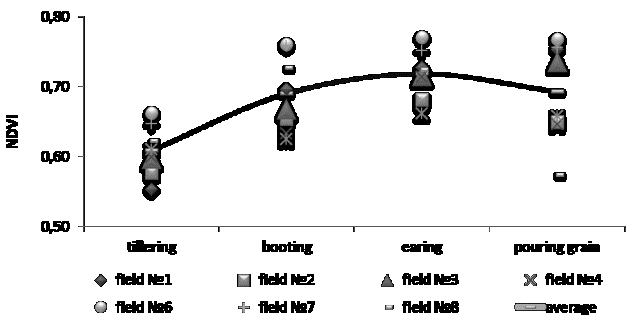
Figure
1 –NDVI fields of winter wheat
The range of NDVI levels for objects of research is
wide. In tillering phase it composes from 19.7 %, in booting phase – 21.7 %, in
earing phase – 16.5 %, and in pouring grain phase – 34.0 %. Dynamics of this
characteristic represents the curve with maximum in earing phase.
We conducted the analysis of NDVI correlation and
assimilating surface area of crops winter wheat (table 1). Researches presented
that the correlated coefficient of these characteristics from each field for
our experience composed the value, which were in the limits from 0.50-0.92,
with the exception of field number eight, which has Кcorr.=-0,23.
Nevertheless, correlated dependence values 0.58 amounts in an average.
Table I. Assimilating
surface area of crops winter wheat and correlated coefficients with NDVI.
|
Number of field |
Assimilating surface area, m2/m2 |
Кcorr. withNDVI |
|||
|
tillering |
booting |
earing |
pouringgrain |
||
|
№1 |
0,59 |
0,70 |
1,14 |
1,23 |
0,84 |
|
№2 |
0,24 |
0,33 |
0,71 |
0,65 |
0,79 |
|
№3 |
1,79 |
1,23 |
2,23 |
2,53 |
0,62 |
|
№4 |
0,41 |
0,60 |
1,15 |
1,18 |
0,79 |
|
№5 |
1,10 |
0,99 |
2,34 |
1,81 |
0,92 |
|
№6 |
1,47 |
1,33 |
2,09 |
1,86 |
0,50 |
|
№7 |
0,48 |
0,52 |
0,82 |
0,96 |
0,59 |
|
№8 |
1,90 |
1,27 |
1,67 |
1,44 |
-0,23 |
|
Average |
1,00 |
0,87 |
1,52 |
1,46 |
0,58 |
Essential values of correlated coefficients can be
explained by the levels of vegetative index which depend on the coefficient of
reflection in the infrared region of electromagnetic waves and its value
depends on plants cellular construction. Therefore, the greater assimilating
surface area so the more objects conditioning this structure [1, 2, and 3].
Correlated interconnection between NDVI and
assimilating surface area of crops of different fields on the specified phase
of winter wheat progress is missed virtually.
Thus, the interconnection between NDVI and
assimilating surface area of crops winter wheat exists, but it’s not stable.
Different plants organs contain different quantity of
chlorophyll which changes in ontogeny besides. That is why, characteristics of
sizes of photosynthetic apparatus and ability of its development use the
quantity of chlorophyll. This characteristic is closely allied with plants
productive process and its productivity[4, 5].
We studied ontogenetic alteration of chlorophyll
content in plants (table II). Interconnection between the chlorophyll content
of NDVI crops exists more closely than in the assimilating surface area. So, Кcorr. for 1,
2, 5, 6 and 7 fields defines the value of 0.90-0.96, for 3 and 4 – 0.52, but
for 8 field it is missed (correlated coefficient consists -0.07).
Table
II – The relative content of chlorophyll (a+b) in winter wheat plants and
correlation coefficients with NDVI
|
Number of field |
The relative content of chlorophyll (a + b),
mg/g |
Кcorr. with
NDVI |
|||
|
tillering |
booting |
earing |
pouringgrain |
||
|
№1 |
4,56 |
3,16 |
1,30 |
0,88 |
-0,93 |
|
№2 |
3,91 |
2,12 |
0,85 |
0,78 |
-0,91 |
|
№3 |
4,86 |
2,27 |
1,64 |
0,32 |
-0,52 |
|
№4 |
5,26 |
2,62 |
2,35 |
0,64 |
-0,52 |
|
№5 |
4,81 |
2,36 |
1,51 |
1,13 |
-0,90 |
|
№6 |
5,01 |
2,17 |
1,84 |
0,83 |
-0,96 |
|
№7 |
3,59 |
1,63 |
0,99 |
0,26 |
-0,91 |
|
№8 |
4,79 |
1,84 |
1,23 |
0,45 |
-0,07 |
|
Average |
4,60 |
2,27 |
1,46 |
0,66 |
-0,72 |
Nevertheless, interconnection between relative content
of chlorophyll in plants and NDVI crops on an average defines the value of
correlated coefficient which equals -0.72, even such different facts. Derived
results explain that the maximum absorption of chlorophyll is found in red
region of electromagnetic waves and the value of NDVI depends on crop
reflection coefficient at this spectral region [1, 6, 7]. The same explanations
have the negative values of correlated coefficient, as crops with higher quantity
of chlorophyll reflect smaller quantity of light energy.
Ascertained interconnection instability between the
size of assimilation surface and chlorophyll concentration with NDVI can be
explained by vegetation index, which represents mathematical expression of
correlation of reflection coefficient in infrared and red parts of spectrum of
electromagnetic radiation which depend on the photosynthessing organ area and
on the chlorophyll content in it. Substantially, these characteristics depend
on high-quality features, technologies and growing conditions [8, 9, 10].
Consequently, for the characteristic of the specific
field of winter wheat with the help of data of earth remote sensing (vegetation
indexes) is necessary to apply methods which make up such differences. The most
simple and available characteristic which reflects such features is volume
density of crops or its surface density. The usage of NDVI of crop with a
glance such characteristic allows to bring down the influence of next factors:
1. Varietal
characteristics such as plant height, tillering, assimilation area of
translational surface orientation of leaves in space. These singularities
determine the optical properties of biological seeding.
2. Phenological
features, degree of crop development. Different stages of development are
characterized specific biomass.
3. Radiation
condition features: distribution of photosynthetic active radiation in the
crop, internal reflection and absorption.
For accounting surface density of crop in term of
vegetation index, we multiplied NDVI by biomass unit of crop area (g/m2).
Measurements of value of such characteristic during the growth and development
of winter wheat plants and correlated coefficient with chlorophyll content are
represented in the Table III. The analysis of derived data showed the relevance
between these characteristics. Correlated coefficient on an average is -0.83 by
examined fields.
Table III – NDVI with
subject to surface density of crop and correlated coefficient with relative
chlorophyll content in winter wheat plants.
|
Number of field |
NDVI·kg/m2 |
Кcorr. |
|||
|
tillering |
booting |
earing |
pouringgrain |
||
|
№1 |
0,31 |
1,09 |
1,81 |
1,44 |
-0,93 |
|
№2 |
0,13 |
0,36 |
0,85 |
0,66 |
-0,94 |
|
№3 |
1,21 |
1,77 |
3,51 |
3,11 |
-0,83 |
|
№4 |
0,23 |
0,65 |
1,27 |
0,97 |
-0,77 |
|
№5 |
0,62 |
1,22 |
2,58 |
1,99 |
-0,87 |
|
№6 |
0,91 |
1,97 |
3,06 |
2,36 |
-0,83 |
|
№7 |
0,30 |
0,57 |
0,93 |
0,94 |
-0,95 |
|
№8 |
1,10 |
1,74 |
2,35 |
1,35 |
-0,52 |
|
Average |
0,60 |
1,17 |
2,04 |
1,60 |
-0,83 |
Accordingly, for higher growth characteristic of
photosynthetic productivity of crop should use the NDVI with the usage of
surface density of crop which allows in certain degree recognizing varietal
differences and technological features, also the growing conditions.
Literary facts
evidence that such characteristics as photosynthetic potentials (chlorophyll
photosynthetic potential – CPSP and surface photosynthetic potential – SPSP)
reflect productive process of plants the most exactly. They characterize not
only the size of assimilating apparatus but also its functioning time. By
analogy with CPSP and SPSP we calculated the photo potential with NDVI usage.
Such analogy is quite appropriate because chlorophyll and assimilating surface
area of crop, which are used by calculation exact photo potentials,
characterize the size of assimilating apparatus of crop. But NDVI is the same
characteristic of crop which reflects the chlorophyll content and
photosynthetic surface area. Calculation of new characteristic was made by next
formula:
251658240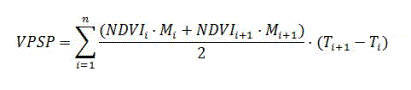
VPSP – vegetation potential
Mi – crop biomass in 1 m2;
Ti –date of test.
We called a new
characteristic as vegetation photosynthetic potential (VPSP). Data of grain
harvest, chlorophyll and vegetation potential and correlated coefficients
between these characteristics are presented in table IV.
Table IV – Yield of grain, photosynthetic potentials of winter wheat crops
and their correlation coefficients
|
Number of field |
Yield of grain, g/m2 |
SPSP, (m2/m2)·days |
CPSP, (g/m2)·days |
VPSP, 10-4(g/m2)·days |
|
№1 |
340,9 |
1,19 |
52,1 |
11,6 |
|
№2 |
250,9 |
0,86 |
19,5 |
5,3 |
|
№3 |
644,7 |
1,99 |
89,5 |
23,4 |
|
№4 |
322,8 |
1,06 |
44,6 |
8,3 |
|
№5 |
685,3 |
1,01 |
88,3 |
17,3 |
|
№6 |
490,8 |
1,13 |
90,0 |
19,2 |
|
№7 |
284,4 |
0,40 |
20,9 |
6,4 |
|
№8 |
470,2 |
1,53 |
65,3 |
16,7 |
|
Average |
436,2 |
1,15 |
58,8 |
11,6 |
|
Кcorr. with yield of grain |
0,61 |
0,92 |
0,90 |
|
Derived results
indicate that the closely allied interconnection between grain productivity and
photo potential of crops (correlated coefficients consist 0.61, 0.92 and 0.90
for SPSP, CPSP and VPSP accordingly) exists.
Thus, for
productivity of winter wheat crop characteristic should use characteristics
which reflect the size and the functioning duration of photosynthetic
apparatus. By our mind, new characteristic of photosynthetic productivity,
vegetation photosynthetic potential, is the most perspective.
Literature:
1. Davi H.
Estimation of forest leaf area index from spot imagery using ndvi distribution
over forest stands/ H.Davi,
K.Soudani, T.Deckx, E.Dufrene, C.François, V.LeDantec // International Journal of Remote Sensing.
‒ 2006. ‒ Т.27.
‒ №5. P. 885-902.
2. Ghosh
M. The effect of planting date and nitrogen management on yield and quality of
aromatic rice (Oryza Sativa) / M.Ghosh, B.K.Mandal, B.B.Mandal, S.B.Lodh,
A.K.Dash // The Journal of Agricultural Science. ‒ 2004. ‒ Т.142.
‒ №2. ‒P. 183-191.
3. Gitelson
A.A. Relationship between gross primary production and chlorophyll content in
crops: implications for the synoptic monitoring of vegetation productivity /
A.A.Gitelson, A.Viña, D.C.Rundquist, G.Keydan, B.Leavitt, V.Ciganda,
S.B.Verma, G.G.Burba, A.E.Suyker, T.J.Arkebauer // Journal of Geophysical
Research. 2006. Т. 111. № 8. ‒ P. 37-42.
4. Gutiérrez-Rodríguez
M. Association between canopy reflectance indices and yield and physiological
traits in bread wheat under drought and well-irrigated conditions / M.Gutiérrez-Rodríguez,
J.A.Escalante-Estrada, M.T.Rodríguez-González, M.P.Reynolds //
Australian Journal of Agricultural Research. ‒ 2004. ‒ Т.55. ‒ №11. ‒P. 1139-1147.
5. Imanishi
J. The independent detection of drought stress and leaf density using
hyperspectral resolution data / J.Imanishi, Y.Morimoto, A.Imanishi, K.Sugimoto,
K.Isoda // Landscape and Ecological Engineering. ‒ 2007. ‒ Т.3. ‒ № 1. ‒ P. 55-65.
6. KabanovaS.N.Organisation
of photosynthetic apparatus of triticale in relation to productivity / Kabanova
S.N., Kabashnikova L.F., Serduchenko E.V., Kalituho L.N., Chaika M.T. //
Photosynthetica. ‒ 2001. ‒ Т.38. ‒ №3. P. 455-463.
7. Kodani
E. Seasonal patterns of canopy structure, biochemistry and spectral reflectance
in a broad-leaved deciduous faguscrenata canopy / E.Kodani, Y.Awaya, K.Tanaka,
N.Matsumura // Forest Ecology and
Management. ‒ 2002. ‒ Т.167. ‒ № 1-3. ‒P. 233-249.
8. Rambo
L. Leaf and canopy optical characteristics as crop-n-status indicators for
field nitrogen management in corn /
L.Rambo, B.-L.Ma, Y.Xiong, P.R.F. da Silvia // Journal of Plant Nutrition and
Soil Science. ‒ 2010. ‒ Т.173. ‒ № 3. ‒P. 434-443.
9. Wentworth
M. Differential adaptation of two varieties of common bean to abiotic stress:
II. Acclimation of photosynthesis / Wentworth M., Murchie E.H., Gray Ju.E.,
Villegas D., Pastenes C., Pinto M., Horton P. // Journal of Experimental
Botany. ‒ 2006. ‒ Т.57. ‒ № 3. P. 699.
10. Xue L. Deriving leaf
chlorophyll content of green-leafy vegetables from hyperspectral reflectance /
L.Xue, L.Yang // ISPRS Journal of Photogrammetry and Remote Sensing. ‒
2009. ‒Т.64.
‒ № 1. ‒P. 97-106.