Miroshnikov G.G.
Astrakhan State University
Analytical
models of IPTV
Personalized interactive IPTV
(Television over Internet Protocol) services are rapidly gaining popularity
worldwide. This, however, impact directly on resources in telecommunications
infrastructure during its process of mass distribution. Today the basic principles
of broadcasting is being abandoned in favour of a multicast approach
considering that a 'unicast' strategy would also oblige providers to upgrade
their network resources exponentially.
Nonetheless, some analysts believe
that 'Time shifted television' would become the most popular and lucrative of
the IPTV services. This is mostly because it can be organized in networks
designed to provide traditional services of IPTV (formerly broadcasters) by
utilizing additional cache servers making the process of deployment more
cost-effective.
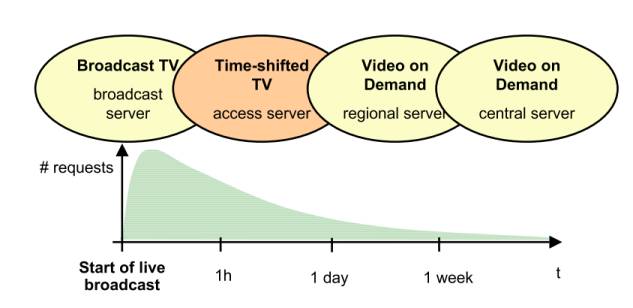
Fig. 1. Delivery
mechanisms for IPTV
Time-shifted television services
allow customers to watch TV regardless of the time when it was broadcast live.
This means that a user can watch a television program that has already started
or even so, one that has already ended. Statistics have shown that measurements
of popularity in TV shows are usually peaking within few minutes after
commencing later decreasing exponentially. Thus, if this initial segment is
being cached simultaneously in separate
access servers located regionally, this would allow to meet a multiple of
queries from all users interested on the show. Conform users continue to watch
the show, other widely distributed less expensive proxy servers (with more
limited capacities) should continue providing the remains of the content.
We shall now consider an analytic
model of the system. In a situation where N
broadcasting programs on the K
channels, cache hit rate (hI)
will be determined by the ratio of the number of requests met by the server in
relation to the total number of requests. Therefore, 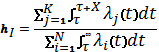
We shall recognize incoming queries as a function of
Gamma distribution:  and
and 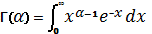 .
.
Then the cache hit rate can be determined by the
formula: 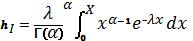
In general cases, hI will be determined by the
formula:

Where min - the minimum value of x (expressed in times/MB), m - form factor, and β - scale factor. We need to assume
that min should be equal to zero
since all requests should arrive no earlier than the beginning of the show.
Empirical observations indicated that function with parameters m = 2 and β = 2 describes the flow of queries most accurately. Therefore,
using data values, simplify the expression for hI. Obtain the following expression, taking as notation  .
.

When scale factor β
= 2, we obtain: 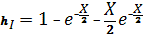 .
.
In the case when we consider requests for service
"Time-shifted Television" function for requests will match the
exponential distribution 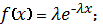 where
where  .
.
Then:  .
.
If the popularity of content only
decreases slowly (for example, 10 percent after each interval), the load on the
server can not be reduced significantly. When the popularity is reduced by half
after each interval, the server load is reduced by half. This can be described
as:  , if X = αΔ.
References:
1. J. Liu, J. Xu, "Proxy caching for media streaming over the
Internet", IEEE Communications Magazine, vol. 42, no. 8, August 2004, pp.
8894.
2. G. O’Driscoll “Next generation IPTV services and technologies”, John
Wiley & Sons, Inc., Hoboken, New Jersey, 2008.