Nurmuhamedova T.K.
Senior Teacher.
Kazakhstan, Kostanay state university named after Baitursynov.A
Project method`s influence at professional development of engineering
students in Kostanay state university.
Analyzing a theory and practice formation history of project based
learning, we can conclude that in domestic pedagogy this method was considered
as:
- A comprehensive exercise of mind
and development of thinking (P.F.Kapterev);
-
Development of creative abilities (P.P.Blonskii);
-
Development of self-reliance and self-preparation of students for
working life (S.T.Shatsky);
- Preparing students for
professional work (A.S.Makarenko);
- Fusion of theory and practice in
teaching (E.G.Kaganov, M.V.Krupenina, V.V.Ignatev, V.N.Shulgin);
- Creative self-realization of the
student: his intellectual and physical abilities, willpower and creativity in
the process of creating new products and services, that have subjective or
objective novelty with practical significance (V.D.Simonenko, M.V.Retivyh, N.
V.Matyash);
- Practical application for existing
knowledge and for self-education
(I.D.Chechel).
Project-based learning is a learning
system in which students get knowledge and skills by planning and
implementation of different practical tasks, i.e projects.
Research was conducted in two stages.
Objectives of the 1st stage:
- Identification of student`s
professional interests;
- The level professional plans
formation;
- The level of professional
knowledge;
- Diagnostics of professional
interests, inclinations and their level of development.
According to goals there
were chosen methods:
1. Questionnaire which detects
career interests and inclinations of students.
2. Questionnaire, which shows
a level of student`s knowledge on studied profession and their attitude to it.
This technique also allows getting
information about possible mismatch between the inclinations to certain
profession and how working conditions of profession corresponds to student`s
expectations (i.e. the level of claims). Throughout learning process, teaching
in experimental groups was conducted by using method of projects. Students
chose their own theme of project, worked and presented at the end of learning
process. Some of projects were individual, some were collective. In control
groups teaching was carried out by traditional methods during whole period. An
objective of 2nd stage was to identify dynamics:
- Development of professional
interests and professional plans of students;
- Development of ideas about
studied profession.
Results analysis of first
stage showed that significant difference in level of professional interest
formation, aptitudes, and professional plan between students of control and
experimental groups were not found.
At the second stage of research
there was found that students of experimental groups significantly increased
interest in studying of profession.
In common, experimental group had 4.9 points, while the sample of
control groups was 4.0 points. Highest interest growth of student was observed
in "Agrotehservice" and "Electric Power" groups. The
experimental group showed a positive dynamics of professional intentions,
64.02% of students in these groups would like to work according to studied
specialty. Same indicator in control group was 46.9%.
Remarkably, that experimental group
students more appreciated value of acquired knowledge by profession, 91% of
them responded that it will be useful for them in the future, and only 1.3%
said that it will not. Control group had 73.8% of positive answer, and 2.6% of
negative answer.
Important task of "Occupational
Safety" discipline is not only giving theoretical knowledge and practical
skills, but also helping students to shape their own professional plans,
enhancing their professional development. Remarkably, that ability to analyze
conditions, to target a task, to consider various options for solving a
problem, to be able make study, i.e. qualities, which are essential during
implementation of project, at the same time it helps students to solve life's
problems.
Total dynamics of
project influence level at professional development of engineering university
students, %
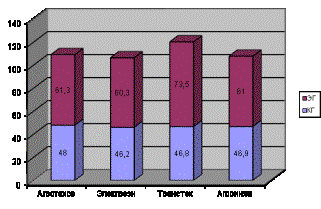
Thus, students of experimental group
showed more dynamics improvement than the control group students. Research
results also show that project method is an effective tool not only for
intellectual, but also for a personal development of students in educational
activity, that is basis of successful adaptation to future career.
In addition, analysis of academic
performance indicators showed that interest stimulation to studied profession
has a positive impact on improving of knowledge quality.
This significantly intensifies
process of professional development. The majority of students at the end of
school year have wholly or partly formed professional plan and intention to
work in the future according to studied major.
References
1. Ilyasov I.I, Galatenko N.A. Study course projecting on a subject.
Teacher Manual. - M .: Logos, 1994. - 208 p.
2. Pichugina I.V, Serikov G.N.
Projecting of educational process as a system. Tutorial. -Chelyabinsk Univ of
South Ural State University, 2003 - 76p.