Zhumataeva B.K., Kambekova
A.R.
L.N.Gumilyov Eurasian
National University, Astana, Kazakhstan
Rethinking the role of teacher
towards grounding to foreign languages in polylingual environment
Keywords: EFL
professional, polylingualism, communication, integration, roles.
As living in
the XXI century, such phenomenon like globalization, nanotechnologies definitely
make sense in our life. Nowadays all the changes, happening in the world arena,
immediately influence in a number of spheres such as the political end,
economic basis, and sociocultural aspect. The field of education is not an
exception too. In opposite, from day to day the role of education become much
more fundamental and dominant. An upbringing of the new generation, ready for
intercultural communication and competitiveness is the key to constant
development along with the production of an effect. An initial step of this
project is the formation of future teachers, who are full – qualified,
competent and highly – motivated. It has been said that teachers who have been
teaching for twenty years may be divided into two categories: those with twenty
years’ experience and those with one year’s experience repeated twenty times. In
other words, sheer time on the job does not ensure fruitful experience and
professional progress. Successful teachers are those who continue to develop
throughout their professional lives (it is based on the concept of life – long
education): the completion of a pre – service course and initial qualification
are only the beginning.
Nowadays
Kazakhstan can be described as a polylingual and multicultural state, where the
education system takes a leading position. Today it is aimed at providing an
all - round education, with the focus on cross – cultural communication and
polylingualism. The last one takes its realization through the national
cultural draft “Trinity of languages”. For the first time, the President of the
Republic of Kazakhstan announced this idea in October 2006 at the XII session
of the Assembly of People of Kazakhstan. N.A.Nazarbayev stressed that this
project should build up new Kazakhstan in the new world. Our state should be
perceived throughout the world as a highly educated country, whose population
is aware of three languages. They are Kazakh as the state language, Russian –
the language of international communication and English – the language of
successful integration into the global economy [1].
First of all,
one of the main steps, in order to achieve this goal, is the preparation of the
relevant COMPETENT staff. In short, it means that our system of education needs
sorely highly – qualified teachers, who have mastered not only native and
foreign languages speaking, professional knowledge, but also ready for
intercultural communication, creative and critical thinking. That is why, in
this article, I would like to focus on a couple of basic issues: to clarify the
role of the teacher of foreign languages, which is currently in demand, and to
explore what does it mean to be an ELT professional.
At all times,
the question related to the teacher’s role can be considered as the point at
issue. Still the concept of ‘role’ or to put it differently, role theory is a
very large topic on which a great deal has been written. One of the earliest
investigations, related to this issue, were beyond the scope of Bartram and
Walton works in 1991. [2] They identified the teacher as:


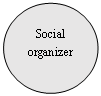
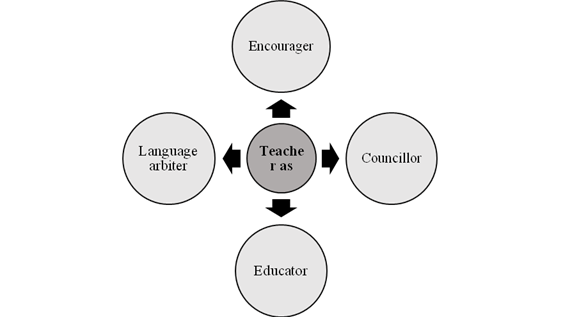
The classification below is widely accepted
as traditional conception, whether the focus is on the teacher, or in other
words, where teacher – centered approach is applied. However, after rapid
changes take place when later the whole process of education turn to the
student – centered instruction. In such type of lessons, the notion of the
‘learner – centered classroom’ takes a crucial role. Furthermore, Tudor, as one
of the founders of the ‘learner – centered classroom’ suggests that apart from
the fact that the teacher is ‘knower’ and ‘activity organizer’, these roles are
not dominant. [3] It is much more significant to prepare learners for awareness
of goals and language, to analyze learners’ needs, to select material, to
transfer responsibility and to involve students.
As far as time passes, day in and day out advanced technologies and
innovations are adapted, up to date approaches and methods in teaching EFL are
created, in general, the whole system of education, its aims, focus groups,
conditions undergo impressive changes. Apparently, it directly influences on
teachers’ duties. Modern educational experts face more serious and global
issues, consequently, their objects become more complicated. The range of their
professional duties and responsibilities also expand greatly. The set of
mentioned below features are interwoven with time – honored capacities and
included in the list of the language teacher’s potential roles proposed by
Harmer [4]. The first two positions are relatively old, which describe the
teacher as a controller, who are in charge of everything that goes on in the
classroom and as assessor or examiner. The last one includes correction and grading.
The following three roles, such as prompter, participant, and tutor directly
deal with the teaching process on the lesson as encouraging students by
‘nudging’ them forward, organizing activities and paying attention to
individuals and small groups working on longer pieces of work. The following two positions are the teachers
as tutors and observers that allow them to give feedback, to evaluate materials
and methods.
All of the authors’ classifications mentioned
below were taken as the theoretical footing, which I tried to put into realization
in practice during studying at the university. From my personal observation of
enlightening EFL at the gymnasium school # 60, Humanities college and at the
Nazarbayev Intellectual school made a great emphasis on my personality within
teaching. An experience that I had gained in different educational institutions
helped me greatly to analyze and comprehend current status of teaching EFL, furthermore,
it gave me an opportunity to observe the collaboration of teachers – students
and teacher - teacher within staff in various conditions and situations.
However primarily I focused on the qualities, features specific to modern EFL
teachers. As a result, the following inference is drawn:
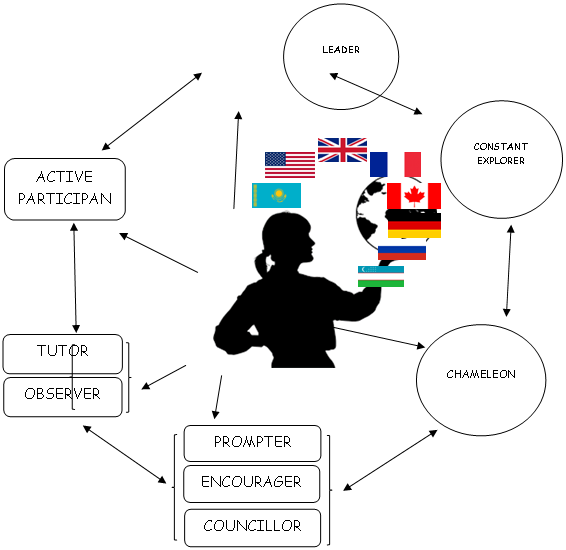
The term ‘role’ of the present - day EFL
teachers in the context of polylingualism is very complex, consisting of the
range of functions. Up to now, balanced co – existence of teachers’ potentially
multiple roles is crucial than ever, where a couple more positions should be
added to the existing ones, such as the teacher as LEADER, the teacher as a CONSTANT
explorer and the teacher as CHAMELEON. The last point means the capacity to
adapt to new circumstances, particularly over time, is a vital one. No teaching
or learning situation is really static. Political and educational circumstances
change, as do resources available for teacher training; views of the methodology
change, as does the language itself; research is gradually disseminated;
teachers develop; learners expectations change. In this case, Wright’s brief
remark can be mentioned, ‘there is more to a role than just doing a job’. [5]
Consequently, the main factor of becoming a
successful highly – qualified educational expert contains the permanent co –
existence and improvements of teaching practice and professional development
within the frame of life – long education.
The model of modern EFL teacher can be illustrated by
the following scheme:


Obviously, not all of these developments have
taken place simultaneously; the various aspects of change have had differential
impact and usefulness, and have naturally occurred at different times in
different contexts, as we will be aware of our own teaching situation.
1.
Nazarbayev,
N. A. (2007). The message of the President of the Republic of Kazakhstan.
Nursultan Nazarbayev to the people of Kazakhstan “New Kazakhstan in the new
world”, Astana.
2.
Bartram,
M. & Walton, R. CORRECTION – Mistake Management: a positive approach for
language teachers.Hove: Language Teaching Publications. 1991, p.104
3.
Tudor,
I. 1993. Teacher roles in the learner-centred classroom. English
Language.Teaching Journal, 47, 1, pp. 22 31.
4.
Harmer,
J. (2001). The practice of English language teaching. Essex, England: Longman.
5.
Tony
Wright. Roles of teachers and learners. Oxford: Oxford University Press, 1987,
p.5