Педагогические науки/5. Современные
методы преподавания
Tulegenova A.M., Rakhymkhanova S.Ye.
Eurasian national university
named by L.N. Gumilyev
Classroom management techniques
Classroom management
is a term used by teachers to describe the process of ensuring
that classroom lessons run smoothly despite disruptive behavior by students. The term also implies the prevention
of disruptive behavior. It is possibly the most difficult aspect of teaching
for many teachers; indeed experiencing problems in this area causes some to
leave teaching altogether. [1; 46]
Teachers
need to behave in different ways at different stages of a lesson to manage the
classroom and to successfully guide learners through the lesson. In order to
achieve a high level of classroom management, teachers must be:
|
Role |
The
teacher: |
|
Planner |
prepares
and reflects on the lesson before teaching, anticipates problems and selects,
designs and adapts materials. |
|
Manager |
Organizes.
the learning space, makes sure everything in the classroom is running
smoothly and sets up rules and routines (i.e. things which are done
regularly) for behavior and interaction. |
|
Monitor/Observer |
goes
around the class during individual, pair and group work activities, checking
learning and providing support as necessary. |
|
Facilitator |
provides
opportunities for learning, helps learners to access resources and develop
learner autonomy. |
|
Diagnostician |
works
out the causes of learners’ difficulties. |
|
Language
resource |
can
be used by the learners for help and advice about language. |
|
Assessor |
evaluates
the language level and attitudes of the learners by using different means of
informal and formal assessment. |
|
Rapport
builder |
tries
to create a good relationship with and between learners. |
The
teachers can be planners before the lesson, rapport builders during the warm-up
and lead-in phase, language resources during the language input and practice
phase, monitors during role-play, pair work activities or writing, and
assessors during the lesson, both formally and informally, and after the lesson
when teachers are correcting learners’ work [2; 165].
Seating: Fixed, semi-fixed and large seating
Teachers
could ask students to:
·
Turn around and sit backwards,
working with the people behind them;
·
Sit on the ends of their row
and work with people in the next row;
·
Sit on their desks and talk
with people nearby;
·
Stand up, move around and
return to a different seat;
·
Stand in the aisle space
between rows;
·
All come to the front (or
another open space) to talk.
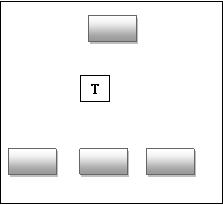
 Figure
1 shows an original seating plan. They can be used in rows because, although
only lightly fixed, there seemed to be no other way to arrange them.
Figure
1 shows an original seating plan. They can be used in rows because, although
only lightly fixed, there seemed to be no other way to arrange them.
T


Figure
1 Original seating plan
However,
there are a number of other possible arrangements (see Figure 1.1). The
horseshoe arrangement, particularly proved very suitable for the English
classes.
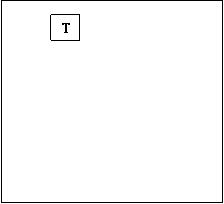
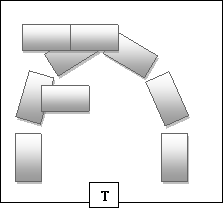
Figure
1.1 Alterative seating arrangements
Moveable
seating
Some
ideas for investigating and exploring the possibilities of moveable seating:
·
Ask students to move seats when
you create pairs or small groups. Don’t let students get stuck in unsuitable seating
arrangements when a move is preferable.
·
If it’s really too noisy, make
the discussion of that (and the finding of a solution) part of the lesson well.
·
Figure 1.2 shows some patterns
to think about.
·
If the students normally sit in
rows, teacher should try forming a circle.
·
Turn the classroom around so
that the focus is on a different wall from normal.
·
Make seating arrangements that
reflect specific context, e.g. a train carriage, an airplane, a town centre or
whatever.
·
Push all seats up against the
wall and make a large, open forum space in the middle of the room.
·
Deliberately place your seat
off-centre (i.e. not at the front). This is an interesting subversion of
expectations and immediately challenges expectations about who a teacher is and
what a teacher should do.
·
Divide the class into separate
groups at far corners of the room.
·
Ask How can we recognise this classroom to make it a nicer place to be?
Let the class discuss it and agree, then do it.
·
Push seats or desks up against
the wall. Sit on the floor (only if it’s clean!).
‘pairs’ ‘opposing teams’ ‘enemy corners’
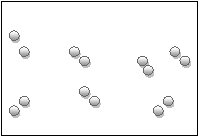
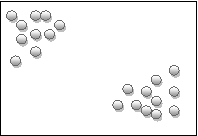
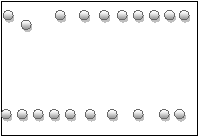
 face-to-face (or back-to-back)
‘panel’
face-to-face (or back-to-back)
‘panel’




 ‘public meeting’ ‘buzz groups’ ‘wheels’


Using the board
Organization
One
resource that almost every teacher has is a board, whether it is a small board
on an easel, a wide chalk board, a pen board or an interactive computer board.
Although it is possible to write randomly on the board as things occur in
class, teacher will often find that it’s worth paying a little attention to
organizing items.
At
the start of the lesson, draw a few dividing lines on the board, e.g. from
three working areas, like this:
|
Review
section (for key points from last lesson) |
Scratchpad
for drawing, displaying words as they come up, etc |
Key
vocabulary and grammar |
Board
drawing
Teachers
must not say they can’t draw! No matter how un-Monet-like teacher’s artistry,
one picture is often worth many unnecessary words. For the quick explanation of
vocabulary items, for setting up a discussion, a dialogue or role play, for
story-building, teacher need pictures. Clearly the basic skills is to draw
people in some form, and stick people are in many ways better than detailed
figures because they’re so quick to do.
Giving instructions
In
multilingual class you have to use English for instructions. But, in
monolingual classes you have a choice: English, native language – or some
mixture of both. It is certainly possible to use only English (and it’s often really
helpful in creating an ‘English’ atmosphere in the classroom), but it’s often
problematic because of the quantity and over-complexity of language used.
Gestures
Try
to develop a range of gestures (and facial expressions) to save you repeating
basic instructions and to increase opportunities for learner talk. Teachers
should remember that learners will need to learn the meaning of teachers’
gestures; they will not magically know that teacher’s pointing means ‘Use the
past tense’, but if teacher give the oral instruction a few times while also
gesturing, they will soon associate the gesture alone with that instruction.
Eliciting
‘Eliciting’
means drawing out information, language, ideas etc from the students. It is a
technique based on the principles that:
·
Students probably know a lot
more than we may give them credit for;
·
Starting with what they know is
a productive way to begin new work;
·
Involving people in
question-and-answer movement towards new discoveries is often more effective
than simply giving ‘lectures’.
There are three
steps to eliciting:
1. The
teacher conveys a clear idea to the students, perhaps by using pictures,
gestures or questions, etc.
2. They
then supply the appropriate language, information or ideas.
3. The
teacher gives them feedback.
Teachers
can elicit: language, ideas, feelings, meaning, context, memories, etc. Teachers
can’t elicit: things learners do not know.
In
conclusion, classroom management techniques are
the most important part of the lesson. In addition, it is the moment-by-moment
decisions and actions concerning organisation of the classroom and activities,
e.g. seating and grouping arrangements, starting and stopping activities,
dealing with unexpected problems, etc. Besides,
effective classroom management, i.e. organising the classroom and the learners,
is dependent on the teacher adopting appropriate roles.
References
1. Scrivener,
J. (2011) Learning Teaching: The
Essential Guide to English Language Teaching (3rd Edition), Macmillan Publishers Limited
2. Spratt,
M., Pulverness A. and Williams M. (2013) The
TKT (Teaching Knowledge Test) Course (Modules 1,2, and 3), Cambridge
University Press
3.
Johnston, J.,
Myers, J., Pollock, K. and Zoet, C. (2007 Draft document) I am the Teacher:
Effective Classroom Management for Occasional Teachers, ETFO Toronto
4.
Rhode, G.,
Jenson, W.R. and Reavis, H.K. (1992) The tough kid book: Practical classroom
management strategies
5.
Weimer, M., (2010) 10 Effective Classroom management techniques
every faculty member should know