D.e.s
Dulambaeva R.T., Akynbayeva M.E.
Kazakh National University
named by Al-Farabi, Kazakhstan
Problems of agricultural insurance
development in the Republic of Kazakhstan
Despite all the advances achieved in science and technology, the most
important industry for the humankind– agriculture- is still remained dependent
on the vagaries of nature. Heavy rains or prolonged frosts could serve as a
real disaster for farmers. Insuring the
risks in agricultural production is a globally important system’s element in
provision of finance and credit support to agricultural producers. [1]
Taking
into account a fairly justified risk in crop insurance, insurance (reinsurance)
organizations are not interested in compensation of most likely agricultural
losses as it extracts the major part of savings. Although the mechanisms for the final formation of the agricultural
insurance system - creation of a state farm insurance company
"Kazagropolis" (1996.), Mandatory insurance of agricultural
production (1997.), The adoption of the Law "On obligatory insurance in
crop" (2004.), the adoption of the Law "On mutual insurance"
(2006). - have been brought in our
country, it was observed that the country, according to the Committee on
Statistics of the Republic of Kazakhstan (Table 1),has a low level of activity
of the insurance business in the mandatory insurance of agricultural sector.
Table
1. Number of contracts between insurance companies and agricultural producers
of Kazakhstan (2007 - 2014gg.)
|
|
2007 |
2008 |
2009 |
2010 |
2014 (until 09.01) |
|
Number of contracts (000’s units) |
25,446 |
33,957 |
32,165 |
17,389 |
14525 |
|
thereof MIS(Mutual insurance companies) |
738 |
5792 |
8292 |
9953 |
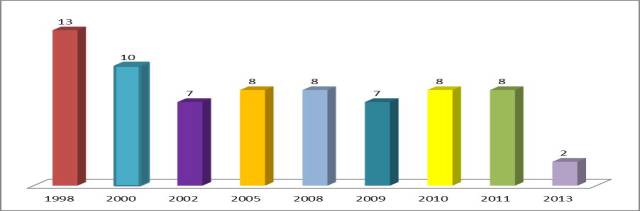
Additionally, the low level of intense activities
among insurance companies, licensed as the mandatory insurance providers, can
be evidenced by the official figures that clearly depict a lack of interest of
insurance companies to this type of insurance and their unwillingness to take
responsibility for the risks in agricultural production occurring throughout
Kazakhstan. (Figure 1)
Figure1.
Number of insurance (reinsurance) companies licensed as the mandatory insurance
providers for agricultural production
Problems of the insurance industry in the agricultural
sphere consist of several systematic problems in this area:
1) The presence of systematic risk
Kazakhstan is in the zone of risky husbandry. The
probability of adverse natural phenomena depends largely on regional factors.
As a result, the frequency of droughts over the years in the whole country is
up to 40% (2 out of 5 years), as for the west of the country, it is up to 60%
(3 out of 5 years).
Unprofitableness also depends on agricultural producers themselves that
do not seek to improve production technology, and in some cases even a slight
deterioration of weather conditions could lead to a loss of a crop due to an
inconsistency of compliance of agricultural technologies at seeding. Besides,
the risk specificity of agriculture gives a rise to make additional
requirements to insurers, such as: the development of the agency network in the
regions or the presence in the state of experts in the technology of growing
crops. All of this requires additional investments that, in return, do not
generate adequate returns. As a result, there is a downward trend of active
players in this segment of market.
The presence of the high risks in this type
of insurance makes it unattractive to insurers. For example, in 2010 there were
six insurance companies that had the relevant licenses for the above type of
insurance, whereas in current days only three insurance companies and 38 mutual
insurance companies carry out operation on mandatory insurance in plant
cultivation.
It should be noted that this type of insurance is
unprofitable though 50% of the insurance payments are compensated by the
government. In this regard, in Kazakhstan mandatory insurance annually on the
average covers only 74% of acreages.
2) The
inadequacy of applicable insurance rates
Law "On obligatory insurance in crop" set
the minimum and maximum rates for groups of crops. Generally, the amount of
insurance premiums is calculated on the minimum insurance rate, which will not
allow generating a sufficient reserve for insurance payments and will lead to
financial instability of insurance companies if insured events occur.
3) Imperfect
settlement system of losses
The existing ban for insurers in terms of the request
to comply with agricultural technology equivalent to a ban on the insurance
investigation, which actually creates a lack of possibility of denial of
insurance benefits, even in the face of clear, demonstrable fraud.[3]
In order
to resolve problematic issues Ministry of Agriculture of the Republic of
Kazakhstan proposes the following measures:
1. Changes in the mechanism
of support of crop insurance by switching from subsidizing insurance payments
to subsidizing insurance premiums based on the experience of the main-crop
producers (Canada, USA, EU).
It is envisaged that state support of mandatory crop
insurance will be implemented by subsidizing insurance premiums paid by the
insured to the insurer under the contract of mandatory insurance.
2. Establishment
of a mechanism of reinsurance of financial risks in the crop insurance by
creating a reinsurance fund of insurance payments in crop - an organization with
one hundred percent involvement of the state and /or national management
holding company created by the government, operating on reinsurance of
financial risks in crop insurance.
For the financial sustainability of the Fund at the
initial stage it is advisable to allocate funds for its capitalization.
3. Clarification
and differentiation of insurance rates by actuarial calculations.
The introduction of more accurate gradation of
insurance rates on climatic zones, taking into the account the frequency of
adverse natural phenomena on the basis of statistics and agent actuarial
calculations, is envisaged.
4. Exclusion of
mutual insurance companies from the system of mandatory insurance in crop.
The need to exclude mutual companies from the system
of mandatory crop insurance is caused by the problems of the practical
realization of the Law "On mutual insurance" and low efficiency of
their operations.
5. Extension of
crop species covered by insurance (with the inclusion of vegetables and melons,
potatoes, fodder crops)
In accordance with the policy of crop diversification
of melons, potatoes, fodder crops areas will be significantly expanded in the
future. This requires taking the measures to cover these crops by agricultural
insurance.
In the description of the
existing problems, it was correctly pointed out that the unprotifableness
depends on agricultural producers themselves that do not
seek to improve production technology, and in some cases even a slight deterioration
of weather conditions could lead to the loss of a crop due to the inconsistency
of compliance of the agricultural technologies at seeding. Then, it is worth
adding that in current days there is no certification of arable land (i.e.
information about which crops can be sown in considered land) on the basis of
which the insurer could determine insurance risks of any farmer in terms of the
non-compliance of agricultural technologies. [4]
Moreover, as the insurance amount is determined in the sum value of the
crop (on average yield for the area) and costs of agronomic measures, in the
case of crop losses at the stage of germination agricultural producers will be
better off if they hide the fact of the occurrence of insured event. That is,
insured event increases the amount of insurance payments. This takes a place
because there are no objective means of monitoring agronomic measures under
which the insurer could determine the actual losses under a separate contract
of insurance or identify fraudulent activities on the part of the insured. As
these important issues were not reflected in the current version of the law,
the unscrupulous agricultural producers could directly take a part in
fraudulent activities to obtain insurance payment again.[5]
In general, there are a
lot of problems in agricultural insurance and approaches to their solutions
should be systematic, analytical, accounting on consequences of changes to be
applied on the insurance legislation.
References:
1. Bakirov AF On the method of subsidizing the damage
for insurance in agriculture // Economics of agricultural and processing
enterprises. 2012.
2. Nikitin convergence programs of agricultural
insurance .// Agroinsurance and lending.
3. Problems of development of agricultural insurance,
Magazine "The insurance market«
http://www.allinsurance.kz/index.php/chto-poseesh-to-i-pozhnyosh.html
4. Tereshenkov D. Improving the system of agricultural
insurance .// agribusiness economics, management. 2006.
5. Prospects for the development of agricultural
insurance market. Irina Sokolova http://www.kgau.ru/img/konferenc/62.doc