Dr inż. Ewa Rauba, mgr
inż. Krystyna Rauba
Bialystok
Technical University
The assessment of possible of cost
recovery for water services in a commune
Introduction
The EU’s Water Framework
Directive as one of the main rules of the Union’s water
policy presents the cost recovery. The realization of this rule in practice is
not simple, mainly because of the restrictions resulting from social aspects,
connected with the possibility of burdening the municipal collectors and
especially households with payments for water services. Therefore social
factors force the boroughs to introduce the full refund plan, of the costs of
water treatment and delivery as well as treatment and discharging of sewage, in
stages. The Water Framework Directive sets the deadline for this process in the
end of December 2010.
The Directive states that water services means all
services which provide, for households, public institutions or any economic
activity:
• abstraction, impoundment,
storage, treatment and distribution of surface water or groundwater
• waste-water collection and
treatment facilities which subsequently discharge into surface water.
The term of water services does not
exist in Poland. It was proposed that the term water services would include,
apart from the services of water and sewage industries to municipal and
enterprise receivers, also services for agriculture. However the abovementioned
definition of water services reflects the idea of mains services (first part of
the definition) and drainage (second part of the definition). Agriculture
utilizes only the melioration services regarding irrigation, which definition
does not correspond to the term of water services included in the Water
Framework Directive. One can therefore assume, that the term of water services
is in unity with the polish term of water and sewage services.
To assess the costs of
implementation and managing of water and sewage investments, being in the
designer period one can use unit indexes of investment expenses and utilization
costs, which amount is dependant on the treatment facility’s throughput.
These data may serve as
a basis for estimating a payment prognosis for water services in a given time
period.
1. Investment expenses and
utilization costs of water and sewage
treatment facility
The
dependence of total and unit costs of building municipal sewage treatment
facilities from their throughput are shown in
pic. 1.

Pic. 1.
The dependence of unit costs of building municipal treatment facilities on the
amount of purified sewage
The
dependence of unit investment expenses in building municipal sewage treatment
facilities may be presented in the following equation:
where:
ik – unit investment expenses on
municipal sewage treatment, zł/m3/d;
Q – sewage treatment facility’s throughput, m3/d.
Alternatively,
pic. 2. presents the dependence of unit utilization costs of treatment
facilities on the amount of treated sewage. .

Pic. 2. Dependence of municipal sewage treatment
facilities unit utilization costs on the amount of sewage
The
dependence show in pic. 2 may be presented in the following equation:

The familiarity with investment
expenses and utilization costs for sewage treatment facilities may be used in
planning the development of collective sewage discharge systems. It may also be
of help when estimating future sewage prices, as water requirements of the
society change in time as well as the systems themselves do, in order to
improve the conditions of sewage discharge.
2. Payment planning for water services in a
commune
The Water Framework
Directive, while specifying the rule for refund of water services, created the
necessity of planning the payment policy for water services. Such prognosis
should be made by the communes, as a unit responsible for collective water
supply and collective discharge and treatment of sewage, in prospect of year 2010, as this is the
deadline for introducing the rule of full refund of water services.
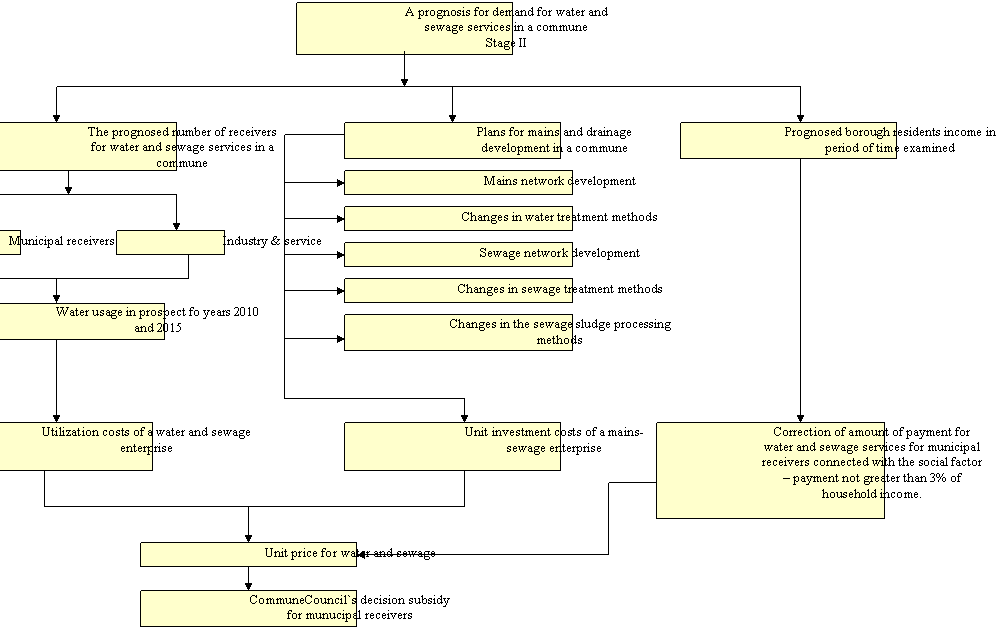
The next steps to be
undertaken in order to estimate the process for water and sewage collective
sewage treatment services in a commune are shown in Pic. 3.
The future population of
a given commune can be estimated using data researched by the Polish Central
Statistical Office (GUS), the Government Population Council and the Committee
on Demographic Studies of the Polish Academy of Sciences. These institutions expert’s prognosis were
based on the National Population and Housing Census
for year 2002. The estimated residents number was calculated in regard to the
whole country, to voivodeship area, subregions, districts and cities over 50
thousand inhabitants. In order to estimate the prognosed population in a
commune, knowing the population in the base Lear, one Has to estimate the
population index in the following years as a quotient of the population in the
following yard and in the base Lear, and refer it to the number of inhabitants
in said commune.
The
next step is assessing the water consumption level in prospect of year 2010. In
the last years water consumption level in households has significantly fallen.
The economical growth prognoses in the country show that in the next few years
there will be a significant growth of income of the population. This allows the
assumption that the water consumption will last unchanged or there may be a
continuous decrease of water consumption.
There
can be therefore, two variants of water consumption prognoses created. In the
first one, the assumption is made that the water consumption will remain at a
constant level of 42 m3 per
capita yearly. This is an estimate close to the water consumption level in the
most developer EU countries (120l/inhabitant daily). His is, however, an
average value. In different regions of the country water consumption level
varies significantly and reaching this value would have to involve not
maintaining the present water consumption level, but increasing it, which,
taking into account the income growth prognosis, is not a realistic assumption.
The
second variant assumes a decline in water consumption. A value of 80 dm3 per capita daily shall be
taken into the prognosis. His is the smallest amount of water, to be used by a
human being, to fulfill all both existential and hygienic needs.. Yearly, a person using a collective water
network and collective sewage discharge network, will collect from the mains
and discharge into the sewage network 29,2 m3 of water and sewage.
The
second water user managed by the water and sewage enterprise is the industry sector,
into which, in the discussed method, fall also services. To estimate the future
water collection level by the industry a method designed by R. Miłaszewski
and T. Walczykiewicz will be used. The prognosis of
water consumption in industry for year 2010 is backed up in this method by data
from the base year – as for currently designed methodology of estimating water
service payments year 2003 is used – and directions of socio-economical
development for a given area designed within regional development strategies.
The
first step in this method is to define the factor A. It defines the meaning of
the socio-economical development’s direction in a given area to the amount of
water consumption. It may have the following values:
0 – not significant,
1 – insignificant,
2 – significant,
3 – very significant.
The
next step is to define the factor B. This factor reflects the change in unit
usage of water in the industry sector. The factor B is calculated from the
equation:
B = C × R
where:
C – index of assumed average
economical growth pace calculated basing on the voivodeship development
strategy (the factor has to be modified using the relation of WDB for a given communy to the value of WDB for the
voivdodeship area); nonsizeable value,
R – a factor amending the average
economical growth index for a given area depending on the value of factor A;
nonsizeable value.
The
relation between factors R and A is as follows:
A
= 0  R = 1
R = 1
A
= 1 R = 1,05
A
= 2 R = 1,10
A
= 3 R = 1,15
The final calculation of the amount of future
water usage in the industry is done with the equation:
P2010 = P2003 × (1 +B)
where;
P2010 – prognosed water consumption for year 2010 in
industry,
P2003 – water consumption in base year, here 2003,
B – as above.
When
estimating the amount of sewage, a rule was used, that their amount is 100% of
the water consumption level.
In this method we
assume, that future working costs of water and sewage systems are dependent on
the amount of water collected and sewage discharged. To estimate their amount
in prospect for year 2010 unit utilization cost indexes, made when admitting
water and sewage services, may be used.
Another
important element while prognosing future water and sewage prices in the
commune is an analysis of long-term investment plans of water and sewage
enterprises. In case expansion of water and sewage systems is required in the
prospect period, to estimate the investment expenses one may use the equations
for unit investment expenses.
The last element
influencing the price of water and sewage is the household income within a commune.
Conclusion
The EU’s Water Framework
Directive, by setting the requirement of filling the costs of water services by
2010 from payments, created the necessity of creating prognoses of future needs
of consumers of water services along with prices of those services, which could
enable to estimate the possibility of fulfilling the requirement with including
the social aspect. The duty of creating such prognoses should rest on the
commune, which is responsible for supplying a collective water supply and
collective sewage discharge. Up to the present, the role of this administrative
unit concerning payments for water and sewage services was limited to approving
the payments designed by the water and sewage enterprises.
The analysis of present
prices for water and sewage in Poland shows, that when setting the price level,
the water and sewage service enterprises took into account mainly the working
and upkeep costs. The did not, therefore, take into account the costs resulting
This is why, the price paid by the receivers of services very often did not
give sufficient coverage of costs made by the enterprise. His situation is
conditioned by social factors. It is assumed that water and sewage price should
be no more than 3,5% of average income of a household.