Skvortsov E.N.
Ogarev Mordovia State University, Russia
CONSTRUCTING OF EFFECTIVE SYSTEM OF ACCOUNTS
RECEIVABLE MANAGEMENT IN THE ORGANIZATION
The liquidity of the current assets is the main
determinant of the risk of investing in working capital. Accumulated assess of feasibility
of different types of working capital over a long period of time can determine
the probability of risk of investments in these assets. In order to minimize
the risks associated with accounts receivable, the organization needs a comprehensive
approach for accounts receivable management.
Construction of such system in the organization
should consist of four stages (Figure 1).
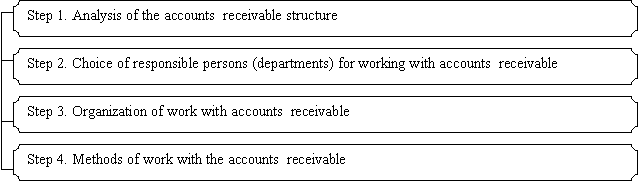

Figure 1 -
Stages of constructing of accounts receivable management system in organization
Step 1. Analysis of accounts receivable (next -
AR) structure. At this stage, the focus should be on common approaches of AR analysis
of organizations, common sharing of AR in structure for understanding the “state”
of AR and decisions on further work. At specified intervals specialists of organizations
should analyze accounts receivables of personal list of counterparties, terms
of formation
|
|
|
and size; control settled payments deferred or overdue, assess the tangibility
of presence of the accounts receivables, to determine ways of accelerating
demand debt and reducing bad debt.
The analysis may include an evaluation of the
absolute and relative indicators of the structure and movement of accounts
receivables.
Additional information may be taken from
rankings of accounts receivables depending on terms of its origin, such as the
30-day intervals, and analysis of its change. To do this, it should be selected
the share of bad debts and its dynamics considered. The growth will indicate the
increasing of risk of non-repayment of accounts receivables and the possibilities
of overdue debts formation.
Operational information about the current debt,
including the period overdue debt, the history of relationship with the
customer, the amount and regularity of their ongoing purchases, its share in
revenues and gross profit, the number of violations of the terms of payment in
the previous periods is very important.
And finally, it should be calculated the actual
accounts receivable with the rate of inflation and depreciation during the late
payment, collection period, losses from not collected payments and write-offs.
The analysis of accounts receivable should be
considered when company plans its future activities.
It is recommended to create some reports in CRM,
1C or simply analyze arrays debtors on the Excel for the analysis of AR. Basic
information: the date of conclusion, date of payment, the amount of contracts, customer
category, etc.
Step 2. Choice of responsible persons
(department) for work with AR. At this stage, the attention should be paid to
choosing of the company`s organizational structure to work with the AR: the
pros and cons of the various responsible persons; the motivation for action; the
control center for work with the AR.
Step 3.Organization of working with the accounts
receivable. At this stage the attention should be focused on the transition
from the issues of deciding who work with AR to how the work will take place at
the organizational level, at the mechanism level, rules of interaction, at the
methods regulation and control:
a) the creation of business processes, policies
and procedures for managing the AR;
b) the formation of a balanced indicators of performance
units (next - IPU);
c) the development of schemes of motivation
based on the IPU, the creation of job descriptions, training of staff
responsible for working with the AR;
d) the creation of system of control and internal
management reporting in CRM for financial analysis and evaluation of the work
of specialists: the choice of performance indicators for the analysis of
responsible staff ('the impact of calls ", the number of calls and
meetings, written letters, paid bills, etc). Ideal option for company will be
the situation when the supervision of staff and indicators of AR could be
carried out automatically by means of reports in CRM systems.
Step 4. Methods of work with the AR. This step includes:
customer calls, writing letters, the interaction with accountants of company to
prepare the documents for the client, meeting with clients, negotiating,
recording information about working with AR. Benefits of prejudicial settlement
of debt - is the lack of additional costs associated with going to court
without prejudice for reputation and partner`s relationship. The financial methods
of influence on the debtors with delay in payment include: the application of
penalties, proposals for offsets, debt restructuring, sale of debt, initiation
of bankruptcy proceedings, etc.
In case of futility of all reasonable actions
the organization can collect the debt through the court. Usually going to court results breaking of the
partnership, but also can be the beginning of a constructive dialogue with the
debtor. In the future, new debtors, knowing that the debt provider always
resolves disputes through the court will try to avoid delay in payment.
Summing up, it should be noted that the increase
in the liquidity of current assets organization can be achieved by constructing
of system of accounts receivable management, this work should be carried out in
stages: stage 1 - analysis of the structure of the accounts receivable; stage 2
- the choice of responsible entities (departments) to work with accounts
receivable 3 stage - organization of work with accounts receivable; stage 4 - methods
of work with the accounts receivable.