The experience on the collapsible
soils of the south of Kazakhstan
Brovko I.S., Doctor
of Engineering
(M. Auezov South Kazakhstan State University)
At the
construction of "Metro"
shopping centre the worked methods of funding were immediately rejected because
of their long time of implementation. The customers indispensable condition was
the building of this object in
3,5 months. As a result, the following version was approved: the
foundations of bored piles of
great length (25 m) with cutting of the whole subsidence thickness and
deepening of low ends into pebble gravel soil for 1,5 -2m. To prevent
the development of negative friction forces at
possible emergency moistening the
field of piles was supplemented
by waterproof shield, located in the upper part top of the bed. The work in foundations construction was carried out in the following sequence:
- a waterproof shield with thickness of 1 m was installed on the
surface;
- through it a well was bored to produce a bored pile with the length of
25m and
1m in diameter (the size of diameter was specified on the basis of seismicity of the region);
- after the installation of the reinforcing cage, filling the well with
concrete and the formation of grills,
one more layer of waterproof shield with thickness of 1m was installed.
Thus the upper part of the pile bore and grills were covered by the waterproof shield with total thickness of 2 m. The waterproof shield was also necessary,
because significant loads on floors (up
to 3 t/m2) from the stored wholesale goods
are stipulated in the shopping
centre building.
Figures 1,2 present photographs of wells boring, and view of the well
with compacted soil in upper part of the bed
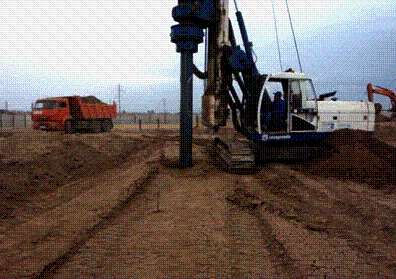
Fig 1.Work to
construct wells for bored piles
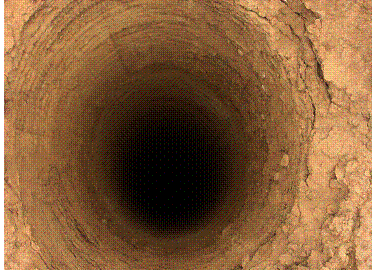
Fig 2. View of the
well with diameter (1m) and depth (25m) with compacted soil in the upper part
of the bed
At the moment of writing the article, the shopping
centre ‘Metro’ successfully is maintained for more than one year.
The main sources of soaking and moisture of soil
subsidence in the ground - buildings are water leaks from the communications
(water, sewage, district heating) and technological devices (tanks, swimming
pools, cleaning pads, etc.), precipitation, filtration of water from
Channel-irrigators in irrigated areas, changes in aeration at building areas,
raising the water table, etc. All these sources of soaking can occur at any
time during the construction and operation of buildings.
Depending on the nature, intensity, soaking soil, source size soaking
generated forms wetlands, increasing the degree of humidity and other factors
in the design of the foundations on collapsible soils should consider the
possibility of soaking and rising damp due to:
a) local soaking soil foundation on top, leading to subsidence in a
limited area within the top or at least - the whole subsiding strata;
b) intensive soaking soil foundation on top for a long time, resulting
in a soil wetting the entire thickness of the subsidence and subsidence as a
full manifestation of its own weight of soil, and the loads from the
foundation;
c) raising the water table, causing subsidence of the lower soil layers
mainly from its own weight;
d) a slow increase in humidity foundation soil subsidence caused by the
violation of the natural conditions of the evaporation of ground moisture due
to construction and paving of the territory and the gradual accumulation of
moisture in the soil infiltration of surface water.
Getting into the loess soil on top of the water spreads and moves in the
interior as the top down, and away from sources of moisture to form a wetted
zone of the soil. The nature of the formation and size of hydrated area
affected by a number of factors, in particular: the shape and size of the
source of soaking, the nature lithology column loess soils, their filtration
properties, etc.