METHODS OF SPARKS EXPLOSION-SAFE SENSOR
ON THE CDU
Modern production places
high demands on safety equipment
to avoid accidents, explosions, fires. In this regard, increasing
the relevance of the use of spark-explosive sensors that can be used in electric desalting plant
(CDU) in elektrodegidratorah to control the current electrodes.
The deep desalting
of oil reduces corrosion and
sediment reduction in the equipment, increasing the overhaul life
units, improving the quality of raw
material for catalytic processes, as well as commercial products - fuels,
bitumen and coke electrode.
Hence, the need for deep cleaning of oil from
the salt becomes very important. Therefore, the preparation of oil to the processing
performed at the CDU,
which are the basic equipment elektrodegidratory [1].
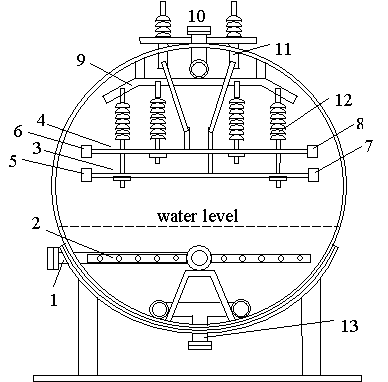
1 - connection
for input of raw materials,
2 - inferior liquor, 3, 4 - electrodes, 5, 6, 7, 8 - fiber-optic
sensor monitoring the electric current,
9 - Upper liquor, 10 - conclude desalted crude
oil, 11 - bushing; 12 - rootstock Snoy insulator
13 - Settled water
withdrawal
Figure 1 - Cross section of the horizontal elektrodegidratora 1EG160
Fiber sensor
is particularly well suited for this application because it uses a non-conductive connection to the electrode [2].
current electrode single-mode fiber Wollaston prism I2 I1 HeNe polarizer

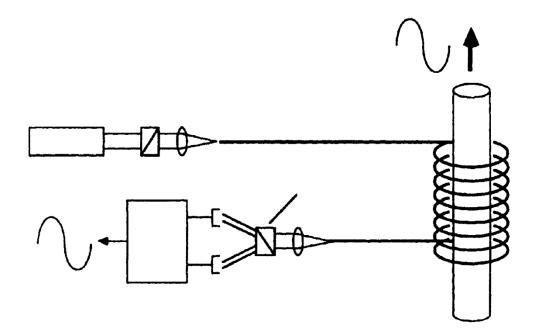
Figure
2 - Fiber-optic current
display device, based on the Faraday
effect in the high-voltage line
The
radiation of a helium-neon laser is polarized and is introduced into an optical
fiber by odnomodnoe microscope. The fiber is twisted to create a permanent
circular birefringence ατ and N times and wrapped around the tire. The output radiation is
reduced to a parallel beam and prop ¬ admits a Wollaston prism to separate the two orthogonal linearly
polarized modes. The difference in output divided by the sum to give the result
of stability and independence of the intensity fluctuations [3].
To
date, the four principles of management of differentiated fiber-optic current
sensors on the Faraday effect in the CDU:
1)
The principle of open loop.
Lies
in the fact that the required control law is formed only on the basis of
management objectives in accordance with the master control. Management,
implementing this principle is called the running for a given exposure. The
system, built on this principle, is open or not closed. A characteristic
feature of an open system is that the process of working the system does not
depend directly on the result of its impact on the managed object. Hence the
main drawback of an open system - a low accuracy.
2)
the principle or the principle of closed-loop feedback.
Lies
in the fact that the control law is based on the deviation of the controlled
quantity from the master control. Such management is controlled by rejection,
in which the controlled quantity has an effect on the control action. A system
that implements this principle is called a closed system or closed loop
control. The main advantage of closed systems is their high accuracy, but their
performance is lower than in open systems.
3)
the combined principle.
Is
to combine the principles of open and closed loops in a single system. Such a
control that combines the control of the setpoint and the deviation is called
the combined control. It provides high accuracy and high speed.
4)
the principle of adaptation.
Lies
in the fact that systems that implement this principle in the process of
adjusting, adapting to changing external conditions. This is called adaptive
management, and systems operating in accordance with this principle, called the
adaptive and are most advanced. Adaptive systems have in their composition, as
a rule, additional blocks and circuits for the analysis of quality control
process or the external environment, which requires adaptation.
References
1.Pat. Rossii № 62712
kl. G01R29/00 Informacionno-izmeritelnoe ustroistvo kontrolya elektricheskogo toka i magnitnogo polya
2.Tehnologicheskii reglament ustanovki ELOU-AVT-6. S.29-30
3. Urakseev M.A.
Primenenie magnitoopticheskogo elementa Faradeya v informacionno-izmeritelnyh sistemah kontrolya magnitnogo polya i elektricheskogo toka / Urakseev M.A., Levina T.M. // Prikaspiiskii journal: upravlenie i vysokie tehnologii – 2008. - №2 (2). S.24-31.
.