Oleg B. Malikov
Ph.Dr., professor, St.Petersburg
State Transport University
METHODS of WAREHOUSE STOCK DETERMINATION
Abstract
The problem of
stock determination at warehouses is very important for supply chains projecting and management.
Usually the problem is searched theoretically while considering some supply chains which contain several warehouses with their stock. These researches mostly are concerned only supplying
warehouses, although there are many other types of warehouses in supplying chains.
Besides there are practical tasks, connecting with warehouse activity of cargo
handling and stocks fluctuation. These procedures significantly influence on efficiency of work both –
transport and warehouses and the whole supply chains. Their projecting
sometimes is underestimated and considered as very simple procedure. Some methods
of taking into account of the warehouse
stock changing while warehouses
projecting. are displayed in this article.
Keywords: Logistic Chain, Warehouse, Stock, Material flow, Unevenness, Cargo, Capacity, Probability, Transport
1. Introduction
Sometimes warehouse stock is considered as
the most important problem in supply chains management. But before management
of some system such as supply chain it is necessary to create this system i.e. it should be firstly
projected, organized or its facilities should be built and put into action. It
is not enough for this to know some constant level of warehouse stock, because
material flows coming into and out of warehouses can change from day to day. So
the warehouse stock is changed also. Under these conditions it is very
difficult to project warehouse and particularly to determine warehouse dimensions,
handling equipment and capacity.
However all main parameters of a
warehouse and whole investments on its building and operation costs
significantly depend on the level of the stock, keeping in it. And this stock
level should be of some specific value.
2. The
simplest methods
Nowadays warehouse stock in projecting more often is calculated on base of
regular terms of stock keeping at warehouse.
These terms were established on foundation of real experience of warehouses operation in different
industries. With this method the warehouse capacity is computed as follows:
E= , (1)
, (1)
where Q – annual value of material flow (in tones,
units or m3);
t - term of stock keeping at the warehouse.
Drawback of this method is constant value
of capacity, that does not take into account
real conditions of changing of the warehouse stock during its activity/.
In real condition of warehouse operation
the quantity stock is a some function of
time and parameters of material flow
going in Q1 and out
of the warehouse Q2 :
I =
f (t, Q1, Q2 ). (2)
So as
changing of material flows, connecting with warehouse, are some stochastic processes, warehouse stock
is also an unknown stochastic
process. But warehouse dimensions and
capacity are constant valuables for every specific warehouse. This contradiction can be overcome with special
methods of warehouse stock calculation.
As was displayed in the Warehouse System
Theory, developed in scientific works and books of the author [1, 2, 3], a warehouse
should be considered as a technical system, i.e. as a complex of interconnected
elements, created for reaching of united objective. The purpose of warehouse is
transformation of material flows, that are going through it, with the least
spending of 6 main resources – space, time, materials, labor, energy and money.
This transformation is fulfilled for provision the most efficient further
transportation or using of cargo. Temporary keeping and management of the
merchandise stock are some part of technological operations, executed for this
transformation of material flows.
So the warehouse system can be
characterized with capacity E of its main storage area, additional capacity
ΔE of its other areas (reception-dispatching areas, loading-unloading
docks etc.) and real quantity of
merchandise I, remaining at the moment at the warehouse.
Interaction of these valuables for
supplying and transferring warehouses
is shown in Figure 1. The difference between these warehouses is the purpose of
their activity. The supplying warehouse should keep some insurance stock I0
, that must provide supplying of consumers in case of interruption of cargo arrival to the
warehouse.
a) b)





















 I
I
I
I

 ΔE ΔE
ΔE ΔE



 E
E
E
E




I0




 0 Time 0 Time


Figure 1. Interaction of stock fluctuating I and
constant values capacity of storage area E and additional capacity ∆E of
other areas for supplying warehouse (a) and transferring warehouses at
long-distance transport (b)
For both these types of warehouses the
stocks are fluctuating between two levels, but these levels are different for
these ones. In supplying warehouse the stock fluctuates from insurance stock I0
to the warehouse storage area capacity E (and sometimes up to additional
capacity some other areas ∆E). In transferring warehouse the stock
fluctuates from 0 to the warehouse storage area capacity E (and sometimes up to
additional capacity some other areas).
Therefore in The Theory of Scientific Inventory
Management several two-level methods of stock management were developed. The consideration of these methods goes over
the limits of this article.
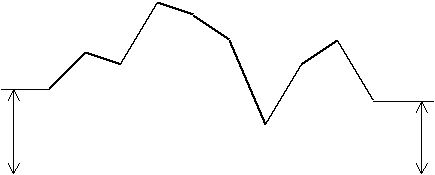
Function
of warehouse stock, depending on time t
I = f (t ) for constant time
steps (for example – days) can be represented in form of polygon as shown in Figure
2.
 I
I









 Stock
Stock
I0
T Ik



 Time
Time

1 2 3 4 5 6 . . . . . . k
Figure 2. Polygon
of warehouse stock function I = f (t)
as depending on time
While researching way of warehouse stock
transformation, the warehouse is considered as
some “black box”, which configuration is unknown and only its changing
under influence of two flows – going in and out of the warehouse - are taking
into account. This process can be described with function I = f (t ).
Having integrated this function by time it is possible to determine the
whole quantity of cargo W, that was kept at the warehouse for some period
T.
However type of this function usually is
unknown. Therefore the value W can be calculated with assistance of polygon of
function, shown in Figure 2. In this case in is convenient to ust formulas of trapezium:
W
= 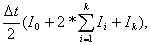 (3)
(3)
where Δt – value of time interval;
I0 and Ik –respectively
initial and finish values of warehouse stock;
k – number of time intervals (for
example days, weeks or months).
Then average warehouse stock:
I= (4)
(4)
where T – the whole time of consideration.
Now the average time of cargo remaining at the warehouse:
τ = or τ =
 (5,6)
(5,6)
where λ - average intensiveness of cargo arrival to the warehouse.
3.Probability methods
There are several methods of warehouse
capacity determination, that taking into account casual processes of arrival and dispatching of material flows from
warehouse.
It is possible to calculate warehouse
capacity as Mathematic Expectation M (I) of
warehouse stock I:
E
= M(I) =  ,
(7)
,
(7)
where Ii - i-value of warehouse
stock during time of stock research;
Pi - conforming Probability of i-value appearance;
n - the whole number of considering values of warehouse stock.
For using this method probability
distribution of the warehouse stock should be created firstly, that can be
fulfilled on the statistic base:

 I = I1 I2 . . . In
P1 P2 . . . Pn
, (8)
where I1 I2 . .
. In -
statistic election of warehouse stock in a warehouse, simi
lar to
that under consideration;
P1 P2 . . . Pn - conforming probabilities of these stock values, that can be calculated with using of number of days in which the relative stock value has been observed:
P1 =
 , P2 =
  , . . . , Pn
=
, . . . , Pn
=  . (9)
. (9)
Other method of warehouse stock and
capacity determination is one with assistance
of Creditable Probabili. In this
case the warehouse capacity is calculated
not as one specific value, but as only possible value with creditable
possibility p, for example 0,95 or
0,97. Other cases of 0,05 or 0,03
probability are considered as very rare and therefore they can be neglected.
For this method using also as in the
previous case probability distribution of the warehouse stock should be
produced, as mentioned above.
For the warehouse stock determination it
is necessary to know the law of distribution of the stock :
F(I) =  (10)
(10)
In Figure 3 an example is shown of
warehouse stock determination for creditable possibility P=0.95.
Probability 



 1.0
1.0




 0.9
0.9
 0.8
0.8
 0.7
0.7


 0.6 F(I)

 0.5
0.5
 0.4
0.4
0.3
0.2


 0.1
Stock I
0.1
Stock I

Figure 3. Graph of
warehouse stock distribution cumulative function F(I) with an example of
stock determination for creditable probability P=0.95
4. New method of the warehouse stock and capacity
determination
This method of warehouse capacity was
created at Petersburg State Transport University and used while projecting a lot of warehouses for various industries. It can be called “In-Out Flows Combination”
and does not require to form graph of
distribution F(I) and contains only mathematic calculations. So it is possible
to fulfill this method on computer and optimize capacity of warehouse with
taking into account casual fluctuations of going in and out material flows.
The following probability distributions
should be designated as initial data:
 of arriving flow: Qa
= Qa1 Qa2 … Qan ;
of arriving flow: Qa
= Qa1 Qa2 … Qan ;
Pa1 Pa2 … Pan (11)
 of dispatching flow: Qd
= Qd1 Qd2 … Qdm
of dispatching flow: Qd
= Qd1 Qd2 … Qdm
Pd1 Pd2 … Pdm .
(12)
The core of this method is calculation of
warehouse capacity as casual i-event,
that is represented combination of
probable values of flows going in Qa and out of the warehouse Qd:
Ii = I0
+ Qia – Qid ,
(13)
where I0 - is some initial or insurance stock, that is set depending on
type of warehouse and some other conditions.
Probability of i-stock at the warehouse
is calculated with formula:
P (I = Ii ) = P (Qai )*
P (Qdi ), i =  , (14)
where P (Qai ) and P (Qdi
) - conforming probabilities, that Qai
cargo would arrive to the warehouse and Qdi cargo would be dispatched from the warehouse;
n – number of values in
the flow going into the warehouse;
m - number of values in the
flow going out of the warehouse.
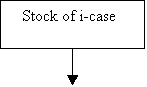
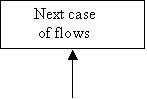
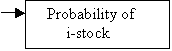
Block-chart of algorithm of the warehouse
capacity calculation by this method for designated Creditable probability “p” is
shown in Figure 4.


Delete number of considered value
Initial Stock
Next minimum
of stock
1 20
19



2 15 Yes
Looking for
minimum 1st combination of two flows

18



 No
No



3 14 17
Sum of stock probabilities ∑Pi Initial probability
of stock = 0 1st value of arrival



1st finding of
minimum
1st value
of dispatch
4 13



5 12 16
Probability of i-case

6 No 21
Probability stock
 11
11
 Yes
Yes

 7
7
Next value
of dispatching
10
Next value
of arriving flow
22




 9
9
Next case
of flows
8
No


Yes

Figure 5. Algorithm
of the method of stock calculation using material flows probability
combination
Calculation of warehouse capacity with
the mentioned method under simple conditions
(when n and m are not more than 3-4) can be easily produced just on-hand, that
is confirmed by the following example.
Let accept that it is necessary to
determine capacity for a warehouse, that experienced the following material flows:
 arriving flow:
Qa = 120 150 200
arriving flow:
Qa = 120 150 200
0.20
0.60 0.20 ; (15)
 dispatching
flow: Qd = 140 180
dispatching
flow: Qd = 140 180
0.65
0.35 , (16)
where 120, 150, 200 - number of transport batches (railway cars, trucks etc.), that
arrive
to the warehouse for some period of time;
0.20, 0.60, 0.20 –
conforming probabilities of these arriving quantities;
140, 180 - number of transport
batches, that dispatch from the warehouse
from
the same period of time;
0.65, 0.35 -
conforming probabilities of
these dispatching quantities.
Let us determine initial stock from the
condition, that the warehouse was not empty at the beginning:
I0
= 180 – 120 = 60 batches,
where 180 and 120 – minimal values relative
arriving and dispatching flows into and out of
the warehouse.
Assign the creditable probability of the
stock calculation p = 0,95.
Let us calculate all the possible unions of arriving and dispatching material
flows (there may be only 3*2 = 6 such combinations in the case):
1st
combination: Stock = 60+20-140=40;
probability of the stock: P(I=40)=0.20*0.65=0.13;
2nd combination:
Stock = 60+20-180= 0;
probability of the stock: P(I=0)=0.20*0.35=0.07;
3rd combination:
Stock = 60+150-140=70;
probability of the
stock: P(I=70)=0.60*0.65=0.39;
4th combination:
Stock = 60+150-180=30;
probability of the
stock: P(I=30)=0.60*0.35=0.21;
5th combination:
Stock = 60+200-140=120;
probability of the
stock: P(I=120)=0.20*0.65=0.13;
6th combination:
Stock = 60+200-180=80;
probability of the stock: P(I=180)=0.20*0.35=0.07.
It is necessary to verify that these cases
form full group of events (in this case the sum of their probabilities must be
equal 1.00):
 =
0.13+0.07+0.39+0.21+0.13+ 0.07 = 1.00.
=
0.13+0.07+0.39+0.21+0.13+ 0.07 = 1.00.
The standard condition is observed.
 Thus probability distribution of warehouse stock as cooperation of two fluctuating
flows has been formed:
Thus probability distribution of warehouse stock as cooperation of two fluctuating
flows has been formed:
Qa
= 0 30 40 70
80 120
0.07
0.21 0.13 0.39
0.07 0.13 .
Now the cumulative function of stock distribution (from less stock up to the bigger ones) can
be produced:
I . . . . . . . . . . . . 0
30 40 70
80 120
F(I) . . . . . . . . . . 0.07
0.28 0.41 0.80
0.87 1.00.
From this function it can be seen that creditable probability
having been assigned as p=0.95 is
located between 0.87 (for stock 80
batches) and 1.00 (for stock 120 batches):
0.95  .
.
So design value of warehouse capacity may
be determined in interval of possible stock
E  with the formula of
linear interpolation:
with the formula of
linear interpolation:
E= 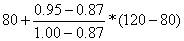 = 105 transport batches.
5. Using the
Queue Theory for warehouse capacity determination
With using of the Queue Theory methods the
warehouse capacity may be determinated
without preliminary gathering
statistics and formation of probability distributions. But the drawback of
these methods is calculation with some average values.
The author used the mathematic model of
“destroying & multiplying” to produce
a method of warehouse capacity
determination with assistance of The Queue Theory.
In this case a warehouse is considered as many-channel mass-service
system, with a place for keeping of cargo representing a canal of service of
one transport batch (cargo from a truck or a railway car). “Refusal” is an
event when the storage area is completely full and there is no room for
reception next transport batch, which is considered as entry, that needs to be
serviced, i.e. unloaded, received and put to the place of storage.
The process of entry service is considered
as keeping merchandise in warehouse during some time τ, so that intensiveness of entry flow:
µ =
1/τ. (17)
The storage area can be in one of the
following states Wi (see Figure 6):
W0 – no place in the warehouse
is occupied, i.e. the warehouse is empty;
W1 – there is one transport
batch in the warehouse;
W2 - there are two transport
batches in the warehouse;
W3 – there are three
transport batches in the warehouse;
. . . . . . . . . . . . . . . . . . . . .
. .. . . . . . . .
Wk - there are k transport
batches in the warehouse (k places are
occupied, other n-k places
are empty);
Wn - there are n transport
batches in the warehouse (all the n places are occupied, no places
are empty);


 λ
λ
λ
λ λ λ
λ
λ
λ
λ λ λ



…… …….
µ 2µ 3µ kµ (k+1)µ nµ
Figure 6. Marked graph of states and transitions of
the warehouse system relative its storage area occupation
From every states to another one in
direction of increasing its stock (to the right in the Figure) the warehouse
system transfers with intensiveness of
λ in the moment, when the next transport batch comes into its
storage area. So the system occurs in
the (i+1) state.
Transition the warehouse system in direction of decreasing its stock (i.e.
to the left in the Figure 7, from the i-state to the (i-1)-state) is happened
with intensiveness of kµ in the moment, when a new transport batch is
dispatched from the warehouse.
In according with the Queue Theory
probability of storage area to be empty may be calculated with formula:
P(W0) =  (18)
(18)
or with taking
into account expression (17):
P(W0) =  , (19)
where λ - intensiveness of the
entering flow.
Probability of only one transport batch
at the warehouse (k=1):
P(W1) =  => P(W1) = λτ* P(W0); (20)
Probability of two transport batches at
the warehouse (k=2):
P(W2) =
 => P(W2) =
  (21)
(21)
Probability of k transport batches at
the warehouse (k<n):
P(Wk) =
 => P(Wk) =
  (22)
(22)
Probability of n transport batches at
the warehouse, i.e. when the storage area of the warehouse will be completely
occupied:
P(Wn)
=  = > P(Wn) =
  . (23)
Now it is possible to
determine probability of the storage area to be full not completely and next transport batch can be received into the warehouse:
P (k< n) = 1 -  . (24)
Having designated average stock of cargo at the
warehouse I = λ τ, it is possible
the expression of probability of empty storage area rewrite in the following
view:
P
(W0 ) = 1/  . (25)
Then probability that there
will be some room for cargo at the warehouse (24):
P(k<n) = 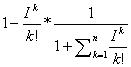 .
(26)
.
(26)
Changing the row, that
is divider in this formula to eI
according to research of Macloren , receive probability of empty warehouse:
P
(W0 ) =  = > P (W0 ) = e-I . (27)
Now the formulas (22) and (24) may be written in the
following view:
Probability of k transport batches at the warehouse (k<n):
P (Wk
) =  ; (28)
Probability that the storage area is not full completely and there is room for
the
next transport batch to be
received into the warehouse:
P
(k<n) =  . (29)

 P(Wi )









 0.270 k=2


 0.250
0.250


 0.200 0.169 k=6


 0.150 k=10
 0.124
0.124



 0.100 0.086 k=20


 0.050
0.050
k
 5 10 15 20 25 30
Figure 8. Character of
probability of having room for cargo at a warehouse P(Wi ) as depending on number of transport batches k at the warehouse at the moment
Distributions of occupying
storage area of the warehouse as calculating by the formula (29) are displayed in Figure 8. It can be seen from this picture that average stock at the warehouse
I = λτ conforms to the most
probable stock and shows vertexes of the graph curves. However the stock may be
exceeded and in this case capacity of the storage area would occur to be not enough.
For practical using this new method of
capacity warehouse determination, the graphs of cumulative functions of stock
distribution were produced which are shown in Figure 9. The graphs were formed
with the following formula:
F
(Wk ) =  .
(30)
.
(30)
F(Wk )








 1.00
1.00



 p=0.95


 I=8,N=1460


 I=4,N=730 I=10,N=1825
 0.50
0.50
 I=20,N=3650


 k
k
5 10 15 20 25
Figure 9. Graphs of Cumulative Function of warehouse
capacity distribution F(Wk ) as depending on
transport batches number k for transferring
warehouse with average term of cargo keeping
2 days (example is shown of warehouse capacity determination for
capacity I=10 batches, annual flow N=1825 batches and creditable
probability p=0.95)
6. Warehouse
capacity determination by way of simulation
The task of determination of warehouse
stock and capacity can be resolved by way of simulation on computer, but for
this it is necessary to have special program, that is rather expensive (as a matter
of fact under Russian conditions). Simulation of warehouse stocks provides
possibility to determine them rather precisely.
Although for that it is also
necessary to know the laws of material
flows distributions – arriving to the warehouse and dispatching out of it. These
laws are to be formed in the same manner as in methods of using probabilities.
The algorithm is based on the continuance equation:
Q1
– Q2 =  (17)
(17)
where
Q1 , Q2 -
arriving and dispatching quantities of
cargo;
ΔI – changing of the
warehouse stock;
Δ t – period of time, for
which the stock has changed by value of ΔI.
So initial data for simulation include
laws of material flow going in and out of the warehouse and number of
simulation experiences n. The flows can be assigned in view
of tables, probability distribution or formula.
While
simulation is in process, the warehouse stock the laws of casual quantities of
arriving and dispatching cargo are formed with assistance of pseudo-casual numbers, evenly distributed in
the interval [0,1] and on the foundation of
assigned statistic distributions of material flows.
The computer program, having created
values of in-going quantity of cargo Q1 and out-going quantity Q2 in every i-cycle of
simulation experience calculates the warehouse stock as follows:
Ii = Ii-1 + Q1
– Q2 , (18)
where Ii-1 - the warehouse stock in
the previous, (i-1)-cycle of simulation experiences, that for the first cycle
of simulation is taken equal to safe stock for a supplying warehouse and can be taken equal to 0 for a transferring
warehouse at long-distance transport.
The number of experiences should be big
enough (for example – 365 days, i.e. one year), so that the results received statistical steadiness and with determine probability
could be acknowledged to be true.
Such simulation model was worked out at
the Freight&Logistics Department of Petersburg State Transport University.
In is displayed in Figure 10
.



* GPSS - Inventory Management
*********************************************************************
*
*
* Order Point
Inventory System
*
* *
*********************************************************************
* Initialize and define
INITIAL X$ACB,150 ;Arrival Cargo Batch.
INITIAL X$Point,300 ;Order point
INITIAL X$Stock,1000 ;Set initial stock = 1000
Inventory TABLE
X$Stock,300,50,7 ;Table of stock
levels
Sales TABLE P$Demand,70,10,7 ;Table of dispatches per day
Var2 VARIABLE RN1@24+40
*********************************************************************
GENERATE ,,,1
Again TEST L X$Stock,X$Point ;Test of stock level
ADVANCE 1 ;Skip over time of 1 day
SAVEVALUE Stock+,X$ACB ;Addition to Stock
TRANSFER ,Again ;Repeat
of stock replenishment
*********************************************************************
GENERATE 1 ;Create daily dispatch
ASSIGN Demand,V$Var2 ;Assign daily dispatch
TABULATE Inventory ;Record inventory
TEST GE X$Stock,P$Demand ;Make sure order can be executed
SAVEVALUE Stock-,P$Demand ;Remove cargo from stock
SAVEVALUE Sold,P$Demand ;X$Sold=Daily dispatched cargo
TABULATE Sales ;Record daily dispatched cargo
TERMINATE
1 ;Daily timer

Figure 10.
The structure of the Stock simulation program in GPSS-World system
The model consists of three main parts: the
initial data declaration; simulation of cargo arrival process to warehouse;
simulation of cargo dispatching process from
the warehouse.
Four columns of the model include: labels;
blocks and commands; operands of the blocks and commands; commentaries.
Additional information in the simulation
model is marked with stars *, this information is ignored by the system
translator.
The first block INITIAL declares parameters of transport batches, arriving to the
warehouse. The next block INITIAL designates the “order point”, that
shows moment of replenishment of the warehouse stock. The third block INITIAL designates the
initial merchandise stock at the warehouse. The command TABLE (with label “Inventory”) forms a table for the changing
stock. The second command TABLE is
intended for offers for cargo to be
delivered from the warehouse. The
command VARIABLE interacts
with generator of casual numbers, forms
and gives them into the simulation
model. The block GENERATE creates offers for dispatching cargo from the warehouse. The block TEST L testifies whether
the stock occurs less than the insurance stock. The block ADVANCE
moves the model time. The block SAVEVALUE forms new warehouse stock. The block TRANSFER transfers the model entry to
the next block in accordance with the simulation algorithm.
The further blocks simulate delivery
cargo from the warehouse.
The block GENERATE forms daily volume of
dispatching cargo from the warehouse. The block ASSIGN forms demand for cargo. The block TABULATE writes in the TABLE with label «Inventory» data of stock.
Block TEST GE testifies whether the stock in the warehouse is enough to
make sure the order can be executed. The block SAVEVALUE decreases inventory
at the warehouse by the volume of
dispatched cargo in this day. The next block SAVEVALUE records the dispatched
volume of cargo. The third block TABULATE
puts in the TABLE with label “Sales”
the volume of delivered cargo. The block TERMINATE
counts number of fulfilled cycles
and finishes simulation if the number occurs to be equal 0.
GPSS system shows results
of simulation automatically in standard view, that is rather full (contains some
dozens of values).
The results of simulation of warehouse
stock with program GPSS-World include the data shown as an example in Figure 11:

GPSS World Simulation Report. GPSS – Stock. 2.25.2



TABLE MEAN STD.DEV. RANGE RETRY FREQUENCE CUM.%
INVENTORY 363,4 128, 6 0
- 300 24 24
300 350 35 59
350 400 17 76
400 450 17 93
450 500 0 93
500 550 1 94
550 - 6 100
SALES 81,2 6,4 0
- 70 3 3
70 80 43 46
80 90 44 90
90 100 10 100
SAVEVALUE RETRY VALUE
ACB 0 150
POINT 1 300
STOCK 1 234
SOLD 0 78
CEC XN PRI M1 ASSEM CURRENT NEXT PARAMETER VALUE
1 0 0,0 1 5 2
FEC XN PRI BDT ASSEM CURRENT NEXT PARAMETER VALUE
102 0 101 102 0 6

Figure 11. Form of
the result table of the Stock simulation program
Simulation system GPSS World can display the
results also as graphs with histograms of stock fluctuation (the table “Inventory”)
and daily dispatching (table “Sales”).
The research with using of the simulation
model is not revealed here. They can be easy executed by any expert depending
on characteristics specific warehouse, parameters of material flows and other
conditions.
7.
Conclusion
In the article several methods
of merchandise stock and storage areas of warehouses determination are
represented. This information may be useful for projecting and research by the
engineers who are interested and eager for reception more specific knowledge on the warehouses in supply chains, where
warehouses are of great importance. These methods take into account probable
fluctuation of warehouse stock during their operation in the logistic networks.
Literature
1. O. Malikov,
Warehouses and Freight Terminals, Saint Petersburg, Russia, 2005,
660p.
2. O. Malikov.
Business Logistics. Saint Petersburg, Russia, 2003, 223 p.
3. O.Malikov, Warehouses
of Flexible Manufacturing Systems. Saint Petersburg,
Russia, 1986, 190 p.
4. O. Malikov,
Automatic warehouses projecting. Saint Petersburg, Russia, 1981,
240 p.
5. O.Malikov. The
Theory of Warehouse Systems. Network Logistics. Research
Report 211, 2009, p.15-24.
6. O.Malikov.
Business Logistics: New Specific Approach to Concept. . Network
Logistics. Research
Report 200, 2009, p.39-52.
7. V.Sergeev.
Management at Business Logistics. – Moscow, 1997, 772p.
Contact information
Oleg B. Malikov
Doctor of
Technical Sciences, professor, Member of Transport Academy of Russia.
Saint-Petersburg State
Transport University of Transport, Department of Logistics & Freight
9, Moskovskey prospect, Saint Petersburg, 190031, Russia
E-mail:
stadnitskey@mail.ru