Економічні науки/3. Фінансові відносини
Lelyuk S.V.
Simon Kuznets Kharkiv National University of Economics
The
cluster analysis as a stage of strategic monitoring of business entities’
financial safety
A
large number of threats formed under the influence of external and internal
factors of business entity’s functioning. These threats disturb strategic
guidelines of sustainable development of business entities, change its environment in general, and its existence
in particular, create problematic aspects to ensure the financial safety.
Timely identification and prediction of internal and external threatening
factors of the financial safety for operational and preventive management
decisions can be provided by strategic monitoring, which is a relations management
system with an environment of the enterprise [3], an instrument of control adopted plans and programs of
business entity, a tool to form an information base for their development.
The
experience of financial safety assessment accumulated in the works of O. Arefieva, I. Blank, K. Horiacheva, M. Yermoshenko,
Yu. Kim, T. Kuzenko, V. Orlova, R. Papiekhin, L. Petrenko,
O. Plastun, M. Pohosova etc. The most significant works devoted to
the essence of strategic monitoring are written by Ye. Atamas,
A. Herasymova, Yu. Matskevyc, L. Pan, I. Protsiuk,
N. Romanchenko etc. At the same time, the issues of enterprise’ strategic
monitoring organization as a whole and the use of tools of cluster analysis as
its stage in particular have not been covered.
Strategic
monitoring is a source of complete and timely information, and thus has an
impact on the effectiveness of decision-making.
Management of financial safety is provided by the
decision-making in the financial sector of enterprise [1]. Therefore a strategic monitoring provides an objective assessment of
the financial condition of business entity. Strategic
monitoring is the target subsystem of strategic management of coordination type
[4]. Full set of strategic monitoring’s related functions as observation, assessment,
analysis, planning and forecasting realized in the course of its implementation.
Thus, the whole set of the determining factors that have an impact on financial
safety management is covered.
Functionality
of strategic monitoring generates the appropriate sequence of steps for the
implementation of its properties. Therefore, it is advisable to distinguish the
following stages for organization of the strategic monitoring of enterprises’
financial safety, which reflect function (fig. 1).
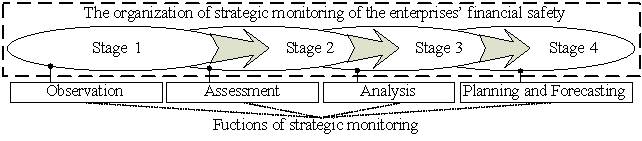
Figure 1.
The organization of strategic monitoring of the enterprises’ financial safety
(compiled by the author)
Stage 1.
Observations of the business entities’ financial safety.
Stage 2.
Assessment of financial safety of business entities.
Stage 3. Analysis
of factors that affect the level of financial safety of business entities.
Stage 4. Planning
and forecasting of business entities’ financial safety influenced by factors
external and internal environment.
Thus, we proposed
to group companies for level of financial safety, under implementation analysis
function of the factors affecting its. Classifications of business entities
allow allocate groups with common characteristics of development and the
factors that shape it. Identification of the aforementioned groups is expected to
produce on the basis of the use of cluster analysis procedures.
Formation of
groups of similar objects, which are characterized by certain features is one
of the tasks of cluster analysis [2]. As mentioned features is proposed to
consider partial indicators of business entities’ financial safety, calculated
at second stage of strategic monitoring. Using of hierarchical clustering
methods become necessary for the classification of enterprises taking into
account the attributes that match the values of partial indicators of financial
safety. Hierarchical clustering methods can determine the possible number of
clusters and the distance at which they are formed. After verification of the
hypothesis about the presence of possible number of clusters business entities
by level financial safety the next step will be to use iterative clustering
procedures which include k-means method. This method involves partitioning the
input set of objects under study in a number of clusters, which has been
identified as a result of the hierarchical agglomerative methods
All of the
above demonstrates that further exploration of research will focus on empirical
studies of business entities clustering by level of financial safety and in
particular and appointed steps of strategic monitoring in general.
References:
1. Бланк И.А. Управление финансовой безопасностью
предприятия / И.А. Бланк. – Киев: Эльга, Ника-Центр, 2004. – 748 с.
2. Многомерный статистический анализ в экономике : [учебн.
пособие для вузов] / Л.А. Сошникова, В.Н. Томашевич, Г. Уебе, М. Шефер; Под ред
В.Н. Томашевича. – М.: ЮНИТИ-ДАНА, 1999. – 598 с.
3. Пан Л. В. Стратегічний моніторинг як підсистема
стратегічного управління підприємством / Пан Л. В., Романченко Н. В. //
Управління проектами, системний аналіз і логістика. - 2008. - № 5. - С.
357-358.
4. Ратушний Ю.В. Формування системи стратегічного
моніторингу середовища функціонування організації (на матеріалах
гірничо-збагачувальних підприємств Кривбасу) : автореф. дис.. к.е.н. за спец.
08.06.01 «Економіка, організація і управління підприємствами» / Ю.В. Ратушний.
– Київ, 2003. – 21 с.