Экономические науки/3.Финансовые отношения
Khussaiyn F., master student
Karagandy еconomic university of
Kazpotrebsoyus, Kazakhstan
Public financial management ANALYSIS from a perspective
of ASSURANCE OF KAZAKHSTAN’s
ECONOMIC SECURITY
The economic security
of the Republic of Kazakhstan today has become one of the problems attracting
attention of political statesmen, jurists , economists, etc. Under the
conditions of weak and inefficient economy it is difficult to contain the
onslaught of internal and external threats, to be a strong and mobile army ,
designed to ensure the military security of the country . In an annual address
to the nation, President Nursultan Nazarbayev said that ".. we will not be
sorry if we lose our statehood , waive strategic fundamentals of sovereignty ,
land and resources ." Past years of independence showed that the market
economy itself does not provide a full-fledged economic security. In this
sense, government intervention was necessary in relation to the chaotic and herd
behavior of other market actors [1, p. 71].
The state holds a key position in the regulation of social relations
associated with cash , speaking both as an owner and as an administrative
entity . It is the role and activities of the administrative entity and represent
the Institute of Administrative Law on " financial management, credit and taxes ." State management
in the field such as finance, carried out by special executive bodies with administrative
means of power and the aid of which the traffic control cash flows. Income received in
the market and in the economy should be shifted so as to provide the necessary
funds for the operating all of the entire state mechanism. In this connection it is appropriate to
recall the aphoristic statement of scholar Jean Bodin , which states that " financial
means are the nerves of the state" [2 , p. 62].
An essential element of economic
security in modern terms - is the financial component. And this is due to the
following arguments and circumstances. In modern conditions geofinansov impact,
global financial systems on individual state to a qualitatively new level. As
rightly pointed M. Osipov, given the dominant position occupied by the
financial component of the modern economy, we can characterize the latter as an
economy -driven basis in its financial way through financial mechanisms by
financial leverage, financial incentives and fiscal purposes. Globalism
demonstrated currently economic civilization, is what creates the conditions
for the establishment of a special financial power, which through the ownership
and disposition of the global currency value, cash flow management allows you
to impact on all the world economic space, and the individual states.
State Administration of financial
security of the state - the main condition of its ability to carry out its own
financial and economic policy in accordance with its national interests. In
general, in our opinion , the financial component of the economic security of
the Republic of Kazakhstan is the ability of its bodies:
- Ensure the sustainability of economic
development in the heart of the strategy "Kazakhstan -2050 " ;
- Ensure the stability of the payment and
settlement systems and major financial and economic parameters;
- To neutralize the impact of the global financial
crisis and deliberate action of the world states , TNCs, sub-state groups , and
others , shadow , etc. , structures on the national economic and socio-
political system of the Republic of Kazakhstan ;
- Prevent large-scale capital flight abroad, «capital
flight «from the real economy»;
- The most optimal for the economy to attract
and use foreign borrowing funds;
- To prevent crimes and administrative
violations in the financial legal relations.
All of the above can also be
represented as some tasks that should solve the organs of state power and
administration in order to ensure safe and efficient operation not only
elements of the financial system of the state, but all interrelated with her
levels of government.
Government and public finance are interrelated, their existence is
unthinkable apart. Projects are both base exercise of public authority. Power
to dispose of funds, perceived as more effective than the methods which
operates law enforcement. But embodied in the law enforcement authorities need
to ensure that state funds , especially for the collection of taxes. Thus, the
public finances - a prerequisite, and a means to simultaneously state activity
[3 , p. 34].
Improving financial management, credit is largely associated with the
organizational structure and powers of government, the activities of ministries
and departments, their relationships with other government agencies. One of the
most important mechanisms that allow the State to pursue economic and social
regulation, a financial mechanism - the financial system of a society, the main
element of which is the state budget [4, p.66].
The state budget, as the principal means of mobilizing and spending of
state resources, political power gives a real opportunity to influence the
economy, finance its restructuring, stimulate the development of priority
sectors of the economy, providing social support to the most vulnerable
segments of the population.
The main volume of administrative functions in
the areas of finance performs Ministry of Finance of Kazakhstan, and included
in its system bodies. Ministry of Finance of the Republic of Kazakhstan is the
central financial and economic government body in charge of general management
of the organization of finance in the country, and is responsible for
implementing a unified state policy in cooperation with the credit, currency,
monetary, tax and customs policy.
The most important function of the
Ministry of Finance is the organization of the work on the budget, which is the
main document of the state. Budget - is calculated and restrictive estimates,
painting income and expenses for a specific period, as approved by the relevant
decision to be executed [5, p. 74].
Implementation of the budget of the state in
terms of reforming the republic's economy is holding a budget and tax policy
that gives priority to collecting money before the expansion of government
spending. The final resolution of issues relating to the internal organization
of ministries, almost impossible, as it is often dependent on external
circumstances.
One of the essential principles of
building services (offices) of the Ministry is to join them on a vertical basis
in accordance with the basic functions of the ministry. Management can not
exist in an unchanged form and evolve according to the law tools to
organizations of executable functions. Financial activities, which originated
with the money, has the ability to pass them, exchange, convert through the
banking system. Of the features of financial operations imply specialization of
functions performed by the various financial authorities [6, p. 81].
The whole system of specialized
government finances wider than the system of financial agencies (agencies). In
accordance with the current legislation of the Republic of Kazakhstan held a definite
distinction between the purely financial, credit and tax functions. Subjects
implement them, and make up a system of financial authorities. Although they
operate independently, but in close relationship within above departmental
inter branch and industry-specific credentials.
The state budget has not only direct but also indirect effects on
socio-economic development of the country. Direct effect - this change in the
distribution of resources in the economy, which are the direct result of the
taxation or budgetary expenditures. Indirect impact is that contained in the
budget documents forecast values key development indicators (GDP,
inflation rate of the national currency, etc. ) , the priorities of the state
financial policy , specific areas of formation and expenditure of the budget
form in society certain expectations and accounted other market when planning
their business activities in the future.
Role of state budget manifested through them perform certain functions:
-
Concentrated in the budget funds intended for the implementation of national
social and economic policy, defense and security of the country.
- With a state budget are implemented ( at
different levels ) and local programs for the development and normal
functioning of the branches of the economy , for the conversion of the military
-industrial complex , environmental protection , to strengthen scientific and
technological capabilities and develop the culture of the country , keeping the
material standard of living population and its separate groups . All these
problems have a common value for the respective territory.
- Accumulation in the budgetary system of large
money funds creates opportunities to ensure uniform economic and cultural
development throughout the country , suitable accommodation within its
productive forces.
- Budget is a powerful control mechanism in the
hands of the state , stands the conductor of his financial policy. Value due to
the state budget not only by being concentrated in it means. In close
relationship with the budget and operate under its influence all other parts of
the financial system.
- Availability budget creates room for maneuver
in the allocation to the needs of society in accordance with their priority for
a certain period of time for the whole country or its regions. As a result, the
budget serves as a realization of the tasks most important to society at a
particular period of its development.
- The role of the state budget is that it
contributes to the implementation of regional and national policies. Among the
main objectives of regional policy, the following : the creation of a single
economic space, leveling the socio-economic development of regions [7, p .
123].
Thus , the state budget - a set budgets, consisting of national and local budget . The role of the state budget in social reproduction is determined primarily by the fact that with the help of the state budget is distributed and redistributed about 30 % of national income , and 10 to 15 % of the gross national product ( expenditure side) . It distributes funds between the various sectors of the economy , manufacturing sectors , the public sphere, economic regions and territories of the country.
In modern conditions of development of Kazakhstan's economy the role of
the national budget is becoming increasingly important . He became the main
instrument for the implementation of economic and social policy of the state ,
providing a significant impact on economic growth , the financial regulation of
the economy and , ultimately , to increase its competitiveness. Republican
budget - a centralized pool of money generated by tax and other income as
defined by the Budget Code. Republican budget is intended to help finance the
tasks and functions of the central state organs, public institutions
subordinated to them and implement country-wide public policies.
To analyze
the execution of the republican budget, consider one section of the structure -
government revenues, because they play a fundamental role in the development
and establishment of the state. Income must be understood system of economic
relations in the course of which a set of funds coming to the state property to
create the material basis of its functioning.
Only national budget received - 4 451.6 billion or 102.5% [8].
Including taxes 3 001.2 bln 102.3%, non-tax - 108.9 bln 126.1%, revenues from
sales of fixed assets - 16.1 bln 113.4% and transfers received 1 325.4 billion,
or 101.1% (Table).
State
budget of the Republic of Kazakhstan in 2010-2012
million tenge
|
Name |
2010 |
2011 |
2012 |
|
1 |
2 |
3 |
4 |
|
I. INCOME |
2 779 228 |
3 626 177 |
4 451 683 |
|
tax
revenues |
1 451 007 |
2 083 555 |
3 001 212 |
|
including: |
|
|
|
|
corporate
income tax |
643 669 |
837 233 |
1 050 380 |
|
value-added
tax |
515 933 |
677 229 |
865 213 |
|
excises |
18 578 |
13 614 |
18 668 |
|
non-tax
revenue |
114 296 |
71 429 |
108 942 |
|
Proceeds
from the sale of fixed capital |
4 538 |
23 736 |
16 088 |
|
Incoming
transfers |
1 209 386 |
1 447 457 |
1 325 441 |
|
II. COSTS |
3 118 646 |
3 860 974 |
4 605 059 |
|
III. NET
BUDGET CREDITS |
25 036 |
35 981 |
84 614 |
|
public
budget loan |
45 540 |
138 297 |
183 853 |
|
Payment of public budget loan |
20 504 |
102 315 |
99 239 |
|
IV. BALANCE
ON FINANCIAL ASSETS |
146 492 |
284 011 |
337 962 |
|
Acquisition of financial assets |
147 083 |
284 711 |
338 321 |
|
Proceeds
from sale of state assets |
591 |
700 |
359 |
|
V. BUDGET
SHORTFALL (SURPLUS) |
-510 946 |
-554 789 |
-575 952 |
|
VI. FINANCING
OF BUDGET SHORTFALL (SURPLUS) |
510 946 |
554 789 |
575 952 |
The main
share of tax revenues accounted for corporate income tax, value added tax and
excise duties. The dynamics of the state budget in 2010-2012 is presented in
Figure 1.
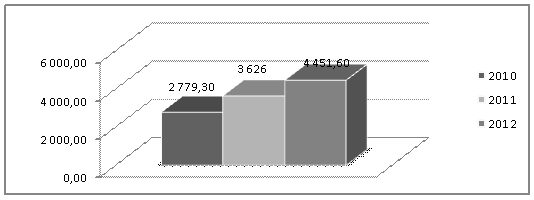
Figure1. The dynamics of the republican budget.
In 2012, revenues amounted to 4 451.6
billion, as compared with 2011 increased by 825.6 billion, or 19%. In 2011
compared with 2010, revenues rose by almost a factor of 2, which shows a
positive growth trend.
As already mentioned above, the budget
revenues are generated through tax and non-tax revenues. Tax revenues in 2012
amounted to 3 001.2 billion, as compared to the year 2011 to more than 917.7
billion, or 30%.
Overfulfillment plan on tax revenues of
66.3 billion, mainly formed by :
- The growth of the foreign trade
turnover of the country and increasing revenue by 48.8 billion tenge in the
value added tax and excise duties on imported goods , customs duties, distributed
in Russia and Belarus due to increased imports;
- Reduction in the rate of VAT refund
from the budget ( at planned return in the amount of 315.2 billion KZT 306.4
bln returned due to non-confirmation of the amounts claimed for refund in the
amount of 10.0 bln due to lack of documents international transit cargo );
- Non-recurring income of $ 17.7
billion ( of which , income tax on the additional income in excess returns for
the years 2011-2012 in the amount of 6.2 billion tenge and premature payment of
the tax on mining activities by individual companies for 4 quarter of 2012 in
the amount of 11.5 billion ( payment deadline February 25, 2013 );
In addition, the corporate income tax
plan is not fulfilled by 10.1 billion, due to a decrease in advance payments
due to lower taxable income for the 2012 single largest contributor.
Non-tax revenues exceeded 22.6 billion,
due to unplanned revenue dividends in the amount of 6.1 billion, in the amount
of fines 12.5 billion, as well as in the amount of 3.3 billion tenge under the
Agreement between the Government of the Russian Federation and the Government
of the Republic of Kazakhstan on cooperation and mutual settlements in the
disposal of nuclear weapons.
For
income transfers plan was exceeded by 14.7 billion for the proceeds amounts
return transfers are not used for their intended purpose and unused targeted
transfers that are not planned.
Despite
the over-fulfillment of the plan revenue growth in 2012 marked the arrears. As
of January 1, 2013 the amount of arrears was - 224.2 billion, an increase of
25.2 billion as compared to 2011 (Figure 2).
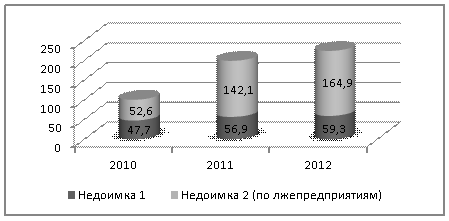
Figure 2. Dynamics of arrears in 2012, KZT.bln
In
the total amount of arrears can distinguish hopeless arrears - 73% or 164.9 bln
and current arrears - 27% or 59.3 billion.
Compared
with 2010 uncollectible arrears increased by 22.8 billion, or 16.1%, current
arrears increased by 2.4 billion, or 4.2%.
Uncollectible
arrears associated with tax audits of taxpayers with signs of pseudo-entrepreneurship.
Current arrears formed on current accruals taxpayers as well as tax audit .
Basically , the current arrears repaid by taxpayers on their own or be
collected by the tax authorities forcibly. However, as part of the current
arrears 23.8 bln or 40.2 % from the arrears of taxpayers with foreign
participation, which are in international arbitration proceedings in respect of
which is the procedure of mutual agreement, in accordance with an international
treaty on avoidance of double taxation. Such arrears, after adjusting for the
results of the appeal shall be transferred to the budget.
In addition, 29.5 bln 49.8% of the total
current arrears falls on taxpayers who have a property which is pledged to the
banks of the second level, as well as problematic arrears taxpayers associated
with the problems of shared construction in therefore, recovery is impossible
in full.
It should be emphasized that the organization of an
effective system of providing financial and economic security in Kazakhstan, we
consider in the context of the formation of organizational support system SFC
in general. Naturally, analyzing the issues of granting any specific functions
SFC oversight of financial and economic security of the country, it is
necessary to take into account their actual capabilities. In light of the
importance of the problem concerned, in our opinion, it is necessary to study
and justification to complement the activities of the Accounts Committee for
Control over Execution of the Republican Budget activity to oversee the
economic security of the Republic of Kazakhstan in the budget process. One of
the most important areas of oversight of financial and economic security of the
Republic of Kazakhstan in the budget process are intergovernmental relations in
the Republic of Kazakhstan. Indeed, hardly anyone doubts that, to ensure the
financial and economic security plays a special role competent regulation of
intergovernmental relations in the country. The current and updated
construction budget system based on the principles of the lower-level budgets,
depending on the parent.
The real financial autonomy of regional budgets is
impossible without addressing the elimination of inter-budget counter flows.
Solving the problem of providing a budgetary rights of regions is also
impossible without establishing a definite correspondence enshrined rights and
responsibilities of each level of the budget.
Solution can only be found in the implementation of
the principle according to which the distribution of income between the budgets
of different levels is carried out in strict accordance with the share of
expenditures allocated to the relevant entity, subject to the decision of tasks
to equalize the revenue part of the budgets of the respective levels. Such a
decision creates inter-budgetary problems the opportunity to provide lower
levels of interest budgets include all reserves to expand revenue sources on
the ground and does not make them "poor relatives" who are forced to
expect or ask for help from "above". In the case of the proposed variant regions will be able to get real
budgetary powers to ensure their actual independence.
In conclusion, here analyzed only some important issues of financial and
economic security of the Republic of Kazakhstan, with the goal to highlight this
urgent problem and at least a "dotted line" to identify options for
solving it. In connection with its significance as all these issues require
further research and development.
References:
1. VD Melnikov,
Il'yasov KK Finance. - Almaty: Economy, 2005. – 682p.
2. VM
Rodionov , Finance and statistics, 2001 . - 587 p.
3.
Utibaev BS, Zhunusova RM, Satkalieva VA State budget: Textbook. - Almaty:
Economy, 2006. - 632 p.
4.
Arystanbekov K.T. - Legal regulation of economic security of the Republic of Kazakhstan
/ / Femida. - 2009 - № 9. - S -17- 22.
5.
Nurmuhanova GJ The state budget. Textbook. - Karaganda: Herald, 2001 . -138
With.
6.
Baimuratov WB Finance Kazakhstan / / Selected Scientific Works. - Volume 2.
Almaty: LSI - 2005 p. -20- 25.
7. VD
Melnikov Public financial management of the economy of Kazakhstan. - Almaty
Karja Karaj, 2008. - 593 p.
8.
Execution of the Republican Budget for 2012 / / Report of the Finance Ministry
on July 24, 2013. - Http://www.minfin.gov.kz.