Economic sciences / 6.
Marketing and management
Isentaev A.D., Cand.Econ.Sci. Baranova N.A.
A.
Baitursynov Kostanay state university, Kazakhstan
BASIC APPROACHES TO DETERMINATION ESSENCE OF RESERVE MANAGEMENT
In the process of organizing business before now faces a number of
issues, and including literacy reserve management. The main objective of
reserve management is to invest in these funds so, to achieve strategic business
objectives. Reserves are created in the industry, and in retail trade, and in
wholesale trade and in all other sectors, enterprises of any form of property.
Without reserves cannot do any one company [1].
Consider the definition of inventory positions with different authors.
According Mishulina O.V., reserves are inventory holdings, intended to be used,
but is currently not used, waiting receipt in the process of production or
personal consumption [2]. Raimbekov J.S. and Sabden O. claim, the material
reserves is a material production, waiting entry into the production process of
consumption, for sale or personal consumption [3].
However, most common definition is Peresvetova Y.V., whereby under
material reserves understood in different stages of production and circulation
production and technical purposes, national consumption products and other
goods, waiting entry into the process of personal consumption or production.
Thus, material reserves are both in production and in the sphere of
circulation. Reserve concept permeates all areas of material production, as the
material flow in the path of the primary source of raw materials to the final
consumer can accumulate in the form of a reserve by any stretch. As a result in
the transformation of raw materials into the final product and the subsequent
promotion of the product to the end user produces two main types of reserves:
-industrial reserves;
-reserves supply and marketing.
Everyone divided
into three types:
-current reserves;
-insurance reserves;
-seasonal reserves (рicture 1)
[4].
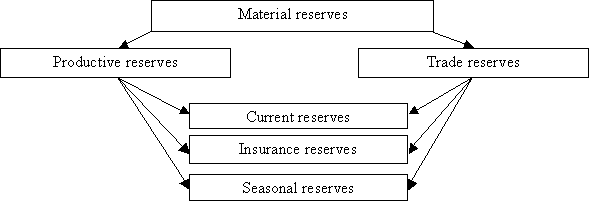
Picture 1.The main types of reserves
It should be noted that the material reserves of the enterprise must be
managed. Reserve management should be considered from the point of view of
process, system and situational approaches. Process approach considers
inventory management, as to ensure the smooth process control, monitoring, and
maintenance of determining the optimum size of the enterprise inventory.
Process approach to reserve management, allowing managers to identify and
manage key processes and performance units, controlling and maintaining stock
levels at the appropriate indicator, also often integrate disparate action
functional units.
According to the reserve management system approach is seen as a set of
interrelated elements, complex models and methods for optimizing reserve resources
in storage and designed to meet the demand for these resources. The essence of
this approach is to separate the process of reserve management elements, but in
general is a unified system in which the interaction of all the elements,
systems, models and methods aimed at improving reserve management.
Situational approach used in reserve management to ensure the required
level of service through the predetermination, flexibility and adaptation of
reserve supply services organization. Speaking about this approach, the
company's management is based on predestination preceding events, which will
have a direct impact on the level of reserves that makes supply services to
adapt and be flexible as to determine the exact level of required reserve
stocks in an unstable timing of orders, a volatile demand for goods and
materials quite difficult.
Thus, inventory management is to establish moments and order volumes to
fill their distribution and newcomer party on downstream links of the supply
chain. Replenish inventory levels depends on factors direct impact, namely:
-
fluctuations in demand for relevant
goods;
-
ineffective logistics inventory
management system;
-
undesired operation suppliers
reserve;
-
absence teamwork between units
manufacturing and supply services [5].
Effective reserve management allows an organization to meet or exceed
customers' expectations, creating such reserves each product that maximizes the
net profit [6].
Literature:
1. Denisov A.L., Dyuzhenkova N.V. Organization of business: reserve
management. - Tambov: Publisher Tambov State Technical University, 2007. – 80
p.
2. Mishulina O.V. Management of expenses and pricing: Textbook. - Кostanay: QSU of name A.Baitursynov, 2008. – 168 p.
3. Raimbekov J.S. Sabden O. Logistics: economics and management. – Almaty:
KN MON RK, 2009. - 911 p.
4. Peresvetov Y.V. Material management. Logistical principles. - Moscow:
Publishing INFRA-M, 2006. – 46 p.
5. Yampolckaya D., Zonic M. Management. - Moscow: Publishing house
«Eksmo-Press», 2004. - 359 p.
6. Fraybfeder J. Effective reserve management. -
Moscow: Alpina Business Books, 2006. – 304 p.