Economic sciences / 6.
Marketing and management
Kalmurzina N.T., Cand.Econ.Sci. Baranova N.A.
A.
Baitursynov Kostanay state university, Kazakhstan
ABOUT MANAGEMENT OF THE PRODUCT ASSORTMENT
The essence of management product assortment is to producers in a timely manner
proposed certain set of goods that would be corresponding to the overall
profile of its production activity, most fully meet the requirements of certain
categories of buyers. There are different approaches to the definition of management
of the product assortment (table
1).
Table 1
Definition of
management of the product assortment
|
Author |
Definition |
|
Kalujnova N.A. |
Activities based on the achievement of rationality assortment [1]. |
|
Kotler F. |
Development and application of
measures aimed at formation of an optimal structure of assortment of the
goods, which most fully corresponds to the current needs of the population. [2]. |
|
Nikolaeva M.A. |
Activities aimed at achieving the requirements of rationality. The
basic controls are a management and level of
requirements in terms of determining the rationality of assortment [3]. |
|
Polovceva F. |
The activities of an enterprise monitoring, analyzing, and making
management decisions in the field of marketing, sales and production for the
purpose of adaptation to a assortment of customer needs [4]. |
|
Dashkov L.P, Pambuhchiaync V.K., Pambuhchiaync O.V. |
Coordination of related activities, science, technology and design, integrated marketing, market research, advertising, promotion,
service demand [5]. |
Summing up the definition of the
essence of management of the product assortment, we can say that the
management of the product assortment is an activity, which is
aimed primarily at achieving the requirements of the assortment.
In the management of the company are the four major functions (Figure
1):
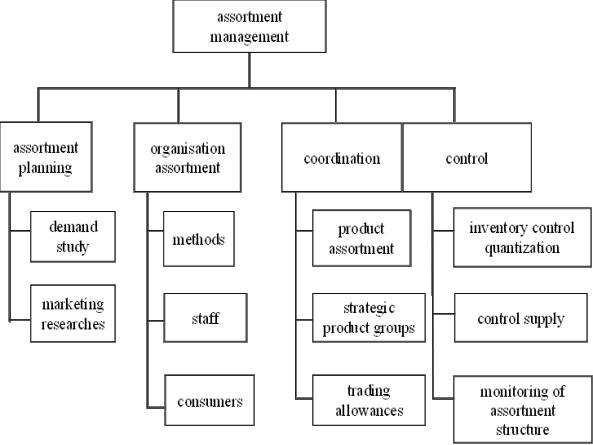

Figure
1. Functions of management of the product assortment
-
planning of the assortment
(the process of determining of the programme of action on a range of products,
based on an analysis of the market and all types of resources);
-
organization of
the assortment (the distribution of tasks between different offices or
employees of the enterprise on the formation of the assortment and the
interaction between them);
-
coordination of
the assortment (ensure the harmonization of the principles of assortment
management with the strategic goals of the enterprise);
-
control of the assortment
(a kind of management that is associated with the formation of the information
on the status and operation of the assortment (accounting), studying data on
assortment (analysis), work on the diagnosis and evaluation of processes of
development and achievement of the effectiveness of assortment strategies,
successes and failures in the use of means and methods for assortment
management [6].
Thus, making the output control of ideation, it should
be noted that of product assortment management is a continuous process.
Planning, evaluation and review of the assortment are
required at each stage of development of the organization. Even a well-designed
marketing plans and advertising may not be justified because of mistakes made
when planning the assortment. That is why the adoption of policy decisions on
the assortment, as it increases or decreases should be clearly justified.
References:
1.
Kalujnova
N.A., Jacobson Y.A. Marketing. General course: Textbook for University
students. - M: Omega-l, 2006. - 476 p.
2.
Kotler
F. Marketing. 9th Edition: translation from English. - M: Publishing house «Williams»,
2003. - 1200 p.
3.
Nikolaeva
M.A., Theoretical foundations of merchandise: Textbook for universities. - M:
Norma, 2007. - 448 p.
4.
Polovceva F.P. Commercial activity. -
PM: Infra-M, 2008. - 248 p.
5.
Dashkov L.P., Pambuhchiaync V.K.,
Pambuhchiaync O.V. Commerce and trade technology. - PM: Dashkov and K, 2011. – 697
p.
6.
Duzelbaevа G.M. Trading management:
Textbook. - Kostanay: A. Baitursynov Kostanay
State University, 2013. - 120 p.