Miroshnikov G.G.
Astrakhan State University
An
experimental approach to the use of proxy servers in Time-shifted TV
Time-shifted television, one of the
most promising services within IPTV, is becoming increasingly popular mostly
because it provides with a powerful and highly valued tool: customization.
The most attractive feature of a
Time-Shifted TV architecture is that it adds a dedicated server and a data
centre to complement an existing scheme of IPTV. The basic principle of its
organization is that a subscriber has access a server which stores recorded
content whilst are still being broadcast or already ended. Storing a large
archive of television programmes over long periods necessarily means a
significant increase of server capacity and a subsequent higher cost of
implementation. On the contrary, Time-Shifted TV services can be provided on
the same existing network infrastructure which is in use for broadcasting over
IP using a multicast channels architecture. A typical model of Time shifted TV
added architecture is described on the Figure 1.
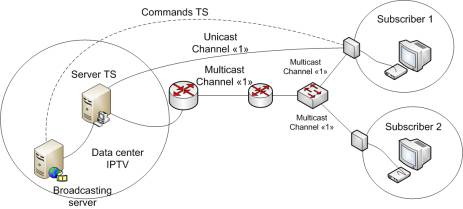
Figure 1: An
architectural model of Time Shifted TV added to an existing Multicast
infrastructure
As seen above, Subscriber 1 could any time whitdraw
content directly from the Time shifted TV dedicated server utilising a Unicast
stream channel "1" even long
after the broadcast of stream channel "1" has ended in Multicast
mode. This is made possible because content was copied simultaneously to a
storage device directly available to set-top boxes so they could access the
"shifted" version at a later stage.
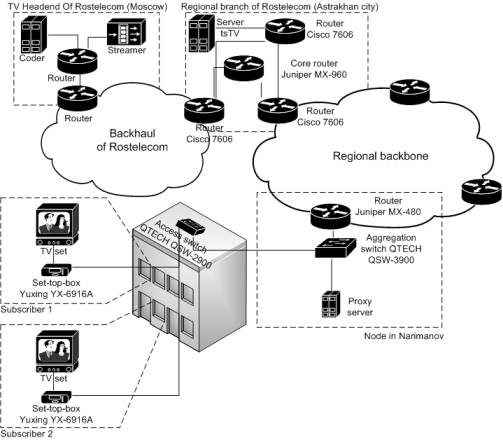
Fig . 2. Topology of a
segment on the testing network used in Narimanov
Under these conditions, Subscriber 2 can only access
the content of channel "1" in real time since there is no direct
connection to the Time-Shifted TV server.
Storing stream segments on a
dedicated server also allows end-users additional functionalities such as
pause, rewind and fast forward content. It is important to note, however, that
a Time-shifted TV server may not need be a single physical part of hardware. It
could be composed, in some configurations, by a streaming server IP directly
fed data from the central IPTV or be distributed across multiple other servers.
To illustrate the latter, a series of simulations were made at the town of Narimanov on a fragment of the network that
belongs to OJSC "Rostelecom" in the Astrakhan region of the Russian
Federation. This fragment included a Metro Ethernet access network covering 79
homes. It's topology is shown in the Figure 2.
During the simulation the load on
the data link between the aggregation node in Narimanov and the central
communication node in Astrakhan city (where the time-shifted TV server is
located) was measured. These measurements were made using the utility Iperf,
and only traffic of the time-shifted TV services was measured. Measurements
were carried out in three stages. Firstly, without the use of proxy servers,
later using a single proxy server and finally using two proxy servers in a
co-operative caching mode.
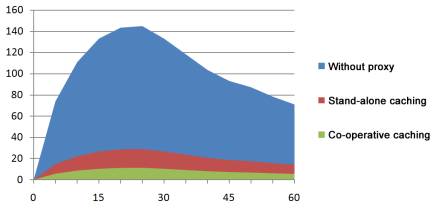
Figure 3: Measurements
of the loading link (in Mbps) between the aggregation node and the central node
taken during the Narimanov's testing under three conditions
These tests have shown that the use of proxy servers
for caching the individual segments of video service in Time-shifted TV allowed
it to reduce the load of the central server services and the data transmission
channel between the access network and the backbone network provider. These
measurements indicated also that co-operating proxy servers could offload the
backbone of a data network between the aggregation node and the node of the
installation in a central server Time-shifted TV more than five times in
average.
References:
1.
M. Cha, P. Rodriguez, J.
Crowcroft, S. Moon, and X. Amatrianin. Watching Television Overan IP Network.
In Proceedings of ACM IMC, 2008
2.
Y. Liu
and G. Simon, "Distributed Delivery System for Time-Shifted Streaming
System," in 35th IEEE Conf. on Local Computer Networks (LCN), 2010
3. J. Zhuo, J. Li, G. Wu, and S. Xu,
"Efficient cache placement scheme for clustered time-shifted TV
servers," IEEE Transactions on Consumer Electronics, vol. 54, no. 4, pp.
1947-1955, November 2008.