Cherkassova
O.L.
Pedagogical
Sciences\ Management in education
Taraz State
Pedagogical Institute, Kazakhstan, Taraz city
The application of
Adair’s theory to the Higher educational system in Kazakhstan
The Sorbon Declaration at 25 May 1998 pointed
out the central role of universities in the development of European cultural
values. It substantiated the making of the European Area of the Higher
education as a key way to the development of people’s mobility with the
opportunity of job placement for the continent’s development. So, the European
Ministers of Education have made a decision to achieve the world wide level of
attraction for the European educational system. To make the university a place
of the highest level of education that can manage all the challenges of
globalization we need good leadership. The leadership that can be centered
around definite goals.
Although
Kazakhstan is still a developing country, it can not escape the process of globalization.
In the progress of globalization the whole world faces challenges concerning
education, as globalization has brought the free market to universities.
Moreover society wants and expects universities to provide a good education. In
order to achieve this, universities must go through a lot of changes and
constantly need to upgrade a process which requires effective leadership.
The
Action-Centered Leadership according to Kippenberger (2002) is a situational
model. The first to introduce this model was John Adair. Adair’s approach to
leadership is based on the use of authority, which is appropriate to the given
situation. Gronn (1999) states that in order to get people to co-operate, a
leader will need to understand the circumstances of the organization and choose
which type of authority would be most effective. Kippenberger says that ‘the
leader who knows what to do inspires confidence in others’ (2002, p.96).
Also Adair’s approach underlines the
importance of group actions and teamwork. Working together a group of people
develops a special personality that has three overlapping areas of need. The
first area is to achieve the task. The second one is to build and maintain the
team. And the third area is to develop
the individual. In order to understand the Adair’s Action-Centered Leadership
Model, these three areas should be examined.
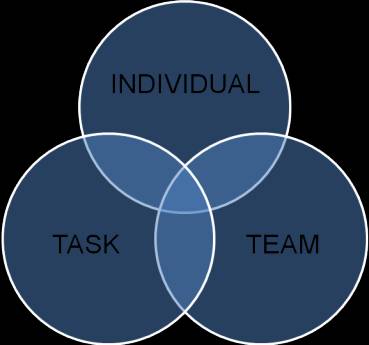
Figure 1. The
three overlapping circle of the Action-Centered Leadership Model.
From an
Action-Centered Leadership perspective Adair (2000) there are some key things
that the good leader should do. First of all, the leader should have the
ability to select people for the university which will be able to achieve the
set task. The leader should not only select the people but he should be able to
delegate the work according to their abilities and involve them into the whole
process in order to motivate them to make their own decisions. The setting of
the time limit to complete the work makes the people to have the definite
purpose.
The next
thing in good leadership is people’s evaluation and people’s training which
lead them to better performance. The primary and the most obvious duty of the
leader is to accomplish the task for which the university exists. The
effectiveness of the leader depends on his ability to influence people. And the
most important thing is to be influenced by the members of the team in the
implementation of the task.
Since
independence Kazakhstan’s government has chosen the policy of democracy for the
state but in fact it continues to follow the Soviet policy of bureaucracy. The
three overlapping circles that best explain the practice in Kazakhstan are:
Task of the
leader
The task of
Action centered Leader is varied, to become a leader of higher education
institute in Kazakhstan the individual must have the expertise in the
particular subject and besides that he/ she should have a doctorate and be able
to boast of number of publication in national and international journals in his
tenure as a professor. One of the important points in this context is the age
of the candidate- he/ she has to be of matured age i.e. youth is not looked at
in favourable light. The leader is appointed by the minister of education not
by democratic selection.
The leader of
the higher education institution is an absolute authority for his subordinates.
He leads managers, the organization single-handedly. His decisions are most
important which cannot be questioned or changed. The policy of the government
supports the authoritative style of leadership. Hare (1997) says that the
leader in Kazakhstan is given lot of power, he is responsible for the finance
that is spend on the research, maintenance of the university and students. He
is also responsible for recruitment of the staff and admission criteria of the
students to some extent. He also plays a vital role in student’s job placement.
He is responsible to open new courses and work for funding. The huge
responsibility on the shoulders of the leader isolates him from the rest of the
staff and makes him a distant overlord who is looked at in awe and reverence.
This distance naturally leads to complex working relationship and a rigid top
down structure of the organization.
Leader then is not in touch with the real situation and is not in
apposition to make effective change.
Brundett et
al (2003) state that achieving the task requires defining what must be involved
in the process and planning how to manage changes and complete the work. The
ability to inspire people is part of leadership.
Adair (2000)
believes that it is possible to inspire individual by setting an example. One
of the task of the action centered leader is to be ready to adapt to new
situations for example if he sets a task then he should be ready to listen to
the implementers of the job i.e. accept new ideas from the subordinate although
they may not be as matured as he is.
Some suggestions
to promote Action Centered leadership are:
·
The leader should clearly define every task that needs to be
performed.
·
The leader should make strategic plans.
·
The leader should allocate work and resources for achieving
the task.
·
The leader should monitor and evaluate the process and
modify the plans.
The team
In
Kazakhstan’s higher educational organizations the teams are not selected
keeping in mind the skills and talents of the staff member but according to the
wishes of the head of the department. This bureaucratic style leads to the
conflict and mistrust in the organization which results in poor performance.
The complex
relationship between the leader and the subordinates is difficult to untangle
and simplify. Action centered leader needs to support the team, encourage them
recognizing their success and learning from the failure while developing the
individual.
There is not much encouragement for the teams to join
decision making. The teams are not given crucial roles to perform leading to
the teams be undervalued.
Some
suggestions to promote team work are:
·
Team spirit should be built.
·
The teams should be made aware of their boundaries.
·
Good communication should be ensured.
·
Feedback should be given and the teams should be further
trained for improvement.
The
Individual
The ideas
from the managers is deliberated but not always implemented. The subordinate
respect and fear the leader to an extent as he can make or break their career.
The decisions of the leader is always followed, any one questioning the task is
thought to be disobedient and not a good worker. The situation is compounded by
the fact that the deans or heads of department at crossroads of their careers
cannot risk anger from the leader as finding new job in other institution is
difficult.
The subordinate respect heir leader as he
is an expert in the field and hence commands authority but now in the changing
world there is a recognition of the opinions of subordinate and many times
ideas is welcomed but in many respect the change is not easily accepted and the
mindset of people in Kazakhstan is difficult. Steers et al (1996) state that the staff has to be motivated by the leader
and it is through his actions and words that this can be achieved because
the culture of the country pays greater attention to the
completion of the task by any means and it is noted that human resources is
ignored and neglected. The leader needs to recognize and use talent and
individual’s abilities in achieving the task thus he should advise and listen
to ideas, provide good training and be attentive to individual needs.
Some
suggestions to develop individual potentials are:
·
The personal concern and anxiety of the individual should be
addressed.
·
The individual should be praised and given recognition
·
The individual should be trained according to the various
tasks and constructive feedback should be given him / her.
The article was devoted to the issues
concerning the Higher Education in Kazakhstan and its structure. It was found
that the leader in higher education institution in Kazakhstan is authorized and
has great power above their subordinates. The Action-Centered Leadership Model
was studied and it benefits were explored. The attempt to study the possible
application of the Action-Centered Leadership Model in Kazakhstan was made. It
was also found that in the era of globalization the system and the leadership
in the higher education institutions in Kazakhstan need to change in order to
be competitive in the globalized market.
Considering the context of Kazakhstan some suggestions to
improve practice are:
·
Individual should be confident of their opinions
·
Deans in their turn should make teams from the heads of the
department and set bigger tasks than their subordinates .
·
Heads of the department must respect individual’s ideas and
encourage them for further decision. They should select individual on their abilities
and make teams to achieve small goals which should help to achieve big
organizational tasks.
·
Deans should not only set the task they should encourage
heads of the department to complete the task in set time.
·
Deans should give good direction to planning and organizing
the work which should be made on equal contributions.
·
Pro-rectors should closely work with the Rector. The Rector
should define the objectives of the organization. He should organize effective
team that will help to achieve the vision efficiently and effectively.
·
The leader should provide for training the managers
throughout their career regularly.
·
The leader should be open toward his subordinate in order to
make them feel useful in the organization and motivate them for better results.
·
The evaluation of individual’s work is a motivating factor
thus the rector should arrange for impartial assessment of the staff.
The
studied questions showed that the Kazakhstan’s higher education leadership is
in a period of transition. The article has studied just Action Centered
Leadership but it hasn’t studied the application of the other theories. Some
suggestion for further research is to investigate the appropriate leadership
model for the higher educational organizations in Kazakhstan.
References
1) Adair, J. (2000). The Action Centered Leader. London: Industrial Society.
2)
Brundrett, M., Burton, N. & Smith, R. (2003). Leadership in Education. London: Sage Publications.
3)
Gronn, P. (1999). The Making of
Educational Leaders. London: Cassell.
4)
Hare, P. (1997). Structure and Financing
of Higher Education in Russia, Ukraine and the EU. 5) Kippenberger,
T. (2002). Leadership Styles. Oxford:
Capstone Publishing.London: Jessica Kingsley Publishers.
6)
Steers, R.M., Porter, L.W. & Bigley, G.A. (1996). Motivation and Leadership at work. New York: Mc Grew-Hill Companies
Inc.