Ladiyeva
L.R.,
Stashkevych P.M., Novoselskyy Y.H.
National Technical University of Ukraine
"KPI",Ukraine
Adaptive
system of control process of membrane
distillation
Is
proposed solution of the problem of adaptive control of non-stationary
heat-mass-transfer of process of contact type membrane distillation (CMD). We
considered the synthesis of adaptive systems on the microcontroller Remikont
P-130.
Setting of problem
Non-stationarity
of properties of the membrane during CMD is the significant practical problem
of automatic control. When there is a change of the properties of the membrane
module, the system ensures the carrying out of technological process under
optimum conditions. Changing these optimal conditions is carried out with the
use of adaptive control systems.
Interest in the problem of adaptive control
of time constantly increasing, due to the constant increase in demands for
quality management systems, and the availability on the market of means of
automation programmable controllers and their relatively low cost. The use of
such controllers in control systems allows providing efficient management of
objects in non-stationary settings. Therefore, the promising structures of
adaptive control system can be considered as such, which consists of PID
controller and block of adaptation (BoA), whose parameters are set in the
process (Fig. 1).
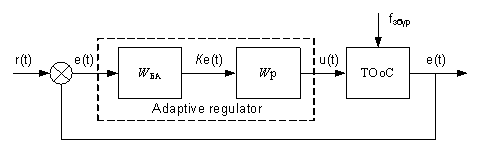
Fig. 1. The general block diagram of the adaptive control system
The
use of control systems with adaptation unit allows you to keep the stability
and the necessary quality control of objects, which parameters in the process
of are undergoing significant changes.
Statement of the main
material
Processes
of membrane distillation belong to the class of non-stationary because over
time change their characteristics of the membrane, which influences the
development of the process of heat mass transfer. This leads for depravation of
quality of control, even in optimally tuned to a particular mode SAR. In
conducting the processes of heat objects it is essential that a time of
transition process was minimal. When using a conventional controller, this is
achieved by increasing its transmission coefficient. However, this caused
undesirable oscillatory processes in the system of regulation. These
undesirable changes can be avoided if you make a transfer ratio regulator
depending on the magnitude and speed of change of error of control
(derivative). Devices, which achieve this goal, should have a block of
adaptation of coefficient transmission controller depending on the fault of
control.
As
such a device can be offered adaptive controller, which consists of a
conventional PID controller and block of adaptation having a transfer function
[1].
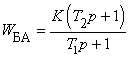 (1)
(1)
Block
of adaptation selects the required transmission coefficient of controller based
on the error management and its derivative. We create a regulator on the
Remikont P-130 microcontroller. To do this, first create a standard PID
controller.
To
create the PID analog controller we used an algorithm PAH (code 20).
Additionally, this algorithm can compute the deviation signal, to carry out his
filtering, can bring the dead zone and limit the output signal as for a maximum
or minimum. In the algorithm of the adaptive controller is created node of
setup that allows changes the settings of the regulator automatically. The
structure of the controller includes several sections.
Section
of deviation (definition of error control) generates a signal:
 , (2)
, (2)
Where X1 - not scalable technical signal;
KM - scalable coefficient, X2 - scalable of input signal.
The input signal - X2 before the adder is pre-filtered
and inverted. With this filter implements a first-order equation with constant
time TF.
PID section from a standard regulator converts signal according to the
transfer function
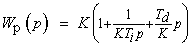 , (3)
, (3)
where K, Ti, Td - in accordance with
the proportionality factor, the time constant of integration and the
sustainable time of differentiation.
Complement
the PID controller by block adaptation, which was created from the following :
a signal of error equal to the difference between the current and the preset
value of the measured parameter, fed to the threshold element (code 59), where
the two thresholds are calculated error signal. If the error signal is within
of the first threshold value, on the output of algorithm-block appears discrete
1 if within the second threshold - discrete 2. Then these signals what
determines a value of the error signal in discrete form, coming the node
summation of scaling , which are converted to the value of the control signal ,
which in turn goes to the switch node numbers (code 85) which directly
determines what coefficient transfer of
regulator at given time should be. This coefficient of the controller comes on
the node of dynamic transformation, on which also comes the signal of variable
(on another input). Sector of dynamic conversion found a derivative variable
and multiplicating the original signal with a factor of transmission of the controller
and added to that factor. Signal, what is formed at the output, consist of the
coefficient transmission of the regulator and the same coefficient that
multiplicating with the derivative of parameter what when is a constant signal
value assignment, task replaces the original signal from the derivative of the
error. Then this total signal fed to the input of transmission coefficient PID
controller, which is a coefficient that depends on the error of regulation and
of its derivative.
So
this adaptive controller selects a regulating effect depending on changes of
the properties of the object control, and improves the quality of the
transition process in the control system.
Experimental
study of the adaptive control system was conducted. For the process of
contact-membrane distillation by channel "amount of coolant - temperature
of solution of the output" was received approximation in the form of the
transfer function. Object management that looks like membrane module was
simulated object of the second order and technically implemented on pneumatic
means.
As
a result of this adaptive controller was obtained graphs transients control
systems that subject to second order at different values of T1.
Conclusions
Past
studies indicate that the transitional process in a control system, which is
implemented using the adaptive controller, has a much higher quality than the
transitional process of management system that is carried out using a
conventional controller. This fact is clearly illustrates with help of the
transient response shown in Fig. 3, 4, 5. The result of work is obtaining
industrially applicable SAR with adaptive properties that can effectively
control equipment meeting the requirements for the course of the process.
Literature
1.Zaytsev G.F. "Automatic
Control Theory and Regulation"
s.335 - 338.