Senior Lecturer Verzhbitskaya I.V., PhD, Economics Ryabovа E.U.,
PhD, Economics Mirgorodskaya O.A.ANO VPO Stavropol Institute of cooperation (branch BUKEP)
The economic
importance of the analysis of counterparties to prevent intentional bankruptcy
Currently,
the Russian economy is in a situation where the majority of companies in
different fields have some difficulties in the field of solvency and liquidity of
its assets. To solve or mitigate these problems, companies have resorted to
different ways replenish their cash reserves or to reduce the size of their
spending. One of the ways to preserve liquidity and solvency are increasingly
using the growth of accounts payable at the expense of his reputation.
Accounts
payable is a relatively inexpensive source of financing with high degree of
risk to the financial stability of the organization. Its low cost is due to the
fact that in terms of economic contracts are often set small-sized financial
penalties for late payments also do not always exhibit the company's creditor
demands for payment of these sanctions. Risks to financial stability is that
the accumulation of accounts payable, the delay of its payment terms,
concentrate a large part of debt in the hands of a few large creditors or
groups of interconnected lead to potential threats both real and deliberate
bankruptcy of the company.
In
accordance with the legislation of the Russian Federation under the deliberate
bankruptcy understand these acts (or omissions), the consequence of which the
economic entity becomes unable to satisfy claims of creditors on monetary
obligations in full. Generally, the objectives of the assignment are deliberate
bankruptcy debtor's assets, acquisition or liquidation of the business of a
competitor.
One of
the methods used in the process of hostile action against the debtor company is
buying its debt from other suppliers, that is, replacement of the lender.
Transmission scheme the lender the right to demand fulfillment of the
obligations of his debtor to another entity in the course of economic activity
often realized. This operation is being used by the creditor to achieve various
objectives, such as increasing the liquidity balance (as receivables exchanged
for cash), and possibly to form a group of related parties, for the acquisition
impact on the company-customer.
To
organize debtor replacement operation lender means that the person is a
creditor ceases to be such, but belongs to him the right to claim the debt is
transferred to another person. Timely detection of the fact of transfer of the
debt claim to a third party organization will allow the debtor to recognize the
first signs of a potential breach of the financial sustainability of their
activities, consisting in focusing the majority of accounts payable in the
hands of one or a group of creditors.
In
addition to the above reasons, of particular interest is the analysis of the
judicial practice of arbitration cases involving refusal of the tax authorities
to grant tax deduction of VAT, or in the recognition of expenses on
transactions made with counterparties qualified as "one-day firms."
The majority of companies believe that recognition of the costs or making VAT
deductible enough to have documentary evidence of the transaction or receipt of
goods.
However,
on this occasion the tax authorities view more stringent. Workers inspections
will try to prove that the taxpayer has not shown due diligence in the
selection of suppliers, therefore, cannot take a deduction of VAT and the cost
of transactions with a counterparty.
In
connection with these assumptions is important regular monitoring and analysis
of accounts payable in different directions, as well as checking the integrity
of suppliers at the time of contracting.
The
importance and necessity of the analysis of counterparties due to a number of
factors (Figure 1).
|
Factors that
determine the need for an analysis of counterparties for the organization |
|
Timely detection
and the development of measures against fraudsters |
|
|
Identification of
affiliation of the founders and officials of counterparties to other
organizations |
|
|
|
Timely prevention
of participation in the criminal organization schemes contractors |
|
|
|
Timely detection of
financial difficulties of the counterparty and the revision of the
contractual relationship |
|
|
|
Reducing the risk
of deterioration in solvency due to irrecoverable receivables |
|
|
|
Reducing the risk
of deliberate bankruptcy by consolidating most of payables in the hands of
one or a group of creditors |
|
|
|
Reducing the time people in the organization
to search for information |
|
|
Figure 1. Factors determining the
need for an analysis of counterparties for the organization |
||


Proposed
areas of analysis of accounts payable and creditors exercised in the accounting
of the debtor company are presented in Figure 2.
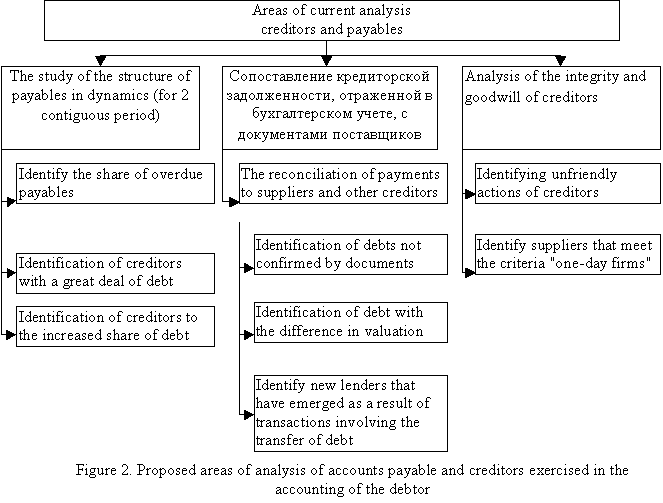

The
study of the structure of payables in the dynamics of at least two consecutive
periods will reveal the growth of the share and the amount of debt a particular
counterparty creditor (supplier). Particular attention should be paid to the
overdue accounts payable.
The next stage of
the analysis should be compared payable debt, reflected in accounting, vendor
documents confirming the fact of delivery of goods, works or services. I.e.
make sure that the existing debts of the company arose as a result of the
actual facts of economic activities in the past. While such comparison should
focus not only on the mere presence of documents (consignment notes,
consignment notes, certificates of services rendered or work performed), but
also by their content and valuation.
If in
the course of this study the reality of payables will be revealed debts are not
documented or have a discrepancy in valuation reflected in the accounting
business entity and documents of suppliers, should be compulsory make
reconciliation statement of accounts payable and send it for approval and
signature of the supplier.
Reconciliation
of debt to suppliers as a requirement of the law should be carried out before
the balance sheet for the year without fail. However, in our opinion, the reconciliation
calculations for the approval and confirmation of the amount of debt for at
least a quarterly basis allows you to control enterprise reality of their
obligations and, more importantly, will reveal the fact of transfer of the debt
claim to a third party, if the notice of such an operation they do not
received.
Identify
the structure of payables new organizations creditor entails analysis procedure
"goodwill" of the counterparty creditor. Research on the subject of
loyalty lender may include a number of stages: gathering information from
various sources, analyze the information and its comparison with the previously
known information, the formation of a professional opinion about the quality of
the lender, possible threats on his part and risks in operations with it.
The
structure of the database on each counterparty is presented in Figure 3.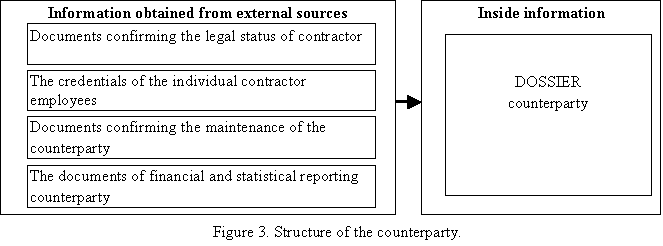

Gathering
information about the counterparty creditor proposed to take on several fronts
simultaneously. The first direction - a written request to the lender
requesting a number of documents supporting its activities. Such documents in
accordance with the letter of the Federal Tax Service of Russia on February 11,
2010 № 3-7-07 / 84 [1] can be:
1)
documents on the legal status of the company:
- copy
of certificate of state registration;
- a
copy of the certificate of tax registration;
- copy
of the charter of the organization;
-
extract from the register (can be ordered independently in the IRS for a
payment or by online inquiry);
-
copies of licenses for certain types of activity (if the counterparty exercises
the licensed activities);
-
copies of the documents on membership in the SRO, a certificate of admission to
certain types of work (if the activities of a company requires to be member of
the relevant SRO).
2)
credentials contractor employees:
- а copy of the
document confirming the authority of the head of organization (Minutes of the
meeting of founders or the letter of appointment of the head, a power of
attorney in the name of the head of branch);
- copy
of the passport head of the organization; [3]
- a
copy of the order or the power of attorney for the right of employees to
certify invoices, bills of lading, certificates of work performed with
signatures of employees (in this case of the order or the power of attorney
must clearly follow that the employee has the right to sign primary documents,
power of attorney must be properly formulated, has not expired, have the
signature of the head and the seal of the organization);
3)
additional documents confirming the conduct of the activities of the
organization [2]:
-
certificate on the counterparty necessary for performance of the contract of
fixed assets;
-
letter confirming the actual location of the counterparty.
In
general, we recommend a list of documents and information to be requested from
the counterparty to a contract or to assess its reality, specify the inside
local act, such as the Regulations on the assessment of counterparties. This
makes sense when determining the composition of the list of information and take
into account the degree of fame and reputation of a company, the amount of the
deal.
The
second area of collecting information - an independent verification of the
information submitted by the counterparty using the service on the site FNS in
"Test yourself and the contractor" [4], on the site office, which
issues the license, or a self-regulatory organization, the site of the
counterparty, in the public domain on the Internet:
-
verification of the fact of registration of the counterparty to the IRS;
- check
the address on the registration of a company belonging to the mass at;
- check
the CEO for his disqualification;
- check
the head of the company in terms of its participation in the management and /
or the presence of the right of ownership in other legal entities (director of
mass, mass founder);
-
assessment of the activity of the company (catalogs, advertising, printing from
the site of the counterparty);
- the
study of the counterparty reviews posted on the Internet;
-
identification of information available at present and / or had in the past
judicial proceedings (criminal prosecutions) involving, directly or indirectly
legal person or company representatives (managers, promoters).
Analysis
and comparison of the received information with the information about the other
contractors of the company (both creditors and debtors) will reveal the
presence or absence of links between organizations, their views and closeness.
The
result of this research can be identified economic ties between the management
or owners of various companies-suppliers, which will conclude a group of
related companies that own a certain amount of payables of the legal entity and
/ or the components of the (sometimes not small) of a portfolio of receivables.
Dossier
formed for each counterparty shall include all the information gathered from
all possible external sources, as well as additional internal information:
- on
operations and transactions previously committed between the debtor and the
creditor counterparty or planned for implementation, their volumes, terms of
payment and other characteristics, details of which may be essential for
decision-making in relation to the company-contractor;
- the
results of the calculation of the coefficients of the financial situation of
the creditor, based on its statistical and financial statements;
- on
the relationship between organizations counterparties themselves;
- on
existing affiliated persons between the parties.
In
other words, a block of external information will be supplemented by regular
internal information generated in the company.
As one
of the unfriendly steps against any organization with the aim of bringing it to
premeditated bankruptcy is the simultaneous presentation of the claim
settlement of accounts payable group of related persons with simultaneous
non-payment of receivables by others belonging to the same group or under its
control, the management of such information dossiers on each counterparty
allow, in our opinion:
- to
identify in advance a potential threat from the others, therefore, timely to
take measures to resolve the receivables and payables;
-
regulatory authorities to prove their diligence in the selection of
contractors, therefore, to confirm the right to deduct VAT or recognition of
expenses for tax purposes;
- have
available the archive information in the form of a constant and complements
available to various internal users at any time, thus reducing costs and time
to gather information about existing or potential contractors, increasing its
quality;
-
minimize the risk of damage or loss of private information on the counterpart
staff of the company, therefore increasing its reliability, integrity, ensuring
the desired level of quality of decisions made based on such information.
The
bibliographic list:
1.
Letter of the Federal Tax Service of Russia from 11 February 2010 № 3-7-07 / 84
"On the refusal to refund VAT, if during the tax control measures proved
lack of due diligence and caution taxpayer in connection with the contractors
and proved the submission the tax authorities of documents containing false
information. "
2.
Letter of the Russian Finance Ministry on August 3, 2012 № 03-02-07 / 1-197 «On
the measures necessary to confirm the integrity in the selection of
contractors."
3.
Letter of the Federal Tax Service of Russia from October 17, 2012 number № АС-4-2/17710 "On consideration of the appeal."
4.
Electronic resource "Test yourself and counterparty» //
http://egrul.nalog.ru/.
5.
Verzhbitskaya I.V., Bale E.G., Internal control of settlements with debtors and
creditors as a tool to recognize the signs of deliberate bankruptcy of the
organization // Economy and Entrepreneurship - 2013. № 12-3 (41-3). Pp. 510-516.
6.
Verzhbitskaya I.V., Value of the analysis of accounts payable for prevention of
bankruptcy of legal entity // Science and modernity. 2012. Pp. 162-167.
7.
Ponomareva N.V. About the methodology of forensic accounting expert examination
of damage inflicted by the crime // Economy and entrepreneurship. - 2015.- №
6-1.- Pp. 583-586.