Экономические науки/ 7. Учет и аудит
Postgraduate student Kolisnyk V.Y.,
Simon Kuznets Kharkiv National University
of Economics, Ukraine
Integrated reporting in
Ukraine: problems and advantages of implementation
Ukraine's transition to sustainable
economic development and its integration into European and world community
require the introduction of modern practices of cooperation between the state
and business, and business and society that would strengthen the mutual
responsibility of participants of public life, to create conditions for further
sustainable development.
In managerial decisions making
enterprise managers should take into consideration important information that
describes all aspects of the economic entity. Reporting, which allows to combine
both financial and non-financial performance and provide full information on
the activities of the entity is integrated reporting (IR), preparation of which
has become a common practice for foreign companies, while the order of
submission of such reports by domestic enterprises requires explanations and
clarifications.
The integrated reporting implies
the process, the result of which is an integrated report as a means of
informing on how strategy, governance, performance and prospects of the
organization lead to the creation of value in the short, medium and long term
[13].
In contrast to the existing
reporting systems, integrated reporting provides the key stakeholders of
companies with essential information about the strategy of the organization,
management and resolution of commercial, social and environmental issues. By
effectively combining these often disparate areas, the company will be able not
only to provide information on past performance, but also to demonstrate the
formation of long-term value of the company in the future.
The problems of organization and
methods of integrated enterprise reporting into various times were considered in
the works such foreign and Ukrainian economists as K. Busko, M. Frigo, A.
Kvattro, A. Rikkabon, A. Hrytsenko, T. Davydyuk, R. Kostyrko, P. Kutsyk, N.
Lohanova, I. Makarenko, B. Petrushevskaya, M. Prodanchuk, T. Slozko, and
others. Not reducing the importance of scientific developments of leading
domestic scientists, the economists note that improving the organization and
methods of integrated reporting has not yet found sufficient attention in their
works. This logically implies deepening and expanding research aimed at improving
the organization and methodology of integrated statements.
The main feature of integrated
reporting is that it focuses on the factors of production, which company consumes
and creates: financial, manufacturing, human, intellectual, natural and social
[2]. The information provided in integrated reports, has more value to users
than a standard financial reporting.
In December 2013 there was adopted
the international standard for integrated reporting, its main objective is to
establish guiding principles and elements that define the general content of
the integrated report and explain fundamental concepts that underlie them. In accordance
with international standards on integrated reporting the integrated report should
include eight elements [2]: a review of the organization and the environment; management;
business model; risks and opportunities; strategy and resource allocation; results
of operations; the prospects for the future; basic principles of preparation
and presentation.
At the moment, we do not assume
that integrated reporting completely replaces the existing format of the
financial statements, which has been and remains one of the most important
resources of information on financial and economic activities of the organization.
This IR will eventually become condensed consolidated source of information on
the company for all its stakeholders and other formats and it’ll replace the
non-financial reporting.
The transition to integrated
reporting will require companies’ considerable transformations, efforts and costs
within the following processes:
¾ rethinking of their activities - the formation of integrated
thinking, without which it is impossible to prepare high-quality (i.e, useful
from the point of view of stakeholders) report;
¾ organization of internal collaboration and increasing employee
motivation as part of the reporting process;
¾ revision
of a number of corporate documents and processes;
¾ development of methodology for the
preparation of the IR;
¾ ensuring the functioning of the system of information gathering;
¾ improving risk management systems related to the publication of
the forward-looking statements.
In order to prepare an integrated
reporting at a decent level, you need to provide opportunities for maximum
interaction between different divisions of the company. Thus, we can determine
are the following advantages of drawing up integrated reporting (Table 1).
In the process of implementation in
practice of integrated reporting a key element is the establishment of clear and precise procedures for the
formation of such statements. In our opinion, the procedure of reporting should
regulate the process of formation of a working group from the moment of its
formation to the procedure approval of integrated reporting. At each stage of
the procedure of forming the integrated report the following elements should be
clearly defined: the necessary data; responsible persons; deadlines.
However, the company may face such
difficulties in the process of drawing up integrated reporting as:
¾ time and costs for the preparation of the
integrated reporting ;
¾ the lack of interest of senior management in the integrated
reporting;
¾ ambiguous understanding of the content of the integrated
reporting;
¾ inadequate assessment of the time required for preparation of the
integrated reporting;
¾ the low efficiency of interaction in the team;
¾ a
lack of understanding of the importance of the integrated reporting and the
requirements regarding the quality of the work performed;
¾ lack of common goals among the various departments in the
preparation of the integrated reporting.
Table 1
Advantages
of preparation of integrated reporting
|
Advantage |
Description |
|
Increasing
the quality of corporate governance |
Organizations that
have implemented ISO, use the integrated report as a central tool of
connection strategy used both inside the company and outside it in order to maintain
time and resources |
|
Compound financial and non-financial key performance indicators |
Companies using IR,
demonstrate an integrated approach in their reports, linking non-financial
and financial key performance indicators in order to present a coherent
strategy |
|
A
greater degree of transparency; increasing the reliability of the information
reported |
Genuine loyalty to the
principles of transparency represents a new approach that requires changes in
the internal thinking. IR helps organizations to maintain a greater degree of
transparency and receive answers to the questions that arise at the level of
the company, about what information is appropriate to disclose |
|
Providing the best environmental, social and public information to
interested parties |
The adoption of IR
allows organizations to take appropriate decisions in connection with
requests for information. Changes in internal processes help companies to
answer the questions of stakeholders with greater confidence in the
information and the best balance between quality and quantity |
At present, the integrated
structure of the report is not uniform. There are no guidelines and legal
framework for the preparation of an integrated report. Analyzing the economic
situation at this stage, it should be assumed that in the near future there will
be developed general requirements for the preparation of an integrated report
to the world community and instructional materials in Ukraine.
Another important problem that
arises in the preparation of an integrated report - shortage of staff with
expertise in this area. The transition to this type of reporting in Ukrainian
organization is just beginning, and in this regard, "ready"
professionals who are able to start work in the new programs with the new
regulatory framework is still the task of our universities.
The first attempts at drawing up an
integrated report by Ukrainian companies are evidence of their desire to meet
international requirements, to become able to be a worthy competitors not only
in domestic market but also in the world community.
At this stage, the implementation
of integrated reporting will lead to the following (Fig. 1).
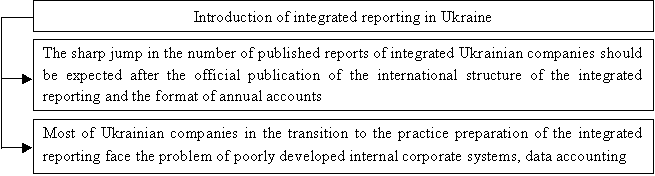
Fig. 1. Possible effects from the
introduction of integrated reporting in Ukraine
As a result, integrated reporting
is the most efficient way to study the needs of companies in the capital since such
reporting eliminates the gap between leadership and investors concerning their
assessment of the success of the business and performance of management
efforts.
References
1. Busco С. Redefining Corporate Accountability through
Integrated Reporting/ С. Busco, М. Frigo, Р. Quattrone //
Strategic Finance. – 2013. – №1. – С. 33-41.
2. The international
IR framework [Електронний ресурс] // The iirc. – 2012. – Режим доступу до ресурсу:
http://www.theiirc.org/international-ir-framework//
3. Porter М. Creating Shared Value: How to Reinvent Capitalism
and Unleash a Wave of Innovation and Growth / М. Porter, М. Kramer // Harvard
Business Review. – 2011. – №1. – С. 62-77.
4. Сорокина
К. В. Интегрированная отчетность – новая модель отчетности для бизнеса / К. В.
Сорокина // Корпоративная финансовая отчетность. Международные стандарты. – 2011. – №7. – С. 8-13.
5. Jensen, J. C.
Determinants of Traditional Sustainability Reporting versus Integrated Reporting.
An Institutionalist Approach / J. C. Jensen, N. Berg // Business Strategy and
the Environment. – Vol. 21 (2012): 299–316.
6. The sustainability
content of integrated reports – a survey of pioneers // Global Reporting
Initiative, 2013 [Electronic resource]. – Mode of access :
https://www.globalreporting.org/ resourcelibrary–/GRI-IR.pdf.
7. Eccles R. Achieving
Sustainability Through Integrated Reporting / R. Eccles, D. Saltzman //
Stanford Social Innovation Review, Summer 2011: 56–61.
8. Cheng M. The International
Integrated Reporting Framework: Key Issues and Future Research Opportunities /
M. Cheng, W. Green, P. Conradie, N. Konishi, A. Romi // Journal of
International Financial Management and Accounting. – Vol. 25 (2014): 90–112.
9. Davyduk T. V.
Convergence of accounting and social reporting in terms of human capital: the
development of existing approaches / T. V. Davyduk // Economics: rime
realities. 2012. – Vol. 2(3). – Pp. 123–129.
10. Костирко Р. О. Інтегрована модель звітності компаній: передумови, принципи, складові / Р. О. Костирко // Економіка України. – 2013. – № 2 (615). – С. 18–28.
11. Куцик П. О. Організація впровадження
Інтегрованої системи обліку та звітності / Петро Олексійович Куцик // Торгівля,
комерція, підприємництво: збірник наукових праць. – 2012. – С. 48-60.
12. Єфименко Т. І. Запровадження інтегрованої
звітності та реформування бухгалтерського обліку в умовах інтеграції / Т. І.
Єфименко // Фінанси України. – 2014. – № 10. – С. 7–23.
13. Соловьева
О.В. Тенденции развития корпоративной отчетности: интегрированная отчетность /
Журнал «Международный бухгалтерский учет», № 35 (281) — 2013 сентябрь.