V.S. Savenko1, A.G. Silivonec2,
S.A. Ermokovec2
1 Doctor of technical sciences, Professor
MSPU named after I.P. Shamyakin,
Mozyr, Republic of Belarus
2 Undergraduate of physics and engineering faculty
MSPU named after I.P. Shamyakin,
Mozyr, Republic of Belarus
THE CONTRIBUTION OF THE PONDEROMOTIVE FACTORS IN THE
PHENOMENON OF ELECTROPLASTICITY OF DEFORMATIONAL MAGNESIUM
The paper
presents the results of research of influence of pulse current on the implementation
of electroplastic deformation. We have chosen magnesium as a material. It is
widely used in modern technology due to its low density, which can
significantly reduce the weight of components and structures. Magnesium is
widely used in the aviation and automotive industries.
The
article presents calculations of the ponderomotive factors of its own magnetic
field and electric field inside a conductor when implementing a multipass electoplastic
rolling of magnesium.
Introduction. There
are a number of factors of secondary force pulse current that affect the
plastic deformation of the metal under mechanical stress above the yield
strength such as the pinch effect occurring under the influence of its magnetic
field current and the polarization of electron subsystems of the metal with the
creation of the transverse electric field of Hall, preventing further
compression of electron plasma.
Skin
effect implements the reduction of the amplitude of electromagnetic waves as their
penetration into a conducting medium at the flow of high frequency alternating current
(AC) through the conductor creating the uneven distribution over the cross
section of the current density with a decrease in axial areas and increase near
the conductor surface. And it is associated with the he rate of diffusion of
the magnetic field in the metal and the presence of characteristic time τp of
magnetic field penetration in the conductor with current. [1]
It
should be noted that during the electroplastic deformation in addition to the secondary
pinch and skin effects in transmission pulse of electric current, there is a
thermal softening of the lattice, the calculation of its parameter for the considered
duration of the current pulses (10-4 - 10-5 s) is not
significant.
Pinch and skin effects. Electroplastic deformation implemented by multipass rolling of
magnesium (35 transitions) when
passing through the metal the pulse current density of 105 A/mm2,the
duration and pulse repetition rate of 104 s and 600 - 800 Hz. Final
geometrical parameters after 35 transitions: thickness is 1mm, width is 4mm.
On the surface of the sample
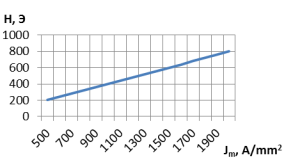
self-magnetic field takes the maximum value (fig. 1a):
 , (1)
, (1)
where  is amplitude value of the current in the conductor, then:
 , (2)
, (2)
where  is the cross-sectional area of the
conductor.
is the cross-sectional area of the
conductor.
Mechanical pressure on the surface of
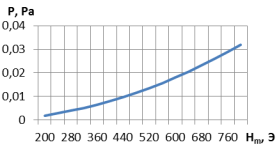
the sample for the electron plasma compression is equal to (fig. 1b):
 , (3)
, (3)
where is mechanical pressure (Pa),
  is magnetic permeability for magnesium 1,257·10-6
  .
.
Maximum axial force from the pinch-effect is equal to:
 , (4)
, (4)
where  is maximum axial force,
  is Poisson's ratio equal to 0,27,
 is mechanical pressure,
  is
cross-sectional area of the sample.
is
cross-sectional area of the sample.
A special role in the phenomenon of electroelasticity
played by the material of sample and its conductivity, the rate of diffusion of
the magnetic field in the sample, which respectively determines the magnitude
of the pinch-effect. The value of pinch-effect depends on the circular
frequency which is 600 - 800 Hz.
Q factor should be small, such as when is the value of
  . [3, 4] Pulse duration should be
minimal in this case, it was τ = 10-4s.
. [3, 4] Pulse duration should be
minimal in this case, it was τ = 10-4s.
The thickness of the skin layer for the sample of magnesium
was determined as (5):
 , (5)
, (5)
where  is the thickness of the skin layer,
  is magnetic
permeability of magnesium,
is magnetic
permeability of magnesium,
 is conductivity
of magnesium,
is conductivity
of magnesium,  is pulse
repetition rate.
is pulse
repetition rate.
Then, the thickness of the skin layer at 600 Hz:  .
.
The thickness of the skin layer at 800 Hz:  .
.
It is obvious that at sufficiently
high frequency ω, the thickness of skin layer can be very small (fig. 2).
а) b)
Figure 1 - a)
Сhange of the self-magnetic
field of current h on the surface of magnesium at different values of current
density Jm; b) Modification of mechanical pressure p on the surface of
magnesium at different values of its own magnetic field current n
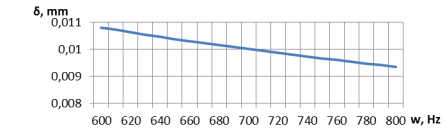
Figure
2 - Сhange of magnitude of the skin layer δ from
the circular frequency ω
Conclusion.
To achieve high pinch effect, it is necessary to select such a frequency of
current pulse, so that the magnetic field does not have time to substantially
penetrate the surface of the sample. When the deformation of the sample occurs due
to the pinch effect, magnetic field diffuses the crystal, the speed of
diffusion depends on the conductivity of the metal and the frequency of the
current. At the same geometry of the samples, the pinch effect is stronger on
the material that has high electrical conductivity. Thus, the pulse current in
addition to electronic plastic action and exerts a ponderomotive effect on the
deformable material (compression of the sample with its own magnetic field and
excitation of elastic waves with a repetition rate of pulsed current). [1, 2].
Bibliography
1. Savenko, V. S. Mechanical twinning and electroplasticity
of metals in terms of external energy impacts : monograph / V. S. Savenko. – 2nd
ed. – Minsk : BGAFK, 2003. – 203 p.
2. Roshchupkin, A. M. About the influence
of electric current and magnetic field on interaction of dislocations with
point defects in metals / A. M. Roshchupkin, I. L. Bataronov // Solid state
physics. – 1988. – V. 30. – № 11. – 3311 p.
3. Baranov, U. V. Physical basis of
electropulse and electroplastic treatments and new materials / Y. V. Baranov,
O. A. Troitsky, J. S. Abraham,
A. D. Shlyapin – M. : MOSCOW STATE INDUSTRIAL UNIVERSITY, 2001. – 844 p.
4. Troitsky, O. A. Fundamental and applied
research of electroplastc deformation of metals / O. A. Troitsky, V. S. Savenko.
– Minsk : IVC, 2013. – 375 p.
©
Savenko V.S., Silivonec A.G., Ermokovec S.A., 2016