HOVHANNISYAN
T.N.
STABILITY OF MULTIVARIABLE L1
ADAPTIVE CONTROL SYSTEMS
The paper
examines the stability of MIMO (i.e. Multiple-Input Multiple-Output)  adaptive control
systems based on the properties of positive real transfer matrices. Such systems are stable for large values of
the adaptation gain, even in the case of systems with right half plane zeros.
adaptive control
systems based on the properties of positive real transfer matrices. Such systems are stable for large values of
the adaptation gain, even in the case of systems with right half plane zeros.
Keywords: multivariable (MIMO)
control system,  adaptive control,
reference model, positive real system,
stability.
adaptive control,
reference model, positive real system,
stability.
 adaptive control was
developed to address some of the drawbacks evident in Model Reference Adaptive Control (MRAC), as a loss of robustness in the presence of
fast adaptation [3,4].
adaptive control was
developed to address some of the drawbacks evident in Model Reference Adaptive Control (MRAC), as a loss of robustness in the presence of
fast adaptation [3,4].
As a basic model
of linear  -dimensional, i.e. having
  inputs and
  outputs, MIMO systems
with constant parameters let us consider the system that can be expressed in
the following standard state-space form:
outputs, MIMO systems
with constant parameters let us consider the system that can be expressed in
the following standard state-space form:
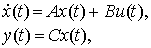 (1)
(1)
where
 is an
is an  -dimensional state vector;
 and
and  are
are  -dimensional vectors of inputs and outputs;
  are constant matrices
of appropriate sizes. We will assume that system completely controllable and
observable, strictly stable, and, maybe, with Right Half Plane (RHP) zeros.
are constant matrices
of appropriate sizes. We will assume that system completely controllable and
observable, strictly stable, and, maybe, with Right Half Plane (RHP) zeros.
The MIMO system
(1) can also be described in the operator form by the  scalar strictly proper
rational matrix in complex variable s.
scalar strictly proper
rational matrix in complex variable s.
Generally, the transfer matrix  is connected with the
matrices
is connected with the
matrices  in (1) by the formula
[5]
in (1) by the formula
[5]
 , (2)
, (2)
where  is an identity
matrix.
is an identity
matrix.
We will adhere to the  architecture with
state predictor and low-pass matrix filter presented in [2]. Let an
architecture with
state predictor and low-pass matrix filter presented in [2]. Let an  -dimensional strictly stable multivariable system be
described in state-space by the following equations:
-dimensional strictly stable multivariable system be
described in state-space by the following equations:
 (3)
(3)
where
 is an
is an  -dimensional time-dependent vector of unknown externally
bounded (
-dimensional time-dependent vector of unknown externally
bounded ( ) disturbances that should be rejected by adaptive control,
and all other matrices and vectors have the dimensions as in (1).
) disturbances that should be rejected by adaptive control,
and all other matrices and vectors have the dimensions as in (1).
The
state predictor has the same structure as the system in (3). The only
difference is that the unknown disturbance vector  is replaced by its
estimate
is replaced by its
estimate  .
.
The process is
regulated by the following adaptation law [2]
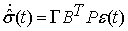 , (4)
, (4)
where
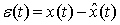 is the prediction error,
  is the solution of
the Lyapunov equation
is the solution of
the Lyapunov equation
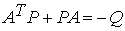 (5)
(5)
for
an arbitrary symmetric positive definite function  (
( ), and the positive scalar
  is called the adaptation gain [2].
The control
signal  of the
system is given in operator form as
of the
system is given in operator form as
 , (6)
, (6)
where
 is an
is an  -dimensional reference signal,
  is an
is an  static (gain) matrix,
and
static (gain) matrix,
and  is the transfer
matrix of a low-pass filter.
is the transfer
matrix of a low-pass filter.
In the Fig. 1, it
is shown general block diagram of the multivariable adaptive control system (4)
with integral feedback and disturbance rejection law [2].

Fig. 1. Block diagram of the adaptive
multivariable system with the state
predictor and the adaptive disturbance rejection law
The architecture of the discussed adaptive MIMO control system
represents a linear multivariable system with integral feedback and therefore
can be investigated by the methods and approaches of linear multivariable
feedback control [5,6].
Based on the block diagram in Figure 1, it is easy to derive the
following matrix equations of the adaptive system with the state predictor:
 , (7)
, (7)
where
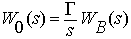 ;
; 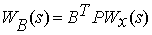 . (8)
. (8)
From the matrix equation (8) can be seen that the output signal of the
system consists of two components, where the first one describes the system
behavior with respect to the reference  signal while the other is
generated by the disturbance
signal while the other is
generated by the disturbance  .
.
Let us proceed to the stability analysis of the adaptive system in
Figure 1. From the first summand of the matrix equation (7), it is evident that it represents a stable open-loop
MIMO system, which does not depend on the adaptation gain  . Therefore, no problem with stability can arise here. The second part of the equation contains a negative feedback loop system, where
  transfer matrix
  in (8) can be written in the state-space form as
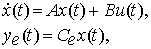 (9)
(9)
where
 .
(10)
.
(10)
Taking into
account the form of the matrix  (10) and recalling the Kalman-Yakubovich lemma [2-4,
7], we come to a
conclusion that
(10) and recalling the Kalman-Yakubovich lemma [2-4,
7], we come to a
conclusion that  belongs to the
so-called Positive Real (PR) transfer
matrices for which the Hermitian matrix
belongs to the
so-called Positive Real (PR) transfer
matrices for which the Hermitian matrix  is positive
semi-definite for all real
is positive
semi-definite for all real  , for which
  is not a pole of any
element of
is not a pole of any
element of  . As shown in [6],
the condition
. As shown in [6],
the condition  implies that all his scalar Characteristic
Transfer Functions (CTFs)
implies that all his scalar Characteristic
Transfer Functions (CTFs)  are also Positive Real, that is
 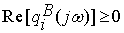 for all real
  . This means that all
  are strictly stable
and minimum-phase, have relative degree 0
or 1, and the Nyquist plots of
are strictly stable
and minimum-phase, have relative degree 0
or 1, and the Nyquist plots of  lie entirely in the
right half complex plane or, which is the same, the phases of
lie entirely in the
right half complex plane or, which is the same, the phases of  are always less or
equal to
are always less or
equal to  .
.
The same is true for
CTFs of the transfer
matrix  (8). They have relative degree 1
or 2 and are minimum-phase, even if the initial system
(8). They have relative degree 1
or 2 and are minimum-phase, even if the initial system  has RHP transmission zeros, which implies
that the Nyquist plots of
has RHP transmission zeros, which implies
that the Nyquist plots of  cannot encircle the
critical point
cannot encircle the
critical point  , irrespectively of the value of the gain
  .
.
Summarizing, it is shown that the adaptive system in Figure 1 is
stable for any strictly stable transfer matrix  and any value of the
adaptation gain
and any value of the
adaptation gain  . That feature ensues from the fact that the transfer matrix
  (8) always belongs to the
class of Positive
Real
matrices.
(8) always belongs to the
class of Positive
Real
matrices.
Example. The results of simulation of the two-dimensional
adaptive system with the help of Simulink
for  , sinusoidal disturbances with unit amplitudes in both
channels and the period
, sinusoidal disturbances with unit amplitudes in both
channels and the period  , where the oscillations in the second channel are shifted by
 degrees, and two
different values of the adaptation gain
degrees, and two
different values of the adaptation gain  (
( and
and  ) , are shown in Figure 2. The increase in
  brings to smaller
deviations of
brings to smaller
deviations of  from zero, i.e.
to the higher performance of the
from zero, i.e.
to the higher performance of the  adaptive
system (the absolute maximum deviation of the output signals for
adaptive
system (the absolute maximum deviation of the output signals for  is more than 20 times
as small as for
is more than 20 times
as small as for  ). The further increase in
  will result in
smaller errors tending to zero as
will result in
smaller errors tending to zero as  .
.

Fig
2. Simulation results:
(a),(b)  ; (c),(d)
 .
.
References
1. T. Hovanissyan, N. Vardanyan, E.
Kharisov, O. Gasparyan, Hovakimyan N. On
Application of L1 Adaptive Control to Multivariable Control Systems. Part I.
General-Type Multivariable Systems // Известия НАН
и
ГИУА. Сер. ТН. – 2014. – Т.67, №4. – С. 434-445.
2. Hovakimyan
N. and Cao. C.  Adaptive Control
Theory - Guaranteed Robustness with Fast Adaptation. - SIAM, Philadelfia, 2010.
– 340 p.
Adaptive Control
Theory - Guaranteed Robustness with Fast Adaptation. - SIAM, Philadelfia, 2010.
– 340 p.
3.
Astrom K. and Wittenmark B. Adaptive
Control. - Addison-Wesley Longman Publishing Co., Inc., Boston, MA, 1994. -575
p.
4. Ioannou P. and Sun J. Robust Adaptive Control. - Prentice Hall, 1996.
– 834 p.
5. Skogestad
S. and Postlethwaite I. Multivariable Feedback Control. Analysis and
Design. -John Wiley and Sons Ltd., Chichester, Sussex, UK, 2005. - 595 p.
6.
Gasparyan O. N. Linear and Nonlinear
Multivariable Feedback Control: A Classical Approach. - John Wiley & Sons,
UK, 2008. - 354 p.
7. Slotine J.-J. E. and Li W. Applied Nonlinear Control. -
Prentice Hall, Englewood Cliffs, USA, 1991. - 476 p.