Koshykar
I. Y., student.
National
Technical University of Ukraine «Kyiv Polytechnic Institute»
SYNCHRONOUS
GENERATOR WITH COMBINED EXCITATION OF AUTONOMOUS POWER PLANTS
Introduction.
In general, an autonomous power plant consists of a primary drive system
(usually an internal combustion engine (ICE)), and the generator is usually
simultaneous with electromagnetic excitation. A characteristic feature of the
system is based on the ICE operating range of load of 0.5 to 1.2 of the nominal
power. Therefore the external characteristics of a synchronous generator should
be designed for idle voltage close to the voltage under load ≈50%. In
this case the range of changes in the external characteristics taking into
account regulatory requirements for an autonomous power complex (support
voltage of ± 10%) should be between 200 to 240 under a load of 0.5 to 1.2 rated
power. This fact simplifies the task of stabilizing the external
characteristics of the generator with permanent magnet excitation with
electromagnetic shunting.
Materials and research results. The use of synchronous generators
with permanent magnets (SGPM) expands with the introduction of new areas of
their application as well as the development of new magnets which have improved
characteristics. SGPM have a relatively high value of efficiency but it is
difficult to be adjusted. One option for the stabilization of the external
characteristic is the use of magnetic shunts. The article deals with
synchronous generator (SG) with a magnetic shunt to the rotor is made on the
basis of serial asynchronous motor (AM) AIР100L4. As a base
selected AM for several reasons: firstly AM - are serial which in turn means
that they are optimized; secondly the use of
stators for SG generators means unification. Use this generator to
highly autonomous power AC. Longitudinal sketch SG shown in Fig. 1:
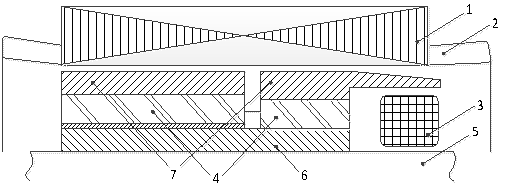
Figure 1 - Sketch SGPM with magnetic shunt
Figure 1: 1 - magnetic core of stator; 2p - stator
winding; 3 - magnetizing winding; 4 - permanent magnets; 5 - the shaft; 6 - the
plug; 7 - pole pieces.
On the three-phase stator
generator posted a distributed stator winding. SG rotor consists of two parts:
a radially magnetized permanent magnets (4 poles), which create a working
magnetic flux; magnetic shunt (support portion SGPM) intended to stabilize the
external characteristic SGPM (± 10%, GOST 13109-97 from the sources
transducers) and for the purpose of regulating the output voltage over a wide
range. In accordance with current regulations the maximum deviation of the
actual voltage over the entire range of operating current and the character of
the load (cosφ = 1, cosφ = 0,9) deviation of the generator voltage
should be in the range 198 - 242 V.
The advantages SGPM magnetic
shunt include high operational reliability due to the absence of sliding
contacts and brushes of inductor no loss to the excitation regardless of the
source of direct current high efficiency. The main disadvantages of these
machines is the absence of a direct method for controlling voltage and a
relatively low maximum capacity of the machine (up to 100 kVA). The test SGPM
characterized by the following rating: power Pn = 4.0 kW, phase voltage U1 =
220, the number of pole pairs p = 4, speed n = 1500 rpm, the frequency of the
output voltage of f = 50Hz, the material of the permanent magnets NdFeBr-H-38.
The goal of the article is to
develop a mathematical model of the field SGPM and optimizing the working area
of its rotor. In order to save hardware resources PC considered cross section
of the working part of the rotor and the stator section.
To solve this problem we
developed two-dimensional mathematical model of the test field GCNM in cross
section. The estimated area of the generator is shown in Fig. 2.

Figure 2 - The estimated area of the test generator
Fig. 2: 1 - magnetic armature; 2 - armature winding; 3
- shaft; 4 - permanent magnets; 5 - pole pieces. The polarity of the permanent
magnets is marked with relevant symbols.
When radially magnetized
permanent magnet pole space is filled with a solid non-magnetic structure which
gives the structure the required mechanical strength and serves as a base for
placement of permanent magnets and the pole pieces so the width of the magnets
remains constant. In addition the increase in the width of the magnets will
lead to an increase in stray fields.
1.
Chumak V.V., Ponomarev O.I.
Synchronous generator with combined excitation // Energya – XXI century. –
2013.
2.
Vas'kovsky Y.N. Simulation operating
modes of traction synchronous motor with permanent magnets / Y.N. Vas'kovsky,
Y.A. Gaidenko, A.E. Rusyatinsky // Elektrotehnіka i elektromehanіka. – 2013.