SNR calculations
for magnetic nanoparticles under asymmetric stochastic resonance conditions
A.G. Isavnin, I.I.Mirgazov
Kazan (Volga region) Federal University, Russia
Stochastic resonance phenomenon has been well investigated in various
areas, including magnetic nanoparticles systems [1,2]. In some previous papers
the effect was considered as application to superparamagnetic particles, with
noise intensity measure being temperature of the sample and external periodic
signal being weak radiofrequency field [3,4]. There are two commonly used
approaches to describe the system behavior under such conditions: the two-state
model, based upon the master equation for Kramers escape rates [5], and the
continuous model, based upon numerical solution of the Fokker-Planck equation
with a periodic drift term [6]. The influence of additional permanent magnetic
field, applied at different angles to the “easy axis”, to dynamic magnetic
susceptibility was also thoroughly explored before [7-9]. Here we present
calculations for output signal-to-noise ratio (SNR) of the system of magnetic
nanoparticles with auxiliary permanent magnetic field applied at arbitrary
angle. Along with dynamic magnetic susceptibility, SNR is the most important
characteristic of stochastic resonance. As usually we consider thermal switches
of the particle magnetic moment as internal noise of the system, and output
signal is assumed to be regular part of the magnetic moment motion at frequency
of external weak radiosignal.
So, the energy of single-domain particle with uniaxial magnetic
anisotropy is  , (1)
, (1)
Here the first term describes interaction of the magnetic moment of
superparamagnetic particle with anisotropy field (K is anisotropy constant, v
is the particle’s volume, q is the angle between magnetization
vector and easy axis); the second term is associated with permanent magnetic
field Н applied at angle α to
the axis of easiest magnetization; the last term represents interaction with
radiofrequensy field.
We use the two-state model or the discrete-orientations approximation in
our calculations. Therefore the magnetic moment of the particle is allowed to
be in just two states corresponding two minima of the double well. It is
convenient to define discrete variable x=Mcosq describing
projection of the magnetization vector to the easy axis. So, this variable can
take only two values. The two-state theory used trough this paper implies that
instead of continuous diffusion of the particle’s magnetic moment over a sphere
we consider its stochastic switches between two directions. Advantage of such
approximation is possibility of using the master equation for transition rates
that yields analytical solution. The master equation is [3]:
 . (2)
. (2)
Here n± is the probability of
discrete variable x=Мcosq to take value x±. W±(t) is escape rate
from ± state corresponding to stable directions of the magnetic moment. The
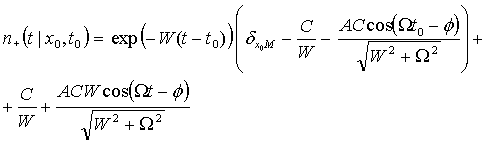
analytical solution of (2) for asymmetric double-well potential was obtained in
[8]:
 , (3)
, (3)
where
 , (4)
, (4)
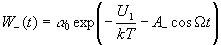
and the escape rates of the magnetic moment over potential barriers:
 ,
,  . (5)
. (5)
Here C=a0exp(-U1/(kT))
is the Kramers escape rate from the lower minimum of the stationary asymmetric
potential. f=arctg(W/W) is the phase shift between
response of the system and external periodic signal. It was shown in [9] that |cosqmin- | » |cosqmin+ | when m0МH < K, so for simplicity we assume A+=A-=A. Here 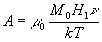 is a
dimensionless amplitude of the external modulation’s projection to the “easy
axis”. Let us denote also M0=Mcosqmin- . The attempt
frequency a0 is usually of order of 109 - 1010
s-1 for fine ferromagnetic particles. More precise expression for
the attempt frequency can be found in [10].
is a
dimensionless amplitude of the external modulation’s projection to the “easy
axis”. Let us denote also M0=Mcosqmin- . The attempt
frequency a0 is usually of order of 109 - 1010
s-1 for fine ferromagnetic particles. More precise expression for
the attempt frequency can be found in [10].
The autocorrelation function has the form [5]:
 . (6)
. (6)
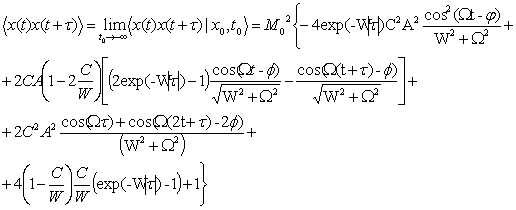
So we
have calculated it for our case in the limit of t0 →∞
: (7)
 .
.
The
averaged over t autocorrelation function is
 . (8)
. (8)
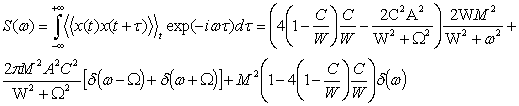
The power spectrum of the system as Fourier transform of the
autocorrelation function is (9)
 .
.
We are interested in values that have physical meaning, so one can
consider the result only for positive frequencies:
 . (10)
Signal-to-noise ratio is defined as ratio of output
power of the signal to output power of noise at frequency of external signal.
So after integrating of the second term over ω and taking noise power at
unity frequency interval near Ω we obtain
 . (11)
The temperature dependence of the SNR continuously reveals well known
nonmonotonous bell-shape form with distinct maximum.
REFERENCES
1. Fauve S., Heslot F.
// Phys.Lett.A. (1983), V.97, P.5-7.
2. Jung P., Hanggi
P. // Europhysics Letters (1989), V.8, N
6, P.505-510.
3. Sadykov E.K.,
Isavnin A.G. // Physics of the Solid State (1994), V.36, N 11, P.1843-1844.
4. Sadykov E.K.,
Isavnin A.G. // Hyperfine Interactions (1996), V.99, P.415-419.
5. McNamara B., Wiesenfeld K. // Phys.Rev.A (1989), V.39, N
9, P.4854-4869.
6. Gang H., Nicolis
G., Nicolis C. // Phys.Rev.A (1990), V.42, N 4, P.2030-2041.
7. Isavnin A.G. //
Russian Physics Journal (2005), V.48, N 5, P.511-515.
8. Isavnin A.G. //
Russian Physics Journal (2005), V.48, N 7, P.694-700.
9. Isavnin A.G. //
Russian Physics Journal (2006), V.49, N 3, P.308-313.
10. Isavnin A.G. // Russian Physics Journal (2007), V.50,
N 5, P.471-476.