Interrelation of tax incentives and the tax potential
This article describes the tax incentives and tax potential Stimulation
of investments through fiscal instruments (tax incentives and preferences)
during the modernization of the economy has become an urgent necessity. It is
necessary to take into account the fact that the tax incentives can reduce the
tax potential. The effect of tax incentives for tax potential can be ambiguous.
For this reason, the government must correctly relate these two categories in
the process of alignment of intergovernmental fiscal relations and the level of
the region's development in the country.
Availability of tax incentives aimed at solving specific problems, and,
above all, is to support the socially vulnerable segments of the population,
stimulation of certain types of economic activity (agriculture, small
business), scope (innovative technologies, charity, philanthropy, etc.) [1].
Regarding the latter reason one can add that it is necessary to develop
and maintain an adequate level of tax incentives in the economy due to the fact
that the implementation of innovative enterprises need free financial resources
that can be released in case of reducing the tax burden [2].
Having noted the need to implement tax incentives, will focus on the
consideration of the concept of «tax incentives».
Tax incentives are a purposeful activity of public authorities and local
self-government for the establishment of tax incentives and other measures of a
tax nature of tax legislation, improving the property or the economic situation
of certain categories of taxpayers [3].
Tax stimulation is carried out through a cost-based system of incentives.
It is a cohesive package of tax incentives and strategic preferences, which is
compensating funds invested in the production of new competitive products, the
modernization of technical processes, to strengthen the foundations of
entrepreneurship and business [4].
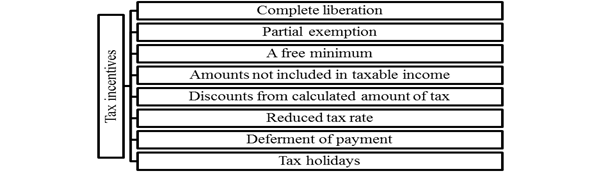
Tax incentives are presented in Figure 1. They themselves will never be
effective in the absence of other systemic mechanisms of protection and support
taxpayers from the government (stability, certainty of tax legislation, the tax
burden is feasible within the general tax regime, the legitimacy of the tax
authorities of the state, fair penalties for tax evasion, etc.).
Figure 1. Types of tax incentives - tax incentive instruments [5].
Therefore, the use of tax incentives as from the government, and by the
taxpayers should be initially valid, comprehensive and thoughtful [6].
In addition to tax incentives, tax preferences may also be a tax
stimulation tool. One will consider the following concepts to get an
idea about the investment tax preferences:
‒
Definition;
‒
Subjects and
objects of investment preferences.
The definition of investment tax preferences could include - a benefit
that provides exemption from CIT and lies in the fact that the value of tax
preferences objects and/or follow-up costs for modernization and reconstruction
are deductible.
Since 2009, the procedure for obtaining tax preferences has been
simplified. If earlier for tax preferences should conclude a contract by the
Investment Committee, now the taxpayer can apply on their own preferences to
obtain prior permission unless necessary. The right to apply the investment tax
preferences belongs only to legal entities, except those that meet at least one
of the following conditions:
‒
Enterprises
operate within the territories of special economic zones (these taxpayers have
the right to reduce the amount of CIT payable at 100%, and they applied the
coefficient of 0 in the relevant interest rates and the average annual value of
objects of taxation on land and property taxes);
‒
Enterprises are
involved in production and / or sale of excisable goods (alcohol, alcoholic
beverages, and tobacco products). The preferences are aimed at the development
of the productive sector of the economy, which in turn is intended to lead to
the improvement of the economic and physical well-being of citizens;
‒
The taxpayer
applies the special tax regime for legal entities - producers of agricultural
products, fishery products and rural consumer cooperatives. This category of
taxpayers applies a special category of CIT incentives, VAT, social tax, land
tax, payment for use of land plots, property tax, tax on vehicles (calculated
in accordance with the established order of the taxes and fees are subject to
reduction by 70%).
The objects of preferences are first put into service in the territory
of the Republic of Kazakhstan buildings and facilities for production purposes,
machinery and equipment, which for at least three tax periods following the tax
period of commissioning, at the same time meet the following conditions:
‒
Recognized as
fixed assets in the accounting records of the taxpayer;
‒
Used by the
taxpayer in activities aimed at generating income;
‒
Not used in the
activities under the subsoil use contract [5].
In addition to the positive effect of the tax stimulation with the help
of tax incentives and preferences, it negatively affects the tax potential.
Tax potential - a potential budget income per capita or resources of the
region budget revenues, which can be obtained by the authorities for a certain
period when used in the country of the same tax conditions [7].
Inclusion in the tax potential
of taxable resources of the region can be represented by two variants:
‒
Are considered only resources to be currently taxable on a statutory basis;
‒
In addition to the above-mentioned resources, there are considered not
involved taxable resources, i.e. objects of the shadow economy, which are required
legalization in accordance with the law.
The first option is more negative impact on the political, economic and
social stakeholders' livelihoods, but in theory can solve some short-term,
current problems. The second option gives you the ability to achieve the
'software', long-term goals. This separation creates a new factor allowing
allocating "tax potential" subcategories, namely, the time factor,
which is expressed in the short and / or long term.
Figure 2. Sub categories of the tax potential, according to the time
factor [8].

The functional capacity of the tax is not taxable or partly taxable
entities that are able to quickly join in the taxation process and do not
require a fundamental change in the legislation. In turn, strategic - entities
that operate outside the law on taxation in connection with the implementation
of informal or illegal activities. Such tax potential requires the creation and
implementation of new or change old laws, as well as improving the future tax
revenues, which will be used for the implementation of any projects and
programs [8].
Tax incentives and tax potential categories are interrelated, because
both belong to the constituent elements of the tax system of the country. The
use of tax incentives in the short term negative impact on potential tax due to
the fact that the taxpayers will be partially or fully exempt from tax and thus
revenue decrease, which will reduce the tax potential of the region. On the
other hand, in the long term, there will be a reverse trend. This is due to the
fact that the tax incentive period is completed, and taxpayers, by improving
their financial situation will pay taxes in the budget in standard mode and
high volume, as their incomes rose.
Summarizing all above-mentioned one could derive that the use of tax
incentives might affect the tax potential, giving the government another tool
to align the intergovernmental fiscal relations and the level of development of
the regions in the country.
References:
1. Ermekbaeva BJ, Abisheva
K. Effect on tax benefits of economic activity in the Republic of Kazakhstan //
Herald TREASURY Series Economical. – 2015, №1 (107). – p.414-418.
2. Timchenko EY Promoting economic development
methods of tax regulation // scientific and educational space: prospects:
Proceedings of the II International. Scientific-practical. Conf. - Cheboksary:
CNS "Interactive plus." – 2016. – p.421-426.
3. Vasiliev SV Legal means of tax incentives
for innovation. Dis. on soisk. Ouch. Art. Ph.D.
12.00.14. - Moscow. – 2009. – p.70.
4. Kireeva EF Tax incentives for innovation as
a factor in the stabilization of the economy of the Republic of Belarus //
development of economic cooperation between the Republic of Belarus and the
Republic of Moldova in the international economy: Proceedings of the II
International scientific-practical conference - Minsk: Belarusian State
Economic University – 2010. – p.68-73.
5. The Tax Code of the Republic of Kazakhstan dated December 10, 2008 №
99-IV (as amended as of 01/01/2017 was). – Almaty: Lawyer. – 2017. - p.436.
6. Ermekbaeva BJ Problems of improving the use
of tax incentive mechanism // Herald TREASURY Series Economical. – 2016, №1
(113). – p.110-115.
7. Lemeshko NS Comparative characteristics of
the tax capacity estimation techniques regions // Economics. – 2012, № 7. –
p.61-63.
8. Simonov Yu Tax potential // Young scientist. – 2014, №1. – p.423-425.