UDK 373:[615.851+004]
COGNITIVE PROCESSES IN PRESCHOOL CHILDREN: A GESTALT -
APPROACH AND INFORMATION TECHNOLOGY
Zhamalieva S.М.,
master of social sciences
Seitbattalova А.S.,
the candidate of pedagogical sciences
Kazakh-Russian
University, Astana s., Republic of Kazakhstan
saltanat-35@mail.ru,
seitbattalovaAS@yandex.ru
Anotation: The peculiarities of
gestalt-approuch, the usage of
information technologies in the development of cognitive processes of senior
preschool age children are considered in this article.
Key-words: gestalt-approuch;
information; senior preschool age; cognitive process.
The
educational system can’t exist outside the foundation of consciousness and the
acquirement of the scientific knowledge
system. There are certain requirements for the
content and functioning of the
educational system which are
considered in many government
documents such as: Educational Development Concept of the Republic of Kazakhstan till 2015
year; Messages of the President Nazarbaeyev N. to the people of Kazakhstan [1]. Basing
the cognitive skills and the stable
habit for studying, the preschool education should provide a high level of personality socialization and personal identity in life..
Analysis
of scientific literature has shown that various aspects of the problem of
cognitive development of children and enhance cognitive and creative activities
of children examined in the works of several authors: Obukhova l. F.,
Nepomnyashaya N.I. Talyzina, N. F., Brunner, J., Sonstrem, E., Donaldson M. S. Papert,
J. Piaget and others.; in studies of domestic psychologists: Sangilbaev O. S.
Andreev, Bajžumanova I.V., Mambetalina, A.S., Nadirbekova A.S.,
Džumažanova G. et al. But at the same time the issues connected with
the cognitive process development of preschool children together with the usage
of gestault - approach and information technologies were not thoroughly examined in
the investigations..
The analysis of the problem shows that, in order to
improve and enhance its efficiency requires elaboration and introduction in
educational process of children of pre-school age this model (Figure 1) and
authoring program that meets modern requirements of education and upbringing of
children of this age period.
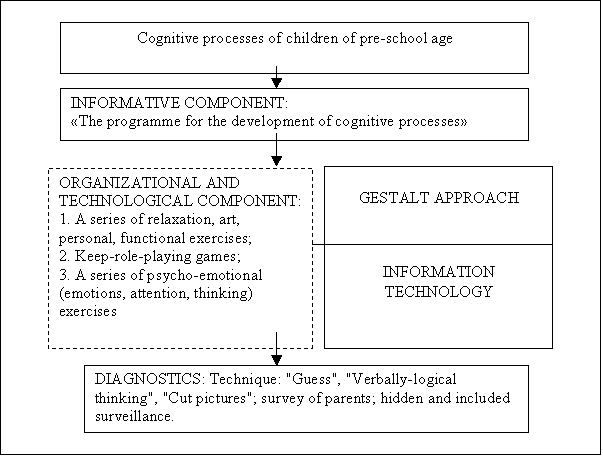
Figure 1. Model:
"Development of cognitive processes of preschool children using the
gestalt approach and information technologies"
The author's program "journey to the land of
self-knowledge was pilot tested in kindergartens and primary schools covering
over 150 children of pre-school age, which enabled us to arrive at the
necessary alignment of the gestalt approach and modern information technology,
influencing the learning process.
Today, a new "living" space for the virtual
world. In a computerized environment among children of pre-school age apparent
non-linear dependence between the level of mental rigidity and properties,
which in regular (non-computerized environment) do not appear or appear weak.
The basic
principle of the use of information technology in the development of cognitive
processes of children-activate the motivation to cognition. The most popular
is: MicroSoft Office PowerPoint; set multimedia courses (lessons learned) with
the animation and sound, recorded on CD; the use of software-based study, the
consolidation of new material for verification and correction works;
application of electronic encyclopaedias and books on CD-ROM for assignments,
exercises, developing communication skills [2]. The proposed information educational technologies variations, based on
the content, the goal of developing programs and accounting individually-age
children.
Gestalt-approach
is one of the leading trends in modern psychology and shares its basic
principles. The gestalt approach is the awakening of the potentially existing
in man natural processes that contribute to the personal growth, reaching
maturity and integrity. One of the key provisions is as follows: "the
whole is different from the sum of its parts" and appears as a result of
their many interactions and emphasizes the importance of subjective perception.
Different
aspects of the problem of children’s
cognitive development and questions of cognitive and creative activity
are analyzed by:
- increase awareness of reflection, existing obstacles
(emotional and personal plan) towards addressing educational problems;
- development of self-control, self-education,
self-education, during joint and independent work of children;
- creates the atmosphere of confidence, assistance and
support;
- helps to reduce or completely eliminate the fear in
children education;
- enhances the credibility of the instructor [3].
To the author's program was the development of the basic properties of
thinking, attention, memory, perception and imagination of children of
pre-school age. In the content of the curricula are
three blocks that perform the tasks to achieve the objectives of the programme.
1 unit – entertainment (contact) – includes children,
focused on the creation of good jobs and secure environment.
2 block-correction-correction-developing + to
cognitive processes.
3 block – entertainment + developing + control.
Control phase allows you to see the effectiveness of the programme.
The following local
psychologists worked over that problem:
1. the adoption of the child such
as it is;
2. no rush, no slow down
gameplay;
3. take into account the
principle of gradual immersion and exit situation that traumatizes;
4. the beginning and end of
classes should be standard to save the child's sense of integrity and
completeness of classes;
5. the game does not comment on
adults;
6. in any game child offers the
possibility of improvisation.
All
classes have a flexible structure, everything different content.
Thus,
in the light of the foregoing, the following conclusions can be drawn: the
application of gestalt approach helps to build the most effective contact with
children; and information technologies in the area of pre-school education are
individually-oriented education and training in the group. Integrated generates
cognitive activity, processes, develops creative ability and skill-learning to
Centre yourself "necessary for the future of learning information in
innovative progress.
We believe that the proposed US model will contribute
to considerable modernization of education children of pre-school age and would
bring it into line with the needs of society.
Bibliography list:
1. Program for
pre-school upbringing and education "Balapan" at the 2010-2015
period. -Almaty, 2010. –p.30.
2. Sejtbattalova A.S.
Organization of distance learning (manual)/. -2008-Pavlodar: Rio -p.103. PPI.
3.
Malkin -Pih I.G. Technicians of a Gestalt and cognitive therapies:
Eksmo; Moscow, 2004