Physics/2 Physics of a firm body
D.f. TH н. Urusova B.I., асп. Mamchueva F.M., Umarova M. H.
Karachaevo - Circassian state university, Russia
The physical nature of return magnetisation of
mountain ores
The purpose of the given work is research of the
physical nature of return magnetisation of mountain ores (gabbroid), rivers
Maryhi taken from a left bank, Zelenchuksky area, Karachaevo - Circassian
republic, number of a borehole 8/1021 and age  .
.
The character, therefore natural magnetisation
has a magnetic field dipole corresponds to a direction of a vector of the
geomagnetic field, existing during formation mountain ores.
In mountain ore (gabbroid) it is possible to explain occurrence of return
magnetisation two hypotheses: 1) the magnetisation self-reference; 2) inversion
of a geomagnetic field. From the first hypothesis follows, that return
magnetisation communication is connected physics - chemical the processes
caused by magnetisation of mountain ore (gabbroid) against a direction of a geomagnetic
field. And from a hypothesis of inversion of a geomagnetic field follows, that
a principal cause of occurrence of return magnetisation is existence in time of
formation of mountain ore (gabbroid) the magnetic field of the Earth which had
a direction return existing. That assumes numerous inversions of a magnetic
field of the Earth. However, this statement it is insolvent, in view of the
magnetisation self-reference.
On Neel [1], thermoresidual magnetisation of
saturation -  , can change the direction at temperature passage through critical points.
Knowing the mechanism of processes of the
self-reference of magnetisation that is: the mechanism operating in homogeneous
magnetic systems and mechanisms characteristic for diverse magnetic systems and
according to theory Нееля follows, that in the first group the basic role
is played by negative exchange interaction of knots А-В
sublattice whereas interactions А-А and В-В can
be both positive, and negative.
Then, a resultant spontaneous magnetisation is a difference of
magnetisations caused by two sublattices A and B:
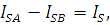 (1)
(1)
Where  - at heats and
  at low temperatures where there is
a self-reference.
at low temperatures where there is
a self-reference.
Change cationing distributions in sublattices A
and B in the course of cooling of magnetic mountain ore (gabbroid) at heats and
after its cooling can be the reason of distinctions in temperature dependences  .
.
In two-and multiphase magnetic systems
self-reference mechanisms sublattice
can be divided on magnetostatics and exchange between phases through their
border.
Calculations have shown, that at small distances between grains A and B is
observed magnetostatics the mechanism. For this purpose, a necessary condition
is non-simultaneous magnetisation of grains of different phases of mountain ore
(gabbroid).
Exchange interaction in diphasic system is
possible only at cristallography continuity of phases, presence of the general
oxygen layers. Thus the self-reference can occur, if  , and, the greatest effect is observed, when a phase A - weak
ferromagnetic, and a phase B - ferromagnetic.
, and, the greatest effect is observed, when a phase A - weak
ferromagnetic, and a phase B - ferromagnetic.
The literature:
1. Neel L. Some theoretical aspects
of rock magnetism.//adv.phys.1955.V.4. №14.P.191-243.