Dr.S.(Phys.-Math.) Sidorov N.V., Teplyakova N.A., Obryadina E.Y.,
Dr.S.(Eng.) Palatnikov M.N.
The
laboratory of materials for electronic engineering, Institute of Chemistry and
Technology of Rare Elements and Mineral im. I. V. Tananaeva of Kola Scientific
Center of Russia Academy of Sciences.184209, Apatity, Russia.
e-mail:obryadina@chemy.kolasc.net.ru, www.chemy.ksc.ru
Structural phase transitions and processes of “order-disorder” in
ferroelectric solid solution of Li0.12Na0.88TayNb1-yO3
The system of solid solutions of the Li0.12Na0.88TayNb1-yO3
(LNTN) with oxygen-octahedral type of structure is of great interest because
the change of the components concentration and the temperature is accompanied
by a variety of structural phase transitions. Thus, on the basis of this system
one can obtain the materials with ferroelectric, superionic and semiconducting
properties and also the one with cross-effects.
Particularly, solid solutions of the Li0.12Na0.88TayNb1-yO3
are promising as materials with high superionic conductivity. When х=0.12 the structure orders in such a way as to make the phase transition
in a superionic state possible. We may vary the temperature of transition and
its degree of fuzziness in wide scope by ranging the order of structural units
in niobium and tantalum sublattice. Besides, when the temperatures equal to 315–350оС
in the Li0.12Na0.88TayNb1-yO3
solid solution we may observe the phase transition from ferroelectric to antiferroelectric
taking place before the superionic phase transition. Temperature dependence of
conductivity and Raman spectra of the Li0.12Na0.88TayNb1-yO3
solid solutions with у=0, 0.2, 0.4 и 0.5 and of the LiхNa1-хTa0.1Nb0.9O3 solid solution have been investigated
(fig 1). Phase transitions in the superionic state were found at the
temperature ~400÷460оС (fig
2). It was found that the superionic phase transition in the LiхNa1-хTayNb1-yO3 solid solution was observed with х=0.125 only.
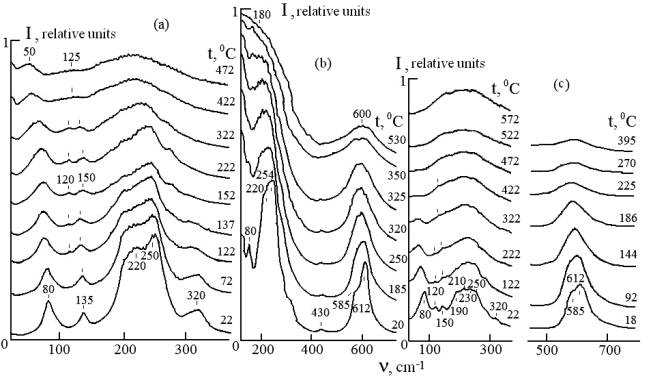
Fig.1. Raman spectra of Li0.12Na0.88TayNb1-yO3
solid solution at different temperatures:
(а) - Li0.12Na0.88NbO3; (b) - Li0.12Na0.88Ta0.2Nb0.8O3;
(c) -Li0.12Na0.88Ta0.4Nb0.6O3
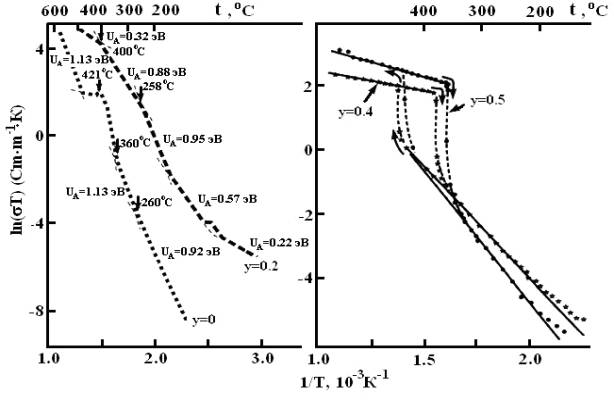
Fig.2. The temperature dependence of the conductivity of Li0.12Na0.88TayNb1-yO3
solid solution with у =0, 0.2, 0.4, 0.5
In the LiхNa1-хTa0.1Nb0.9O3
solid solution with х~0.12 by Raman spectra the
increasing in structural ordering was discovered. It is explained by the
proximity of this composition to a particular concentration point (Li:Na=1:7)
where an increasing of degree of a short- and long-range order in the
sublattice of an alkali metal is likely to be. Since the degree of short-range
order determines significantly the physical properties of a solid solution then
the anomalies of the physical properties may correspond to peculiar
concentration points. In this case it is the superionic conductivity.
While studying at a room temperature the concentration phase transitions
by Raman spectra of Li0.12Na0.88TayNb1-yO3
(у=0÷1) solid solution it was found that the substitution of
niobium ions by tantalum ions with the same radius resulted in structure
distortion and the change of the geometry of the oxygen octahedral with
tantalum ≥0.5. It is evidenced by the appearance of new lines as well as gaps
in the frequencies of certain bands corresponding to oscillations of oxygen
octahedra (500÷700 cm-1). In addition, when у~0.55 the band at 80 cm-1 accorded to the totally symmetric
libration of the oxygen octahedra as a whole disappears and this shows a complete
disorientation of the oxygen octahedra in the solid solution structure.
Materials with a disordered structure are usually characterized by lower points
in the structural phase transition as compared with the materials of an ordered
structure. Thus, by reducing a degree of the long-range order in the sublattice
of niobium when the latter is substituted by isomorphous tantalum cations a decrease
of the phase transition point in antiferroelectric and superionic states is
possible. We can supported it by our investigation of structural arrangements
at high temperature in the Li0.12Na0.88TayNb1-yO3
(у=0.2, 0.4) solid solutions.
In the Raman spectra from the temperature dependence of the band intensity
with frequency 875-877 cm-1 corresponding to the stretching
vibrations of oxygen atoms, there discovered morphotropic phase transitions
between phases with different symmetry of the unit cell at temperatures 100-120оС. At ~315-350оС the phase transition from ferroelectric to antiferroelectric was
observed. This transition manifests itself in the Raman spectra mainly in
disappearance of the band corresponding to the stretching modes of oxygen atoms
of the polar axis which is forbidden by the selection rules for centrosymmetric
octahedron (fig 3). It was shown that the phase transition given refers to the
"order-disorder» type and is caused by the predominant increase in the anharmonicity of cation’s vibrations
in the octahedral cavities of the structure.
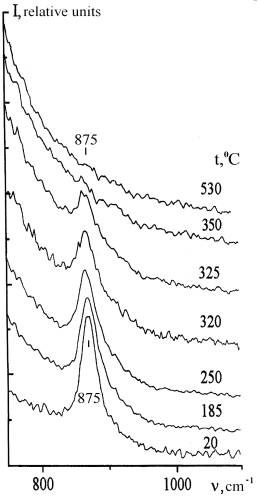
Fig.3. Raman spectra of ceramic Li0.12Na0.88Ta0.2Nb0.8O3
solid solution in the region of stretching modes of oxygen atoms В-О-В in
the ВО6 octahedral anion at different temperatures
It was registered by the Raman spectra that the increase in the vibrational
anharmonicity of all the cations and the translational mobility of Li+
cations with temperature substantionally simplify misorientation of the oxygen
octahedra. It reveals itself in the Raman spectra in the disappearance of the
line at 80 cm-1 corresponding to the librations of the oxygen
octahedra as a whole. In addition, the Raman spectra with the increase of
temperature have a significant, preferential in comparison with other lines of
the spectrum, broadening and a decrease in intensity of lines in the region of 100-160
cm-1 corresponding to the vibrations of the Li+ and Na+
cations in the cuboctahedron and their complete disappearance near the
point of the phase transition in the superionic state. This fact, in our
opinion, corresponds to the "melting" of the alkali metal sublattice at
the phase transition to the superionic state.