Технические науки/5.Энергетика
Kirpichnikova
I.M., Doctor of Technical Sciences, Professor
Vozmilova A.A., Postgraduate student
South
Ural State University, Chelyabinsk,
Russia
THE SYSTEM OF THE HEATING BUILDINGS FOR THE CONTINENTAL CLIMATE
Modern tendencies of power complex
development imply availability of effective solutions concerning contraction of
energy consumption levels. Here belongs the usage of energy-efficient
technologies on the basis of renewable energy sources. One of such solutions
can be represented in the form of conjugation of wind-energy set of vertical-axis type “Wind turbine-3” with the
wattage of 3 kW produced by State Rocket Centre “SRC-Vertical” Ltd. in Miass
city, Chelyabinsk region, and infrared membranous electric heater.
Wind-energy set is a technical device aimed at
conversion of wind power into electric power. The key elements are wind turbine
rotor with impellers, generator component, aerodynamic brake, hub group and
lattice girder (Fig.1).
Lattice girder Hub group Aerodynamic brake Generator component Rotor with impellers




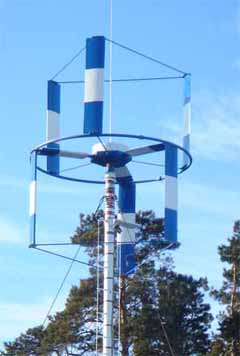
Figure 1. Vertical-axis turbine device
Rotational speed reaches a certain number of turns per minute, with a
further strengthening of the wind, is stabilized by the so-called aerodynamic
brakes, invented by "SRC-Vertical" scientists. To work in cold
conditions, such as in the Far North, the blades are equipped with special
coal-plastic slick, that prevents surface icing of blades. The hub contains a
specially designed bearing system that allows the maximum to reduce the losses
from the moment of resistance.
In the continental climate of Russia, on 16-20 meters mast, the average wind
speed is 5-6 m / sec. Given the optimal location of wind turbine (mountains,
coastal areas of seas and lakes, tundra, etc.), the speed can be up to 6.5 m /
sec. Wind turbine-3 at a speed of 6.5 m / s produces 1 kW of
instantaneous power [1]. This power can be used to energize the slick heater.
Membranous electric heater is aimed at
economical, highly comfortable and effective heating-up of accommodations,
office buildings and industrial enterprises. Heater is a multilayered polymeric
material inside of which a resistive heating unit and an aluminum shield are
integrated. The shield functions as a radiator for temperature equalizing on
the whole surface of the heater and as a radiating element. Heater is only an
element constituent of building up an infrared system of central heating and
separate usage of it and of other elements (heating controllers and heat-reflecting thermal insulator) is not
rational.
The system operation is as follows. When power is applied to the resistive
element, the latter is heated to 40-50 C°. The aluminum screen allows to
distribute heat evenly across the surface of heater. Ceiling surface areas in
this case must be closed with heater
elements on 65%. Further distribution of heat is due to radiant heat exchange (infrared
radiation).
Inside the room the slick is mounted on the ceiling surface and can be
closed almost with any kind of building decoration. Room temperature is
controlled by the thermo regulator manually, automatically
or remotely and requires no special maintenance. If necessary, a slick heater
can be installed in walls and under carpeting.
Heater is plugged-into a three-phase wind
turbine generator with the help of the
primitive regulator which allows to stabilize the constant voltage equalizing
48 V on account of bridging connection of four series-connected electric
accumulators with the voltage equalizing of 12 V. Wind turbine generator voltage due to its variability as to
electrical angle, electric frequency and amplitude changes from 0 to 300 V.
Constant voltage at the voltage regulator output is 48 V.
(Fig. 2).
This scheme allows to provide continual
heating-up of buildings according to construction norms and regulations. It
allows to predict the efficiency of the usage of such a system in wide
application and mass consumption as well. Moreover, it is important to choose
parameters of the wind turbine and heater to match according to their
characteristics.
On-peak loads and operation conditions of the system are characterized
by a considerable power demand – 200 W. per m averagely. Such wattage cannot be provided by accumulator battery
(wind turbine), but it can be obtained through triggering mode. In its normal
mode wind turbine compensated the energy consumed. Besides, it is possible to
heat-up several rooms simultaneously or to diminish the line load during the
activation when using a controller allowing to gradually heat-up the building
on account of successive warming-up.
averagely. Such wattage cannot be provided by accumulator battery
(wind turbine), but it can be obtained through triggering mode. In its normal
mode wind turbine compensated the energy consumed. Besides, it is possible to
heat-up several rooms simultaneously or to diminish the line load during the
activation when using a controller allowing to gradually heat-up the building
on account of successive warming-up.
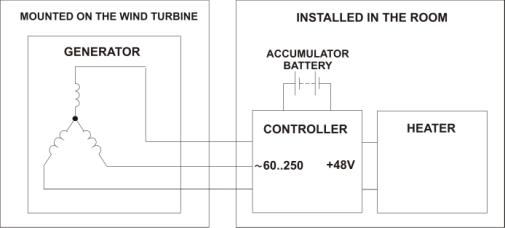
Figure 2. Heater connection scheme
Thus, the system can be divided into two parts:
1) wind turbine-3 - battery;
2) battery - heater;
The presence of a battery in the system is very important. In addition to
energy reserve battery will cover the peak power consumption during system
startup.
Wind Turbine works on accumulator battery. This section of the load
energizing chain is realized with a fairly high degree of difficulty based on
the intellectual controller. Based on the external parameters (battery charging
current, load current, the instantaneous available power), the controller
should ensure optimal operation of the system to be able to provide comfortable
living conditions.
Naturally, the better the room will be thermally insulated, the smaller
will be the magnitude of conductive heat loss and, consequently, the minimum
energy consumption, as in the mode of start-up and working. Therefore, the
maximum degree of insulation – the one of the important factors of high working
efficiency of the "Wind turbine-heater" system.
Directly load (heater) powered by 48
DCV. Heater heated to a temperature +45 0C.
On the surfaces whose temperature is different from + 45 0C, there is radiant heat
exchange. In turn, the intensity of this heat exchange will depend on the
characteristics and geometry of the surfaces themselves, and, specifically, the
degree of blackness (ε) and coefficient of irradiance (φ1-2). The higher the value ε (not to exceed 1) in the infrared spectrum,
the more heat can get the surface involved in the radiant heat exchange.
Coefficient φ1-2 shows the proportion of the
radiant flow incident on the heated surface of the total flow radiated by the
heating elements. This parameter is for all cases of possible arrangement of
surfaces in the room can be determined from the graphical dependences, which
makes it clear that with increasing height space of the room proportion of the
heat flow falling on the floor, decreases, and against to the walls increases.
Heating the room with the help of heaters does not allow drafts. In
addition, the walling must have the highest heat resistance. For this reason,
for example, do not use a system of "Wind turbine-heater" for room
heating with walling based on foam plastic ("fabricated" homes).
Using conventional thermo regulator can lead to an overestimation of the
level of energy consumption, as they have an infelicity of regulation ±2 оC. An increase of the setting temperature on 1 оC leads to an overestimation of energy consumption
by 5%. It is therefore advisable to use digital temperature sensors with
microcontroller control systems. In this case, the infelicity of regulation is ±0,1оC. Also useful to divide at least
two modes of heating. For example:
1) Power Save Mode (12-14 оC). The lower bound must not be
below the dew point. Such a mode will not unfreeze the room and significantly
reduce energy consumption during the absence of people.
2) Comfort mode (19-21 оC). Due to the high growth over a
short period of time creates conditions favorable for human habitation.
Switching between modes can be done remotely through GSM - modules, which
increases the attractiveness of such a system for remote areas. In addition, it
is known that at the infrared heating comfort is achieved at lower air
temperatures (17-18 оC) than at convective heating
method. Also infrared heat dries out the insulation materials, reduces their
coefficient of thermal conductivity, and consequently, lower heat loss than at
convective heat exchange. Running the system at low negative ambient
temperatures determines the largest by value (200 W/m2.) and the duration of peak energy consumption, which is extremely
undesirable. The system should be run at the first stable cooling (late summer
- early fall).
The lack of installed capacity (heating several rooms) is one of the main
problems. Provides several solutions:
- The use of non-priority load disconnection relay (some rooms are heated by
the residual principle);
- The alternate inclusion of rooms on equal intervals;
- The use of 2 or more wind turbines;
- Use of more powerful wind turbine;
- Conjugation of the "Wind turbine-heater" system with other
energy sources (solar battery, diesel - generator, electrical grids);
- The use of the "Wind turbine-heater" system as an additional
heating;
- Use a larger capacity battery;
- Reducing heat losses as well as electrical losses at the energy
transformation.
This heating
system can be applied to heat-up those
accommodations, which are situated considerably far from central heating
systems, electric power supply and gas-supply (country houses, farms, tourist
centers, fishing and hunting husbandries, caravans in temporary villages,
exploration crews, frontier posts and other similar objects). (Fig. 3).

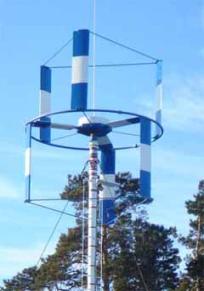
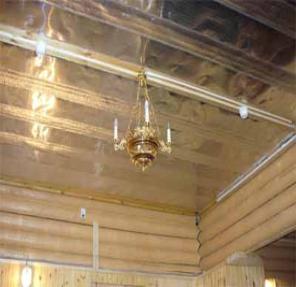

Figure 3. Energizing of infrared slick
heater by wind turbine-3
It is efficient to use this system in cases when expenditures on
traditional central heating-up systems exceed expenditures on the solution of
this problem using wind turbine-heater. This system will be used effectively in
a continental climate, for example, on the North of Russia and Scandinavian
countries such as Finland, Sweden, etc.
List
of references
1. Kirpichnikova, I.M., Solomin E.V. Vertical axis Wind Turbine / / Journal
of South Ural State University “Vestnik”. "Energy" series.- 2008. -
Ed. 10, № 26. - P.15-16.
2. Kirpichnikova, I.M., Solomin E.V. Panasyuk I.N. Conjugation of low power
wind turbine with the slick electric heater for room heating / / Journal of
South Ural State University “Vestnik”. "Energy" series. - 2009. - Ed.
12, № 34. - P.74-77.