ABSTRACT
The principal manufacturers of
light water currently apply the method of distillation in rectifying columns. The
disadvantage of this method is the low separation coefficient. Multiple stages
are needed in order to significantly reduce the deuterium content which makes
the method expensive. We have designed the
electrolytical method with a recuperation unit
which allows reducing by 4-6 power consumption required for producing light
water comparing to rectification methods applied nowadays.
Keywords: deuterium
depleted water, light water, rectification, electrolysis, recuperation system, MHD
generator.
1. INTRODUCTION
The light
water in which the content of deuterium is lower compared to that in standard
mean oceanic water (SMOW D/1H=155.76 ppm) modifies the velocity
of chemical reactions, ions' solvation, their mobility, etc. Taking light water
leads to normalization of carbohydrate and lipid metabolism, weight
improvement, elimination of toxins from the organism. It is determined that the
taking such water improves work efficiency, physical activity, endurance and
resistance of organism [1, 2].
The
Institute of Medico-Вiological
Problems of the Russian Academy of Science has determined that deuterium-rich
water has stimulating effect on the organism' reproduction function and has no
toxic effect on laboratory animals' organisms, and a long use of deuterium
depleted water leads to diminishing the severity of radiation injuries caused
by gamma radiation every day exposure with low doses [3].
The main effect of light water
is a graded decrease of deuterium content in the body's liquids due to isotope
metabolism reactions. The use of water
with low deuterium content results in decrease of this element's concentration
in blood plasma, in erythrocytes and in homogenate of laboratory animals'
hearts. Such changes induce in their turn the decrease of pro-oxydant load in
organism and recover of pro-oxidant/anti-oxydant system balance which is
further accompanied with higher immunity of laboratory animals [4, 5].
2. Existing methods for obtaining light water
The principal manufacturers of
light water currently apply the method of distillation in rectifying columns
[7] which uses the difference in different mass isotopes' evaporation rate
which grows as the atom mass reduces. Light water has the boiling point in
normal conditions at 100.0 °С, while heavy
water's boiling point is at 101.4 °С. The study
describes a deuterium depleted water plant (fig. 1) consisting of the unit
of producing vapor from initial water 1, the unit for feeding water vapor
into the rectifying column 2, the unit of interaction vapor-liquid 3
with a contact device inside 4, of the unit for water vapor condensation 5.
The vapor pressure inside the rectifying column is from 0.05 to 0.6 bar,
the outcome of condensed light water is from 0.001 to 0.25 to the total volume
of water vapor fed through the column. The plant allows industrial production
of light water with the content of 1Н216O no less than 997.13 g/kg and with total content of 1Н217O, 1Н218O, 1HD16O,
1HD17O, 1HD18O, D216O,
D217O, D218O no more than 2.87 g/kg
of the total quantity of H2O.
The disadvantage of this
method is the low separation coefficient due to the complicated process of
maintaining a stable temperature of boiling liquid. Multiple stages are needed
in order to significantly reduce the deuterium content which makes the method
expensive.
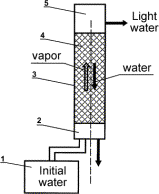
Fig. 1 – Light water producing plant with a
rectifying column
Membranes
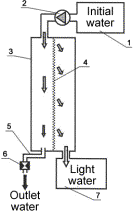
are also proposed to obtain light water [8]. The plant is shown in fig. 2 and consists of
the initial water tank 1, the pump 2 for feeding the initial water
into the filtering element 3, of the vessel 7 and flow regulator 6 in
the form of a laminar resistance. Inside the filtering element 3 the water
flow passes along the membrane 4 axe. Under the pressure amounting from 0.1 to
30 bar some water penetrates through membrane 4 and passes to the
vessel 7 in the form of light highly pure water. The second water flow
bypasses and regenerates the membrane 4, then is fed again to the
discharge 5 via the regulator of flows ratio 6. The produced volume of deuterium
depleted water is from 0.05 to 0.8 of the
total initial water volume. The content of light molecules of 1H216О in the produced light water amounts to no less than
99.734 % of the total quantity of Н2О, the concentration of 17O in the obtained
light water is no more than 372 ppm, and the concentration of 18О does not exceed 1960 ppm.
 The weakness of this
method is a high cost of membranes which require extra pure initial water and
wear out fast, and the method does not enable to reduce the deuterium content
below 117 ppm.
The weakness of this
method is a high cost of membranes which require extra pure initial water and
wear out fast, and the method does not enable to reduce the deuterium content
below 117 ppm.
Fig. 2 – Light water
producing plant with membrane
The crystallization method
allows reducing the deuterium content at most to 136 ppm which is good for
health but not enough for medical application. This method may be used as a
preliminary phase for further refinements.
Multiple other methods are
known which may be used to separate hydrogen isotopes [6], although most
of them have a low separation coefficient about 1.01, others are too
expensive in installation and operation. Thus, there is a need to design a more
cheap and effective method to produce light water.
3. New method for obtaining light water
We have designed a method for
producing water that is poor in heavy hydrogen and oxygen isotopes which bases
on the difference of oxidizing and deoxidizing potentials and kinetic
properties of hydrogen oxido-reducing process from light and heavy water [9-14].
The electrochemical method has been used earlier for the reverse process, i.e.
for obtaining heavy water in nuclear power industry.
The separation is carried out
as follows. Water is electrolyzed when most decomposed molecules are those
containing protium due to lower covalent link strength. Then water is
synthesized from an oxygen/hydrogen mixture rich in protium. In order to
increase the coefficient of separation and to reduce the hydrogen's overvoltage
the electrodes are made of nickel. The plant allows the outcome of product with
any specified depletion down to a very low deuterium content – 10 ppm.
The
method is implemented using various designs [9-14] and, contrary to other
methods permits returning a part of energy back into the production cycle which
importantly reduce the power consumption and thus to reduce the final product
prime cost.
The
energy may be recuperated using the following:
1. Fuel hydrogen/oxygen element [9-10].
The line is equipped with gas mixture separator including a membrane made of
palladium and silver installed between the drying unit and the fuel element,
and the electrolysis gases into water converter is designed as a low
temperature hydrogen/oxygen fuel element with ion exchange membranes providing
that the fuel element is electrically connected to the electrolyzer.
2. Gas turbine [11-12].
Electrolysis gases converter is designed as a high temperature gas turbine the
shaft of which is mechanically connected to that of the generator supplying the
power to the electrolyzer.
3. Magnetohydrodynamic
(MHD) generator [13]. The gas mixture is fed into a magnetohydrodynamic
generator where it is heated, being burned, up to 2700-3000 °С. The formed plasma while passing through a magnetic
field produces electric power supplied into the electrolyzer.
4. Thermoelectrical generator [14].
It is
a leak-tight metal rectangular vessel having inside opposite partitions which
are offset relatively to each other in the way to prolong to maximum the
distance the gas passes. Thermoelectrical modules are fixed to the unit's
surface which converts a part of heat into electrical power by virtue of
Seeback's effect.
5. A
line using simultaneously a magnetohydrodynamic (MHD) generator,
thermoelectrical cooling generator and low temperature turbine [14] is
shown in fig. 3.
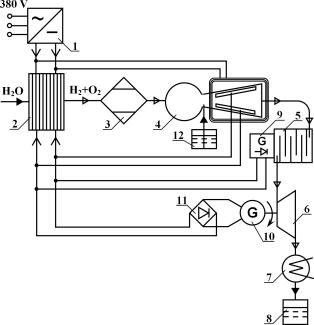
Fig. 3 –
Production line for obtaining light waterusing a MHD generator, thermoelectrical
modules and gas turbine
The alternative current from
an external power distribution network is transformed into direct current by
the power supply 1, then flows to the electrolyzer 2 into which
distilled water is also fed. The mixture of oxygen and deuterium-poor hydrogen
so formed in the electrolyzer, in order to prevent the reverse isotope exchange with water vapors, is passed through the
dryer 3 filled with regenerated water absorbing substance. Then the
dried gas mixture is fed into the MHD generator 4 in which it is heated,
being burned, up to 2700-3000 °С and into which a
salt solution with the salt content required to produce drinking water is injected
from the vessel 10. The salt is ionized at that. The forming plasma passes
through a transversal magnetic field of the MHD generator, and Lorentz force
separates it into a positive and the negative flows which get onto the
appropriate electrodes, and the produced electric power is supplied into the
electrolyzer. The gas temperature is reduced down to 1000-1200 °С. Then water vapor is fed into the cooling generator 5
in which it passes via a coil tubing with thermoelectrical generators attached.
After that the gas is fed into the turbine 6 where it rotates the shaft of
the generator 7 which produces the electric power that is supplied into
the electrolyzer through the rectifier 11. Then water vapors are fed into
the condenser 8 and then to the collector 9.
CONCLUSION
The use of the
electrolytical method with a recuperation unit allows reducing by 4-6 power
consumption required for producing light water comparing to rectification
methods applied nowadays. Thus we may draw a conclusion that in the nearest
time this method will became one of the main ways to produce light water.
This work was supported by the RF Ministry of
Education and Science no. 7.369.2011.
REFERENCES
1. G. Somlyai,
The biological effect of deuterium depleted water. A possible new tool in
cancer therapy, Anticancer Research
Journal. Vol. 21, № 3,
2001.
2. G. Somlyai,
The biological effect deuterium depletion (Budapest,
Akademiai Klado, 2002).
3. D.V. Rakov The effect of water with low content of heavy stable
of hydrogen's isotope of deuterium and oxygen 18О on the development of radiation injuries in case of
gamma radiation exposure at a low dose, Radiatsionnaya biologiya. Radioekologiya,
Vol. 4, № 4, 2006, 475-479.
5. M.G. Barishev, A.A. Basov,
S.N. Bolotin, S.S. Dzhimak, S.R. Fedosov, V.U. Frolov, D.V. Kashaev, D.A. Lysak, D.I. Shashkov, A.A. Timakov
The assessment of antiradical activity of water with modified isotope
composition using NMR, EPR and mass-spectroscopies, Izvestiya RAN. Seriya
fizicheskaya, Vol. 76, № 12,
1507-1510.
6. I.N. Bekman Radiokhimiya.
Razdeleniye izotopov (Moscow: MSU, 2006)
7. Patent
№ 2295493 Russian Federation, IPC C01D5/00, B01D59/00, B01D59/02, B01D3/14. The process method and the
plant for light water production. / S.P. Solov’yev, – priority 28.05.2004.
8. Patent № 2390491 Russian Federation, IPC C01B5/00, B01D59/00, B01D59/12, B01D61/00. The
process method and the plant for light water production. / S.P. Solov’yev, – priority 08.05.2007.
9. Patent № 101648 Russian Federation, IPC B01D59/40, B01J25/02, C01B4/00. Production line
for obtaining bioactive water with low content of deuterium. / V.U. Frolov, M.G. Barishev, L.V. Lomakina,
S.S. Dzhimak, – priority 25.05.2010
10. Patent № 2438766 Russian
Federation, IPC B01D59/40, C01B4/00, C02F1/461. Method for producing bioactive water with
low content of deuterium. / V.U. Frolov, M.G. Barishev, L.V. Lomakina,
S.S. Dzhimak, – priority 25.05.2010.
11. Patent № 97994 Russian
Federation, IPC C02F1/00. Production line for obtaining bioactive water with low
content of deuterium. / V.U. Frolov, S.S. Dzhimak, – priority 25.05.2010.
12. Patent № 2438765
Russian Federation, IPC B01D59/40, C01B4/00, C02F1/461. Method for producing bioactive water with low content
of deuterium. / V.U. Frolov, M.G. Barishev,
S.N. Bolotin, S.S. Dzhimak, – priority 25.05.2010.
13. Patent № 106559
Russian Federation, IPC B01D59/00. Production line for obtaining bioactive water with
low content of deuterium. / V.U. Frolov, M.G. Barishev,
S.N. Bolotin, S.S. Dzhimak, – priority 22.02.2011.
14. Patent
№ 113977 Russian Federation, IPC B01D59/40, C02F1/461. Production
line for obtaining bioactive water with modified isotope composition. / M.G. Barishev,
S.S. Dzhimak, M.A. Dolgov, L.V. Lomakina, V.U. Frolov, –
priority 17.11.2011.