Khodova
A.A., Yerysh L.A.
Donetsk
national university of economics and trade
named after
M. Tugan-Baranovsky
PRINCIPLES
AND STEPS OF RISK-MANAGEMENT
A
substantial body of knowledge has developed around risk management.
In general, risk management includes development of a risk management
approach and plan, identification of components of the risk management
process, and guidance on activities, effective practices, and tools for
executing each component.
Risk
management is the identification, assessment, and prioritization of risks followed by
coordinated and economical application of resources to minimize, monitor, and
control the probability and/or impact of unfortunate events or to maximize
the realization of opportunities. Risks can come from uncertainty in financial
markets, threats from project failures (at any phase in design, development,
production, or sustainment life-cycles), legal liabilities, credit risk,
accidents, natural causes and disasters as well as
deliberate attack from an adversary, or events of uncertain or
unpredictable root-cause.
The International Organization for Standardization
identifies the following principles of risk management:
Risk management should:
·
create value –
resources expended to mitigate risk should be less than the consequence of
inaction, or (as in value engineering), the gain
should exceed the pain
·
be an integral part of organizational processes
·
be part of decision making process
·
explicitly
address uncertainty and assumptions
·
be
systematic and structured process
·
be based on the best available information
·
be
tailorable
·
take human
factors into account
·
be
transparent and inclusive
·
be dynamic, iterative and responsive to change
·
be capable of continual improvement and
enhancement
·
be continually or periodically re-assessed
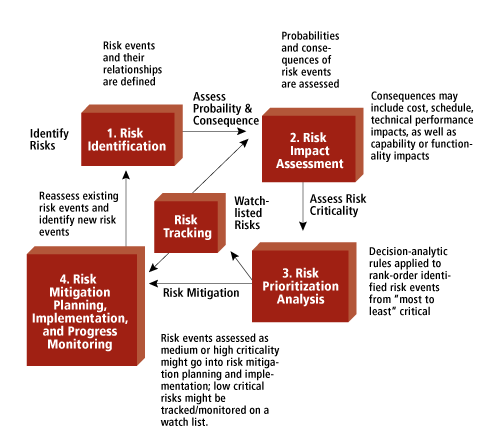
Figure 1. Fundamental Steps of
Risk Management
Step 1. Risk
Identification. Risk identification is the critical first step of the risk management
process. Its objective is the early and continuous identification of risks,
including those within and external to the engineering system project.
Step 2. Risk
Impact or Consequence Assessment. In this step, an assessment is made of the
impact each risk event could have on the engineering system project. Typically,
this includes how the event could impact cost, schedule, or technical
performance objectives. Impacts are not limited to only these criteria.
Additional criteria such as political or economic consequences may also require
consideration. In addition, an assessment is made of the probability (chance)
each risk event will occur.
Step 3. Risk
Prioritization. At this step, the overall set of identified risk events, their
impact assessments, and their occurrence probabilities are
"processed" to derive a most critical to least critical rank-order of
identified risks. A major purpose for prioritizing risks is to form a basis for
allocating critical resources.
Step 4. Risk
Mitigation Planning. This step involves the development of mitigation plans
designed to manage, eliminate, or reduce risk to an acceptable level. Once a
plan is implemented, it is continually monitored to assess its efficacy with
the intent to revise the course-of-action, if needed.
Literature
1.
International Organization for Standardization (ISO)/International
Electrotechnical Commission (IEC), ISO/IEC Guide 73, Risk Management VocabularyGuidelines.http://www.iso.org/iso/catalogue_detail.htm?csnumber=44651
2.
Risk-management http://en.wikipedia.org/wiki/Risk_management
#cite_note-iso3100-5
3.
Risk-management
http://www.mitre.org/publications/systems-engineering-guide/acquisition-systems-engineering/risk-management