Economic Sciences/6. Marketing and Management
Krystyna Sokhanych
Taras Shevchenko National University of Kyiv, Ukraine
Impact of product design at global companies performance
Many of the world’s most successful
brands create breakthrough ideas that are inspired by a deep understanding of
consumers’ lives and use the principles of design to innovate and build value.
How to make design to be a drill for the successful
companies performance? At the very beginning the company should begin involving
design thinkers at the very start of the innovation process, before any
direction has been set. Design thinking will help explore more ideas more
quickly. The company should create an expectation or rapid experimentation and
prototyping. It is important to encourage teams to create a prototype in the
first week of a project and measure the progress with a metric such as average
time to first prototype or number of consumers exposed to prototypes during the
life of a product. [1]
The global companies performance depends on managing a
portfolio of innovation that stretches from shorter-term incremental ideas to
longer-term revolutionary ones. Expecting business units to drive and fund
incremental innovation but be willing to initiative revolutionary innovation
from the top.
Looking for the talents is a very important part of
successful performance in terms of design. People with more conventional design
backgrounds can push solutions far beyond your expectations. You may even be
able to train nondesigners with the right attributes to excel in
design-thinking roles.
In many businesses people move every 12 to 18 months.
But design projects may take longer than that to get from day one through
implementation. Planning assignments so that design thinkers go from
inspiration to ideation to implementation is important. Experiencing the full
cycle builds better judgment and creates great long-term benefits for the
company. (Figure 1)
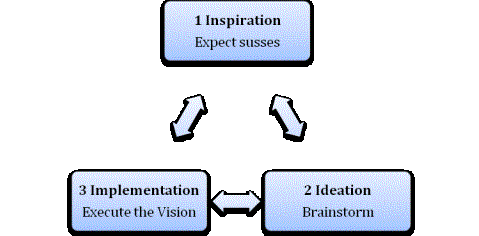
Figure 1. Design thinking process.
Source: Compiled by the
author based on data from [1]
Thinking as a designer can transform the way you
develop products, services, processes – and even strategy. The perfect example
is an Apple corporation, which has been considered a leading designer and
integrator of computer hardware and software since being founded in 1976.
Apple’s success was not just the result of clever strategic moves or an innate
sense of market timing. It came from a deep commitment to understanding how
people used computing devices and a desire to develop “insanely great products
with great design”.
Good design does not always equal good
business. But good business outcomes—especially when the goal is to create new
sources of value in the world—are most often achieved through a well-structured
design process that is more holistic and inclusive than the notion of good
design. [2]
During creation and innovation entrepreneurs with
design thinking define the challenge.
Develop a set of powerful questions to surface opportunities, and frame
innovation.
They gather data and learn how to gather data through qualitative
research such as observation and storytelling to augment traditional forms of
data gathering. Tools include Journey Mapping and Value chain analysis. Managers reframe and clarify the challenge,
which make sense of research by seeing patterns, themes, and larger
relationships between the information. Challenge assumptions and illuminate
opportunities latent within the organization.
They cultivate intuition and develop aesthetic ways of knowing. The
elegant solution wins in the marketplace. Then develop visual thinking skills to de-code images, and
communicate ideas visually. Visual literacy transcends the limitations of
language, and activates our senses. Tools include Mind mapping, sketching
and painting.
They create a visual tangible representation of your idea
and present it to the group for feedback. Create feasibility and an adoption
checklist to get people onboard and exploring alternative futures with
their internal and external customers
Then they gather feedback from prototype. Assess outcomes, and
refine the project.
Create an action plan and test-drive the innovation.
Finally, assess results, modify and improve.
To conclude everything written above I might say that design plays a major
role in a product development as a key success factor which gives any company
an opportunity to have a strong competitive advantage.
1.
Brown T. Harvard Business Review: “Design Thinking” // 2008 – p.8.
2.
Blobmerg Bussinessweek official website – [Online resourse]. – Access: http://www.businessweek.com/