In the given paper laws of water-dissolved gases
distribution in a zone of the slowed down and complicated water circulation of
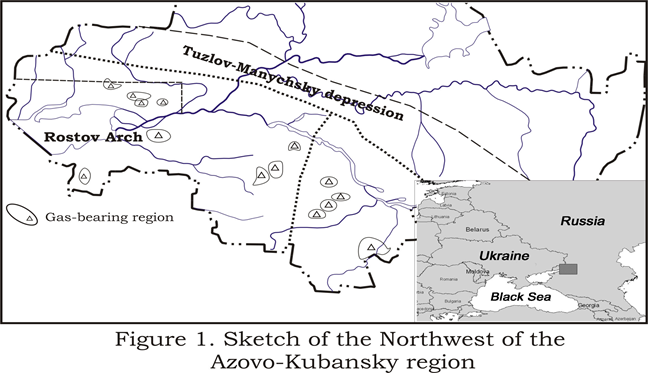
the Rostov arch are considered (Fig.1). The water-dissolved gases concern to a
hydrocarbon class methane type from a Precambrian weathering crust up to
Paleogene aquifer. The certain features distinguish the water-dissolved gases
of a Precambrian weathering crust of the Rostov arch from the Cretaceous
aquifer. In structure of gases prevails methane about 83 - 92 %. Heavy
hydrocarbons concentration is about 0,2 - 0,5 %. High concentration of helium
is a distinctive feature of the water-dissolved gases of the base (about 0,1 -
0,33 %). The Не/Ar factor
is equal here 8,25, that is essentially higher than background values of the
given factor in considered basin. Quantity of the hydrogen and nitrogen is
comparatively high in waters of Precambrian sediments about 1,71 % and 7 - 12 %
accordingly. The structure of gas speaks about the certain Precambrian base
influence on formation of the observable geochemical peculiarities of
underground hydrosphere.

Water-dissolved gas research of the base allows considering this collector not as a part of overlying sediments of the Cretaceous period, but as an independent object of oil and gas exploration. The average maintenance of the water with dissolved gases is 1474 sm3 / dm3 in the Cretaceous aquifer. Its minimal values are observed in the north of Rostov region, maximal quantity is near the Azov deposits. The size of dissolved gases depends on the distance between a point and a gas deposit. The quantity of dissolved gases is reduced in 10 times at removal on 2000 m from the Azov gas deposit, and on the distance 5500 m it is reduced in 30 times. Quantity of the dissolved gases in water is lower in the wells located close to the sub latitude breaks.
Dissolved gas zonation is revealed in waters of Paleogene in considered territory. Its biggest quantity (more than 700 sm3 /dm3) is in the water-dissolved gases of southern and east part of the region. To the north from this zone gradual decrease of dissolved gases is observed. All deviations from this rule are connected with the influence of the gas deposits on gas-dissolved aquifer. At removal from a gas deposit high gas dissolved quantity is kept on up to 2000-3000 m horizontally. While on a vertical, at removal on 15-20 m it is reduced in 1,5-2 times. As the analysis of gas dissolved water has shown the given parameter depends on depth of aquifer. In regional parts of large tectonic elements the chemical compound of the water-dissolved gases changes essentially. Hydrogeochemical conditions are characterized by conditions of a gas deposit formation (growth) within the limits of the Azov structure. Such conclusion is done on the basis of gas deposits water distribution established by Stadnik, E.V. (1992).
Hydrocarbons are prevailing in composition of the water-dissolved gases on the main part of the region. Part of methane takes 60-95 %, and maximum quantity of methane is about 90-95 % on the Azov structure. The average maintenance of methane is about 88 % in Cretaceous aquifer. The highest correlation coefficient is between methane and helium (r = - 0,76). Maintenance of methane in waters of the aquifer decreases (r = - 0,64) with depth. The revealed high negative correlation can be explained by different sources of methane and helium in aquifer. Methane is formed in a biochemical gas zone, while helium collects as a result of migration along tectonic breaks. Methane migrates from beginning Cretaceous into above stratum as a result of absence of reliable barrier in of the given complex. Concentration of helium grows while approaching the foundation and increasing in a degree of closeness stratum systems. Spatial consideration of methane distribution in Cretaceous water aquifer shows its strict differentiation on the area. The maximal concentration of methane is dated for the Azov raising in Cretaceous aquifer. Water contains 90-95 % of methane to the south of the Azov structure up to gas deposits of Krasnodar territory. Further on the east the quantity of methane is reduced on 10 - 15 %. There is a decrease in the maintenance of methane on 4-5 % at removal from gas-water contact on 3 – 4,5 km.
The average maintenance of heavy hydrocarbons in the water-dissolved gases of Cretaceous aquifer is about 1,18 %. Heavy hydrocarbons represent products of thermo-catalytic transformations of organic substance in lithosphere (Kartsev, 1969). The maximal concentration of heavy hydrocarbons is dated for structures of Krasnodar territory where its quantity exceeds 4.0 %. Within the Rostov arch the greatest quantity of heavy hydrocarbons is revealed in a northeast part of the Azov structure (about 2 - 3 %). On the basic part of the territory concentration of heavy hydrocarbons varies from 0,01 up to 0,2 %. Heavy hydrocarbons in aquifer of Cretaceous are absent in the north of the described territory. The high maintenance of heavy hydrocarbons was found on east suburb of the Rostov arch.
Average concentration of nitrogen is 7,7 % in the water-dissolved gases. Nitrogen in gases is genetically diverse. The part gets there from an atmosphere; the part is formed in deposits, waters and oil by decomposition of nitrogen containing organic substances, or has a deep metamorphic origin (Kartsev, 1969). More than 20 % of nitrogen is dated for a joint of the Rostov arch and Tuzlov-Manychsky depression. The maintenance of nitrogen changes from 10 up to 15 % on the basic part of the Rostov arch. Within the limits of the Azov structure change of nitrogen concentration is from 3 up to 10 %. To the south of the Azov arch nitrogen quantity is 5-10 %, the maintenance of nitrogen does not exceed 5 % to the south on structures of Krasnodar territory. Concentration of nitrogen does not exceed 10 % within the Azov arch on distance up to 1000 m from a deposit. Concentration of nitrogen does not exceed 10 % at removal on distance more than 3000 m. Relation between nitrogen and argon shows that air origin of nitrogen gas is insignificant. Studying of nitrogen distribution laws in the described area allows assuming two sources of his formation: bioorganic and metamorphic. His high concentration specifies an appreciable role of metamorphic nitrogen near the break connecting the Rostov arch and Tuzlov-Manychsky depression.
Average maintenance of carbon dioxide is 0,57 % in the water-dissolved gases of the Cretaceous aquifer. In distribution of СО2 severe zonation is noticed. Minimal maintenance СО2 is in the central part of the Azov raising and is not higher 0,1 %. Maintenance of the СО2 grows up to 0,2-0,7 % in process of removal from a gas deposit on 3000 m. Such concentration of СО2 is in the water-dissolved gases of a zone that stretches from a southwest to the northeast. The zone with maintenance of СО2 about 2,3 % in the water-dissolved gases is traced on a southeast. Maximal СО2 maintenance is 10,8 % and it is connected with vertical migration of gas. Concentration СО2 in a high degree depends on depth of aquifer; correlation between these two groups is 0,76. On the basis of this it is possible to speak about it metamorphic origin of СО2.
The maintenance of hydrogen changes from 0 up to 0,02 % on the most part of territory. With increase in depth the increase of hydrogen in the water-dissolved gases (r = 0,60) is observed. Presence of hydrogen at the dissolved gases shows the regenerative conditions of underground waters due to the works of Samarina, V.S. (1977). The highest correlation is observed between hydrogen and helium (r = 0,91).
Cretaceous aquifer concerns to a zone of the complicated water exchange due to the quantity of Не/Ar, and the Azov gas deposit to a zone of rather complicated water exchange. Thus, the analysis of components distribution in the Cretaceous water-dissolved gases allows to forecast oil and gas fields and to speak about prospects of the territory.
The analysis of distribution of attitude Pg/Ppl in Chalk aquifer shows that maximal quality of the given factor 1,00-1,22 is dated to Azov and Birjucheya structures. There is a gradual reduction of this factor to the south. To northeast rate of decrease in the given parameter is much above in comparison with the south. The comparative analysis of Pg/Ppl in the end and beginning of Cretaceous aquifer was held. It was found out that the end of Cretaceous is characterized by the big deficiency of saturation by gases, in comparison with the beginning of Cretaceous.
The maintenance of nitrogen in waters Chalk aquifer varies from 5 up to 8 % on the most part of territory. The average maintenance of nitrogen in waters is 12 %. Concentration of gas increases in a zone of a joint of the Rostov arch and Tuzlov-Manychsky depression till 10-15 %. Hydrogen in the water-dissolved gases of Chalk aquifer is absent on the most part of the territory, or it is found out in the quantities that are not exceeding the 100-th shares of percent. Values of concentration of hydrogen in the end and beginning of Cretaceous aquifer are very close.
Concentration of methane is 90 % and more in Paleogene aquifer on the most part of the territory. The maintenance of methane grows up to 97 % in wells of a southern part of structure. The greatest quantity of heavy hydrocarbons in the water-dissolved gases (3,9 %) is found in structures of the Talovoj area. Moreover, in this well high concentration of heavy hydrocarbons for considered territory was found: in end of Cretaceous it is 4,28 %; in the beginning of Cretaceous it is 2,57 %.
The average maintenance of nitrogen in the water-dissolved gases is 6,9 %. Zonation in distribution of nitrogen in Paleogene aquifer is similar to those in Cretaceous. There is a close correlation between concentration of nitrogen and methane (r = - 0,93). Correlation with other gases is absent. Features of hydrogen behaviour in the water-dissolved gases Paleogene aquifer do not differ from Cretaceous aquifer. The maintenance of hydrogen increases (r = 0.71) with depth.
Concentration of helium within the limits of Azov area changes from 0 up to 0,38 %. The maximal concentration of helium is in the well 1Kasenovskaya in all aquifer: beginning of the Cretaceous is observed at depth 1805 m and is 1,81 sm3/dm3, end of the Cretaceous is studied at depth 1560 m and is 0,53 sm3/dm3 and Paleogene is observed at depth 790 m and is 0,67 sm3/dm3.
The average maintenance of helium in the water-dissolved gases is 0,08 %. The best description of helium behaviour concerning depth is given by polinominal dependence at which the factor of correlation is equal 0,59 (Fig. 2). At other cases this factor is lower. The given dependence is broken by sharp increase in the maintenance of helium near the zone of a joint of the Scythian plate and the East Europe platform. Communication between depth and concentration of a considered element is broken here that can be explained by interrelation between aquifer of different age composing a cut of the given zone. In the water-dissolved gases of Azov oil and gas area the highest correlation dependence of helium is determined for hydrogen. It is 0,92. Helium was studied mainly in the beginning of Cretaceous sediments in East - Predkavkazian oil and gas areas. Its concentration varies from 0,014 % up to 0,638 %, while average maintenance is 0,079 %. Helium is connected by weak correlation dependence only to concentration of nitrogen in the water-dissolved gases (r=0,68).
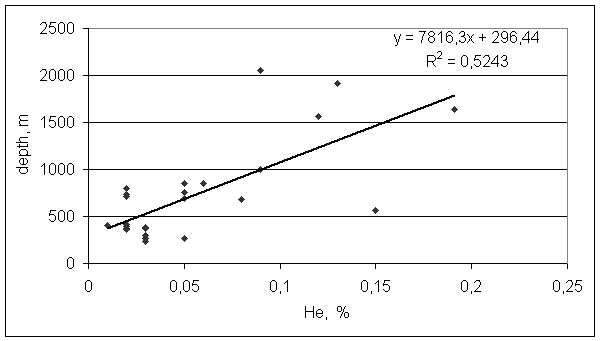
Fig.2. Change of He with depth in the Azovo - Kubansky region, Late
Cretaceous
Gases of Paleogene sediments have a biochemical origin what can be specified by isotope structure δ 13С = -7,03 % (Alekseev, 1978). The maintenance of nitrogen increases with 2,2 up to 26,37 % with increasing of the depth in Chalk sediments.
Migration of hydro carbonic gases is carried out as jets in a collector’s roof, formed directly due to excess of intensity of gas generation over his solubility; liberation of gas from a water solution and at significant rise of the extensive territories containing in a powerful thickness of gas and water saturated collectors according to Vysotsky, I.V. and Vysotsky, V.I. (1986).
Due to the character of gases distribution in Mesozoic and Cenozoic sediments of Azov gas bearing area it is possible to draw conclusions on conditions of formation gas deposits here. A Hydrogeochemical condition of phase balance within the limits of gas deposits of area is characterized by conditions of formation (growth) of a gas deposit (ppl/pg > 1). Such conclusion is done on the basis of laws of water distribution in the gas deposits established by Stadnikom, E.V. (1992). The age of underground waters was calculated in two independent methods – helium - argon and kinetic-geochemical by us. The age calculated by us due to the formula of Pavlov, A.N. (1970) varies from 4 up to 76 million years in beginning Cretaceous sediments. The maximal sizes are fixed near to gas-water contact and there is a decrease at removal from it. Background age is 4 million years. The age of underground waters from the same sediments counted by a kinetic-geochemical method varies from 43 up to 74 million years. Time of the Azov gas deposit accumulation is 4±1 one million years according to geochemical kinetic and was calculated by Reznikov, A.N. and Jaroshenko, A.A. (2001). High concentrations of helium near to a deposit show its connection with a weathering crust of the foundation. Cretaceous sediments are hydro chemically interconnected with foundation in the given area.
The received data are coordinated to geological development history of the region. The trapezoid block of the Scythian plate was pressed between Rostov and Astrakhan ledges Precambrian base on a boundary Miocene and Pliocene, in a time interval of the underground waters age determined by us, (Kopp, 2000). It led to raise Mesozoic and Cenozoic sediments and to liberation of gas in a free phase. Raise of the Rostov arch proceeds now. It is possible to assume, that additional charging of gas deposits proceeds due to the water-dissolved gases. It can be proved by the fact that the authorized stocks of gas on Sinjavskoe deposit are exhausted, but its extraction proceeds in small amounts.
The basic role in formation of deposits Azov gas-bearing area belongs to biochemical processes. Charging of traps proceeds by these gases. Lateral and vertical migration brought the certain contribution to modern geochemical shape of the free and dissolved gases on the part of the Azovo-Kuban depression.
If quantity of saturated gas in underground waters of Cretaceous aquifer is more than 1000 sm3/dm3 it shows distance no more than 500 m up to a deposit; if quantity is 500-1000 sm3/dm3 it means that distance is 500 – 2500 m; if quantity is 250-500 sm3/dm3 it means that distance is 2500 – 5000 m up to a deposit. In overlying Paleogene aquifer these sizes decrease. Attitude Pg/Ppl in underground waters more than 0,5 is a parameter for finding gas deposits. The maintenance of nitrogen in underground waters less than 10 % is observed on distance up to 1000 m from a gas deposit.
References
Alekseev, F.A., Vojtov, G.I. and Lebedev, V.S. (1981) Methane. Moscow, Nedra, 310 pp. (In Russian)
Kartsev, A.A. (1969) The principles of oil and gas
geochemistry. Moscow, Nedra, 272 pp. (In Russian)
Pavlov A.N. About definition of underground waters age
by helium – argon method. (1970) Soviet Geology J.10, 140 – 148. (In Russian)
Reznikov, A.N. and Jaroshenko, A.A. (2001) Definition
of gas and gas condensed deposits
age according to geochemical kinetic. Oil and gas, Stavropol, SevKavGTU, 12 –
25. (In Russian)
Samarina, V.S. (1977) Hydrogeochemistry. Leningrad, Len. State Univ., 360 pp. (In Russian)
Stadnik, E.V. (1992) Water halo of oil and gas
deposits. Theoretical bases of oil and gas hydrogeology. Moscow, Nedra, 161 –
182. (In Russian)
Vysotsky, I.V. and Vysotsky, V.I. (1986) Formation
oil, gas and condensed gas deposits.
Moscow, Nedra, 228 pp. (In Russian)