Педагогические науки/2. Проблемы
подготовки специалистов
Ph.D., Chura M.,
Turakevich
V.
Admiral
Ushakov Maritime State University, Novorossiysk, Russia
EMERGENCY HELICOPTER ESCAPE
TRAINING IN UNDERWATER CONDITIONS
Nowadays we can see the growing tendency of hydrocarbons extraction in the
different areas of the world ocean, including remote outland ones. Mostly the
technology of this process is based on the usage of Mobile Offshore Units (MOUs)
of different types. The development of such kind of technologies in Russian
Federation connected as a rule with a lot of problems. And the most important
one is the training courses for MOUs specialists.
Except the necessary demand of training courses for boring and close
activity specialists IMO (International Maritime Organization)
and some other international organization such as OPITO
(Offshore Petroleum Industry Training Organization) demand
the besic (BOSIET - Basic Offshore Safety Induction & Emergency Training course) and advanced training (FOET
- Further Offshore Emergency Training course) suitable for the emergency
situations on MOUs. The solid part of these courses is (HUET - Helicopter
Underwater Escape Training).
According to IMO А.891(21) [1], Resolution offshore personnel are for
practical reasons, divided into four categories:
Category A: Visitors and
special personnel not regularly assigned who are on board for a limited period
of time, in general not exceeding three days, and have no tasks relating to the
standard operations of the unit.
Category B: Other special
personnel without designated responsibility for safety and survival of others.
Category C: Regularly assigned special personnel with designated
responsibility for the safety and survival of others.
Category D: Maritime crew members.
All the personnel categories should have the preliminary training course
of the personal survival and safety on unit’s board. The members of regular personnel
(category B, C, D) should have the following training courses of personal
survival, such as: fire safety and firefighting courses, first aid courses,
general personal safety and other survival courses. Special training courses should
be provided for crew members according to the responsibility in emergency
situations (mostly category C and D). The training
courses are delivered in accordance with the requirements of International Convention
on Standards of Training, Certification and Watchkeeping for Seafarers
(International STCW Convention) [2] and other international and national
normative regulations [3-5]. The methods of demonstration and competence levels
(criteria) are laid in minimal standard specifications of professional
experience [1] of such areas as personal survival, fire safety and firefighting
experience, first aid and etc. One of the requirements meeting the professional
experience standards in personal survival area is the training for the use of some
available methods in emergency helicopter escape including practical training.
Helicopter transportation is usually used for crew members and other
specialists delivery on unit’s board in the extraction area. The most part of helicopter
flight is going on over the open sea surface and it is of course a risk of some
emergency situations connected with the technical damage. Such kind of emergency
situations may turn into very serious ones.
The problem of emergency passengers and crew members escape in case of
water emergency landing is undoubtfully topical. It is tightly connected with
the off shore removal, North latitude conditions and some constructional features
of a helicopter.
There are some technical specialties in helicopters’ construction: small
width, non-hermetic fuselage, high position of the centre of gravity caused by
air-screw presence. Bad-balanced stability position on the water surface may
cause heeling, overturn and sinking. As a rule it happens for a short period of
time and makes the escape rather difficult. That’s why the training experience of
personnel to perform emergency underwater helicopter escape is very important.
According to the above mentioned requirements Helicopter Underwater
Escape Training (HUET) is regularly held on the base of Shore Training Centre, Admiral
Ushakov Maritime State University from 2010. The training course aims to
emergency underwater escape and provides the following skills [6]:
·
usage of special hydro-equipment;
·
usage of Escape Breathing System (EBS);
·
the order of emergency underwater escape;
·
the usage of rescue equipment;
·
basics on water survival.
The Training
Planning [7] considers the theoretical and practical part of the program. The theoretical
part includes emergency situations’ description which may happen while personnel
of MOUs helicopter transportation, especially in case of emergency on water
landing, the description of rescue equipment of a helicopter and its usage in
emergency situations.
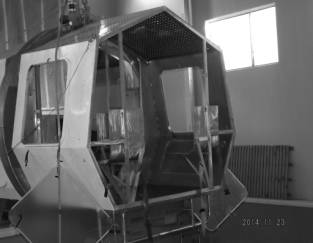
The Training course
applicants get the main purpose of future training program. They study the main
features specialties of a helicopter cabin’s floating abilities, its characteristics
before the practical training with a helicopter cabin model in the survival
pool (pic. 1).
|
|
|
|
Pic. 1. |
Pic. 2. |
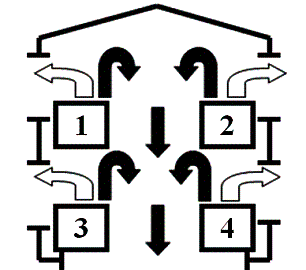
There is a scheme of a helicopter cabin model on picture 2. The numbers of
seats are marked by figures. The emergency escape ways are marked with white pointers. The black ones
mark the exit ways in case of a non-standard situation or interference of an
available diver. In such situation the emergency exit should be performed through
the tail part of a cabin.
The helicopter
crew and passengers activity for emergency underwater escape is analyzed.
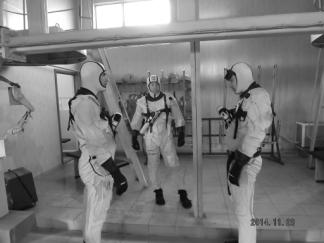
Before the survival pool training the applicants train the ability to use
safety belts fixation, self-concentration ability and right usage of emergency
exits (pic. 3).
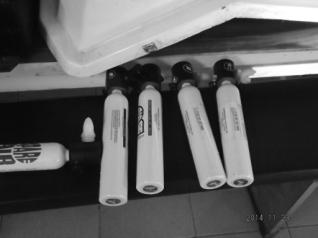
The practical survival
pool training begins with the usage of EBS (pic. 4), on the water surface and
underwater positions. The part of training with the helicopter’s cabin model is
available for applicants experienced enough to use EBS and to orientate in the
underwater position.
|
|
|
|
Pic. 3 |
Pic. 4 |
It is very important
to consider the psychological aspect of draining and ability to control the
breathing on EBS usage. The training performs with the different degrees of
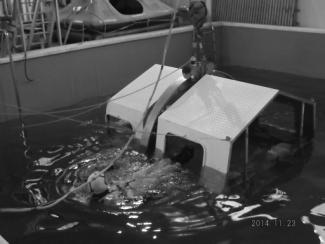
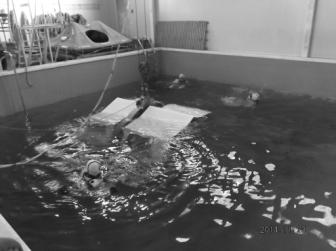
helicopter’s cabin model sinking. From semi-submergible (pic. 5) up to full submergible
position (pic. 6).
|
|
|
|
Pic. 5 |
Pic. 6 |
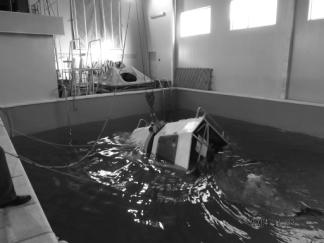
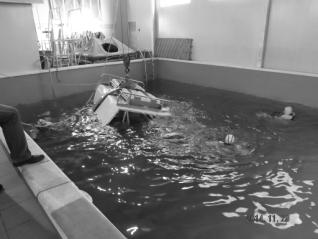
The final
training test is emergency exit out of sinking cabin with the necessary turn
over in 180° (pic. 7, 8). The training prevents to lose orientation in under
water position. It is also necessary to perform this test in no light
conditions which coincides with the real conditions to full extent.
|
|
|
|
Pic. 7 |
Pic. 8 |
The seats in a helicopter’s cabin model are pointed by the instructor. It depends on applicants’ experience on
EBS usage. The most experienced applicants take the head
seats (№ 1, № 2), the least ones take the tail part seats (№ 3, № 4 near to
emergency exit).
It should be
taken into special consideration the order of activity while performing the
training. For example: the safety belt should be unfastened only after
emergency exit activation. In other case extra floating ability caused by the
air presence in hydro suit can prevent the ability to use the emergency exit
way. The right body position with back direction to emergency exit provides the
positive effect on the emergency escape process.
Considering the results of this training test the instructor makes a
conclusion on final attestation of applicants. In case of mistakes in training performance
there is an opportunity to repeat the test.
The special features of equipment and special conditions of the survival
pool training demand the special attention performing this training test. The real
danger can be caused by not only a human factor but equipment failure
probability. The applicants are given safety instructions before the training
test and informed about emergency activity. The necessary condition of this
training test is diving equipment providing.
The training should be performed by a certified instructor having both
theoretical and practical experience in good physical fit in order to
demonstrate the right performance of training.
For the best results achievement there should be not more than 5 - 8 persons
in group if it is not settled in program.
The above mentioned features of the training test performance may cause
difficulties with EBS usage (about 10% of applicants). These difficulties connected
with phsychoemotional state of an applicant. It is possible to rectify them by numerous
performance of the training test in deep underwater position in survival pool.
Analyzing the features of this training course we can make the
conclusion that the necessary conditions for successful training performance
are the strict instructions fulfillment, the performance of training tests in the
survival pool and consideration of every applicant personal abilities.
It’s necessary to train the experience of emergency escape
up to automatical level for the personnel using helicopter transportation
constantly. It necessary to underline that not all kind of emergency situations
can be simulated on a model equipment but even the elementary experience can
provide life safety and what’s very important to reduce greatly the injuries
level.
Literature
1. IMO Resolution A.891(21)
adopted on 25 November 1999 Recommendations on training of personnel on Mobile
Offshore Units (MOUs)
2. International Convention
on Standards of Training, Certification and Watchkeeping for Seafarers
– 1978 (International STCW Convention, 1978) - СПб.: ЗАО ЦНИИМФ, 1996 – 552 с.
3. Concolidated
text of the International Convention for the Safety of Life at Sea – 1974 (International
SOLAS Convention, 1974) – СПб.: ЦНИИМФ, 1996 – 758 с.
4. International
Life – Saving Appliance Code (International LSA Code). – СПб. : АОЗТ ЦНИИМФ, 1996 –
156 с.
5.
Наставление
по борьбе за живучесть судов Министерства морского флота Союза ССР НБЖС РД
31.60.14 – 81. – М.: В\О «Мортехинформреклама», 1983 – 200 с.
6.
Чура
М.Н. Начальная подготовка по вопросам
безопасности для всего персонала МПУ, включая подводный выход из вертолетной
кабины. Материалы научно-практического семинара «Подготовка персонала
морских установок по добыче углеводородного сырья на континентальном шельфе
Российской Федерации» – Новороссийск: РИО МГА имени адмирала Ф.Ф.Ушакова, 2010 – 54 с.
7.
Рабочая
программа «Helicopter Underwater Escape Training (HUET)». – Новороссийск.: МГА имени
адмирала Ф.Ф.Ушакова, 2010 – 6 с.