Ph.D. S. Nurushev
Kostanai
state University A.Baitursynov .
Working body milling form justification.
The most significant drawback of milling of soil
cultivation tools is the high energy consumption and low productivity . One of the elements that determine
their power capacity and productivity
is the form of active working body (
blade) , because it affects the way to the formation of soil cuttings of a
certain size .
KGU named
after A.Baitusynov conducted research
in order to justify the form of T-shaped
experimental blade, which have right and left side folds on one leg ,
and perform the functions of both right -hand and left-hand serial Г-shaped blades mounted
separately on the disc milling cutter drum.
When separating the two serial blades supply half hour right blade passes
through the already preliminarily
clipped by leg left-hand blade (picture). It turns out that half of the supply portion AKE cut twice . In
view of the different sharps left and
right leg conditions for subsequent blade is not made easier, because leg working in a continuous medium with
considerable friction.
Total cut surface can be determined :
F =Fshear + Ffriction
+ Fbend=2h(S+δ bH)
δ - Coefficient taking into account the
difference between the milling depth and length cycloid site. According to Sonne, Ɛ = 2.
h - Depth of processing
bH - Width of the working body.
S - Submission on the
blade.
The disadvantage is eliminated by using a T-shaped
blade having a right -hand and left folds on one leg , for whom the square cut:
F = Fleg +Fshear=h(S+2
δ bH)
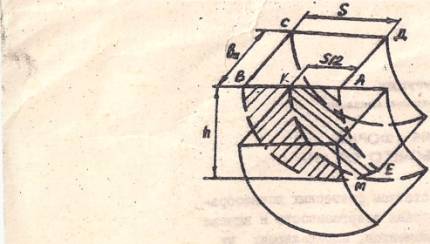
Scheme of formation of soil chips
Consequently , the surface cutting and thus the energy
consumption will be reduced by reducing
the area of the shear of blade leg .
Taking the ratio of expressions using the formulas (I) and (2) and
preformed it, we obtain :
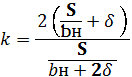
Analyzing this relationship , we can conclude that cutting surface , and hence the energy
intensity of the milling process can be reduced by increasing the permissible
limits agricultural needs by ratio S/ bH and by reducing the area of
the shear of blade leg , which is confirmed by experimental
studies . Thus, data of
comparative tests show a reduction of
specific energy consumption milling soil I, I - !, 2 times experimental working
bodies compared with serial.