Nabiyev
N. K.1, Zhubanazarov D.M.2
1Cand. of Eng. Sci., The JSC «National Company «Kazakhstan Gharysh
Sapary», Kazakhstan
2Master's Degree student, L. N. Gumiliev Eurasian National University,
Kazakhstan
The main stages of circuitry design of data transmission systems
Data
transmission systems (DTS) widely applied the microprocessor equipment are the
typical representative of territorially distributed information computation
systems. Such systems provide improvement of automated systems of control,
design, office activity and various systems in military area. DTS saturation by
microprocessors causes increase of their "intelligence" in technical
aspect and sharply expands areas of their use in the flexible automated
structures.
The
Microprocessor-based Data Transmission Systems (MDTS) represents a basis for
creation the local computing systems with the distributed information
processing. The last ones are created as a final stage of development of
territorially dispersed computers complexes of different types covering small
territories (to 10 km) in various buildings, the organizations, the enterprises
etc. [1, 2].
At
the present time there are two main directions in design process of MDTS. The
first is guided by the theory concept of data transmission networks, the second
defined by the physical concept of less difficult distributed MDTS. The first
direction is characterized by the relation to efficiency and ways of its
assessment. Thus, efficiency of MDTS is understood as that positive impact
which MDTS has on internal and external indicators of a LAN. The concrete
maintenance of MDTS fades into the background; superiority gets a way of an
assessment of MDTS contribution in work of a LAN as a whole. The second direction is mainly characterized by the physically measured parameters of efficiency criteria in which
users are interested, such as capacity, real time of information transfer,
number of stations in a LAN, etc. Such real indicators are usually set in the
form of basic data for design and allow defining a main objective of LAN creation.
An additional point is that such indicators take into account the nature of
interaction of elements, paths in and between stations on the scale of a LAN. In
this behalf, physical contents and characteristics of MDTS and a LAN are the
principal points.
According
to abovesaid, the methods of the analysis and synthesis cover the complicated
multilevel system containing thousands of functional knots interfaces, paths of
a reception-transmission, the control of a monochannel condition, the management
of access to the monochannel etc. Whereas it is quite complicated issue, now
therefore it is solved because of multi-stage circuitry design of products.
Figure 1 depicts
the scheme displaying the process of circuitry design of MDTS with the general
communication channel. This process begins with setting the demanded technical and
operational indicators of LAN, MDTS and stations. The right choice of indicators
is extremely important, considering that mistakes lead to considerable material,
temporary and other expenses in the course of creations and the subsequent
operation of system.
At the level of
design solutions of a LAN the following indicators have special value: cost
index, temporary and sustainable indicators. Function of these indicators is to
provide clarity and unambiguity of the formulations describing offered LAN.
Therefore, at the first design stage it is possible to carry to cost indexes
such, as the given costs of transfer and the information processing, full costs
of introduction in operation and ensuring operability of a LAN, costs of MDTS
creation and transformation of information in it, etc.
One
of the methods of ensuring fault tolerance is the organization of optimum
redistribution of resources at refusals in stations and subscriber systems. As
assessment of functional degradation of a LAN the percent of reduction of
represented resources and information losses owing to indistinct work of MDTS.
For
estimating the dynamic properties of LAN such indicators, as time of delivery
of information to destination, time of the solution of a task on this
subscriber equipment with attraction of resources of other subscriber means, an
answer waiting time at transfer of texts, transaction time at selection of a
certain record of memory of the local database placed territorially on removal
from this subscriber means, etc. are applied [3].
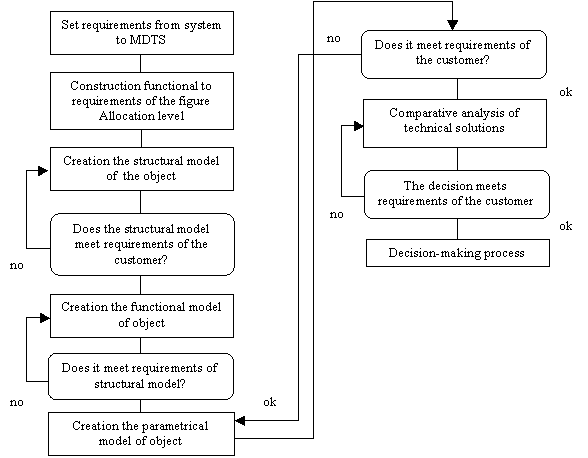
Fig. 1
On
the basis of structural model functional and parametrical models of objects are
developed. For example, on the most top stratum of model – MDTS stratum – the
structural model represents the schedule with temporary indicators t describing
interaction of stations A, B, C (fig. 2). In compliance with this structural
model, on the same stratum formed the functional model that displays interaction
process of elements of model by means of algorithm (fig. 3). Then
transformation to the parametrical model displaying key parameters by which it
is characterized the stratum at this level of the description of system is
made. For the work with MDTS the following indicators of work quality are often
used: the territorial dispersion which is expressing in length of connections
between stations, number of actively working stations in MDTS, a ratio of stations
cost and MDTS equipment as a whole and costs of the terminal subscriber
equipment, information transfer time from the sender to the recipient taking
into account the set method of service of the monochannel from station, the
volume of turn of messages in each station.
Transferring time
and volume of messages turn in paths of stations are interconnected and depend
on a method of control over access to the monochannel and indicators of
hardware means realizing it. It is the main dynamic quality criteria of
stratums; it depends on two major factors of dynamics of influence a tractor in
MDTS. The number of the conflicts belongs to the first factor in case of
application of a method of the competition between stations and a waiting time
of receipt of a marker of go-ahead transfer in case of application of the
centralized form of government by LAN stations. The number of unserved stations
belongs to the second factor owing to a monochannel overload. Thus the increase
in transferring time of shots owing to growth of number of the conflicts and the
related pauses of expectation or a waiting time of a marker of go-ahead
transfer causes increase in number of unserved messages, i.e. eventually – turn
lengths.
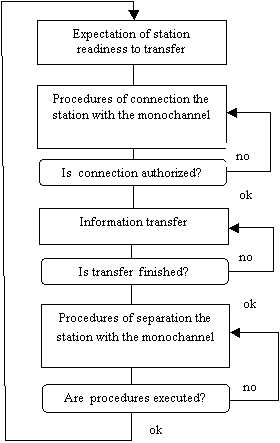
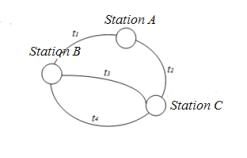
Fig. 2 Fig.
3
Further
process of design is reduced to a choice of the next stratums of station, paths
and station elements. On every such stratum, as in the previous case,
functional, structural and parametrical models of objects are formed.
The
whole process of design is considered as a process of introduction of structure
in a certain functional model. On this aspect, two types of structures are
considered: virtual and real. The virtual structure is set by means of the
description in stratums and layers, and real one is the result of decomposition
of virtual structure on real subsystems (schemes). It reflects the made
structural decision in each design stage.
Though
this technique is considered by authors for decision-making automation in the
course of design of the stations equipment, it can be used in software design of
stations regarding communication protocols at the top levels of interaction of
subscriber systems.
Thus,
the rational circuit decision of quite complicated system as MDTS can be
received only on the basis of synthesis and the analysis of structural
technical solutions and repeated modeling by means of the multilevel stratified
model in the direction "from top to down" and vice versa. Recurrence
of modeling causes wide using and application of computer facilities in a
dialogue mode of the user with models on every stratum. Dialogue is caused by the
fact that the majority of technical solutions on stratum borders is accepted on
the basis of heuristic reasons, i.e. a creative career.
References:
1.
Bertsekas D. Сети передачи данных / Bertsekas D., Gallager R. – пер. с англ. – М.:
Мир, 2003. – С. 562. Bertsekas D., Gallager R. Data Networks. – Prentice Hall,
1987. – P. 486.
2.
Grigoriev V.А., Lagutenko О.I., Raspaev Y.А. Сети и системы радиодоступа. – М.:
Эко-Трендз, 2005. – С. 384.
3. Olifer
V.G., Olifer N.A. Основы
сетей передачи данных. – Интернет-университет информационных технологий, 2003.
– С. 248.