Agricultural sciences / 3.Agriculture, Soil and Agricultural Chemistry.
C.-agricultural
sciences. Yust N.A. postgraduate Gorbacheva N.A.
C.
agricultural sciences. Shelkovkina N.S.
Far Eastern State Agrarian
University, Russia
Increasing the fertility of irrigated land
Guaranteed yield of crops on
reclaimed land is possible with the introduction of technologies of
reproduction of soil fertility through the systematic application of mineral
fertilizers. A case of acute shortage of fertilizers can be used Ashes. For
example, the use of ashes to compensate the lack of manure, compost or other
organic fertilizer that helps to increase the stock of matter and improve soil
physical properties.
Globally, agriculture soybeans ranked first among the grain legume crop area, it has been cultivated in more than 70 countries around the world. In the Russian Federation, more than 80% of the soybean acreage is concentrated in the Far East. This is traditionally the main areas planting soybeans - Amur region, Primorsky Krai
and Khabarovsk territories. However, against the backdrop of deep economic reforms there was a decline in the production of agricultural- natural crops.
This is due to reduced acreage area,
reduced soybean yields and falling natural soil fertility. A powerful factor in
increasing crop production is land reclamation, especially in difficult
climatic conditions of the Amur region. Field experiments were conducted at the
experimental field (p. Gribskov), Amur Region and were accompanied by
observations and taking into account studies conducted in compliance with the
requirements of methods of experimental work. Laboratory experiments were
conducted in an experimental laboratory Institute of soybeans.
Group experiences - irrigation
regimes soy and application rates ash and slag waste, held in 2011 includes:
-
the study of the influence of soil water regime on crop yield in three
variants preirrigation limit of soil
moisture threshold of 60, 70 and 80% of the HB and the control variant -
without irrigation; - Study the effectiveness of making ash doses of 40 and 60
t / ha as chemical meliorants.
The experience was carried out
according to the procedure of field experience. When sprinkling accommodation
options - random. Repeated experience 4 times. The area of the experimental
plot - 26 m2. Studies were accompanied by observations, accounting
and research performed in compliance with the requirements of methods of
experimental work B.A.Dospehova, V.N.Pleshakova, P.G.Naidin [1,2,3].
Water consumption of soybean was
determined by water balance A.N.Kostyakov [4].
Soil moisture was adjusted thermo
gravimetric-gravimetric method, the timing of irrigation - to reduce the
pre-irrigation moisture of the soil to the desired level. Number of feed on the
water when watering irrigation accounted for by the rain gauges F.F.Davitaya.
Repeated experience 4 times .Method of irrigation - irrigation. The depth of
the active layer is controlled irrigation soil moisture of 0,3 m.
The calculated dose of ash and slag waste was determined by the
balance method, based on the account of the natural fertility of the soil.
The initial data to take the
necessary amount of nutrients spent on education a certain level of
productivity, as well as the coefficients of their use of the soil and
fertilizers. Gribskovs boiler
house ash and slag waste have contains a variety of chemical elements. The chemical and mineral composition
of ash depends on the composition of the mineral fuel. Spectral analysis ash
samples on the elements 11 shows that the ash content is: bismuth - at
428,6 times lead – 62,5, arsenic – 48,8, boron – 31,8 molybdenum - 14, 5 times
higher than the earth's crust. The most valuable agronomic standpoint elements
Mo, V, Zn, K sol contains significant amounts of Ca and Mg - in sufficient.
Scheme of field experience - irrigation regimes soybeans and fertilizer
application rates are presented in table 1.
Table
1
Scheme of field experience in 2002-2004.
|
Numbervariants |
Pre Irrigation Soil
Moisture % NH |
Soil Layer |
Planned yield t / hect |
Doses of mineral fertilizers |
|
1 |
80 % НВ |
0,3 м |
|
Control (withoutmakingany) |
|
2 |
0,3 м |
2 |
N15P30K20 |
|
|
3 |
0,3 м |
2,5 |
N60P60K50 |
|
|
4 |
0,3 м |
3 |
N105P90K80 |
|
|
5 |
80 % НВ |
0,3 м и 0,5 м |
|
Control (withoutmakingany) |
|
6 |
0,3 м и 0,5 м |
2 |
N15P30K20 |
|
|
7 |
0,3 м и 0,5 м |
2,5 |
N60P60K50 |
|
|
8 |
0,3 м и 0,5 м |
3 |
N105P90K80 |
|
|
9 |
80 % НВ |
0,5 м |
|
Control (withoutmakingany) |
|
10 |
0,5 м |
2 |
N15P30K20 |
|
|
11 |
0,5 м |
2,5 |
N60P60K50 |
|
|
12 |
0,5 м |
3 |
N105P90K80 |
The result of biological and
biophysical processes that occur in plants, is productivity [5].
In experiments with different doses
of mineral fertilizers on the average years of research yields were as follows:
the minimum value obtained in the third mode of irrigation – 1,43– 2,05 t / ha, the maximum value of the yield was
obtained at 2 irrigation regime – 1,56 – 2, 34 t / ha, with one mode of
irrigation were collected 1,49 – 2,18 t / ha of soybean (tablitsa2).
Table 2
Soybean yield, t / hect
|
Variant |
Planned yield, t / hect |
2002 |
2003 |
2004 |
Themean |
|||||||||||||||||
|
Crop yields |
profit, % |
Crop yields |
profit,
% |
Crop yields |
profit, % |
Crop yields |
profit, % |
|||||||||||||||
|
layer 0 - 0,30 м |
|
|||||||||||||||||||||
|
Control |
|
1,71 |
|
1,11 |
|
1,65 |
|
1,49 |
|
|
||||||||||||
|
N15P60K20 |
2 |
1,98 |
15,8 |
1,29 |
16,2 |
1,90 |
15,4 |
1,7 |
14,1 |
|
||||||||||||
|
N60P90K50 |
2,5 |
2,36 |
38,0 |
1,32 |
18,9 |
2,25 |
36,4 |
1,98 |
32,9 |
|
||||||||||||
|
N105P120K80 |
3 |
2,65 |
54,9 |
1,38 |
24,3 |
2,51 |
52,1 |
2,18 |
46,3 |
|
||||||||||||
|
layer 0 - 0,3 м и 0 - 0,5 м |
|
|||||||||||||||||||||
|
Control |
|
1,79 |
|
1,10 |
|
1,78 |
|
1,55 |
|
|
||||||||||||
|
N15P60K20 |
2 |
2,05 |
14,5 |
1,31 |
19,1 |
2,07 |
16,3 |
1,81 |
16,7 |
|
||||||||||||
|
N60P90K50 |
2,5 |
2,58 |
44,1 |
1,34 |
21,8 |
2,61 |
46,7 |
2,18 |
40,6 |
|
||||||||||||
|
N105P120K80 |
3 |
2,81 |
56,9 |
1,39 |
26,4 |
2,81 |
58,1 |
2,34 |
51,0 |
|
||||||||||||
|
layer0-0,5 м |
|
|||||||||||||||||||||
|
Control |
|
1,68 |
|
1,09 |
|
1,53 |
|
1,43 |
|
|
||||||||||||
|
N15P60K20 |
2 |
1,89 |
12,5 |
1,26 |
15,6 |
1,74 |
13,7 |
1,63 |
13,9 |
|
||||||||||||
|
N60P90K50 |
2,5 |
2,30 |
36,9 |
1,29 |
18,3 |
2,05 |
34,3 |
1,88 |
31,5 |
|
||||||||||||
|
N105P120K80 |
3 |
2,54 |
51,2 |
1,32 |
21,1 |
2,29 |
49,5 |
2,05 |
43,4 |
|
||||||||||||
|
|
НСР05 = 0,12 НСРа= 0,06, НСРв=0,07 |
НСР05 = 0,02 НСРа =0,01 НСРв = 0,01 |
НСР05 = 0,11 НСРа = 0,05 НСРв = 0,06 |
|
|
|||||||||||||||||
Improvement of mineral nutrition of soil creates
favorable conditions for the better use of irrigation water plants, thereby
increasing the efficiency of irrigation. Studies have shown that under
conditions of natural fertility of the soil grain yield of soybean was the
lowest.
The average
yield on years of research on this variant was 1,43 – 1,55 t /ha for all
considered irrigation regimes. Improvement of soil fertility by making
settlement fertilization rates contributed to the increase soybean yields.
Adding to the
minimum dose of fertilizer (N15P60K20) led to an increase in soybean crop in
all the years of research by 0,20 – 0,26 t / ha about control. The average
soybean yields in this variant was 1,63 – 1,81 t / ha. Increasing the dose of
fertilizer was accompanied by an increase in soybean yield. So, when making
dose N60P90K50 happened yield increase of
0,45 – 0,63 t / ha compared to control. Further increase of the dose of
fertilizer helped to increase the yield by 0,62 – 0,79 t / ha and was an
average of years of research 2,05 – 2,34 t / ha. [6]
Indicators of productivity gain from making different
doses of fertilizers in different years of research have some differences. This
is due to the high dependence of the yield on the meteorological conditions of
the year.
Analyzing the effect of various levels of moisture and
mineral nutrition on soybean yield, it should be noted that the highest yield
was obtained with soybean preirrigation
limit of soil moisture threshold of 80% in the
differential layer, and variants with fertilizers - in its maximum dose. [6]
In experiments in making ash and slag waste
lowest yield – 1,4 t / ha was obtained in the control test plot where the plant
and the soil moisture deficit experienced and nutrients. Adding to the minimum
dose ash 40 t/ha resulted in increased soybean yield in all variants of
research by 0,36 – 1,03 t / ha. Increasing the dose of ash and slag waste
accompanied by an increase soybean yields. So, when you make a dose of 60 t /
ha yield increase occurred at 0,55 – 1,18 t / ha about control (Figure 1). [7]
Analyzing the
effect of different levels of moisture and ash and slag waste doses making on soybean yields, it should be
noted that the best mode is capable of lowering soil moisture up to 70% of the
NH in which obtained the highest soybean yield - 2,58 t/h.
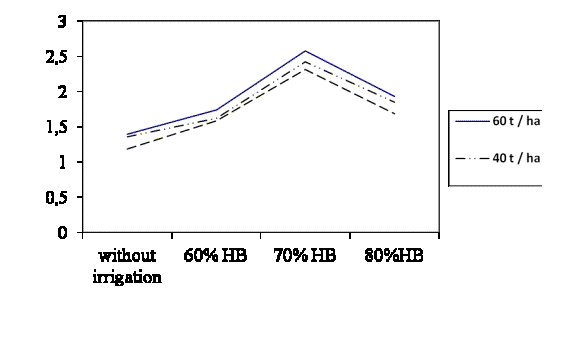
Fig.1. The average yield of soybeans for 2013, t / ha
Thus, the application of mineral
fertilizers and ash dose N105P90K80 dose of 60 t / hа will improve the fertility of irrigated lands in the southern zone of
the Amur Region.
References:
1.
Dospehov B.A. Technique field
experience. 5th Edition, more options. and reworked. - Moscow: Agropromizdat,
1985. - 385 p.
2.
Pleshakov V.N. The method of field
experience in irrigation / V.N. Pleshakov. - Volgograd: VNIIOZ, 1983. - 148 p.
3.
Field
experience / ed. P.G. Naydin. - Ed. 2nd, rev. and add. - M.: Kolos, 1968. - 328
p.
4.
Kaczynski N.A. Soil physics. – Moscow: HighSchool, 1970. - 340 p.
5.
Soybeans in the Volgograd region/
ed. Borodychev V.V., Lytov M.N., Saldanha A.M., Pohomov D.A. - Volgograd:
Panorama, 2008. - 224.
6.
Yust N.A. Soybean cultivation in irrigated areas Amur: monograph / N.A.
Yust, N.S. Shelkovkina, I.S. Alekseyko. - Blagoveshchensk: DalGAU, 2010. – 176
p.
7. Jaremenko A.A., Molchanova T.G., Yust N.A., Gorbacheva N.A.- Land
reclamation Priamurja - Actual problems of environmental safety and
technosphere: Sat. Scien. tr. zaoch. Intern. nauchn.-practical. Conf. -
Brussels: DalGAU, 2014. - Vol. 1 - 93-101 s.