Toktarbekova Aidana Erbolovna
The 1st
year student of Kazakh State Teacher Training University
Environmental Pollution


People have always polluted their surroundings. But until now pollution
was not such a serious problem. People lived in uncrowned rural areas and
did not have pollution — causing machines. With the development of crowded
industrial cities
which put huge amounts of pollutants into small areas, the problem has become
more important. Automobiles and other new inventions make pollution steadily
worse. Since the late 1960's people have become alarmed with the danger of
pollution. Air, water, and soil are necessary for existence of all living
things. But polluted air can cause illness, and even death. Polluted water
kills fish and other marine life. On polluted soil, food cannot be grown. In
addition environmental pollution spoils the natural beauty of our planet.
Pollution is as complicated as serious problem. Automobiles are polluting the
air but they provide transportation for the people. Factories pollute the air
and the water but they provide jobs for people and produce necessary goods.
Fertilizers and pesticides are important for growing crops but they can ruin
soil. Thus, people would
have to stop using many useful things if they wanted to end pollution
immediately. Most people do not want that of course. But pollution can be
reduced gradually. Scientists and engineers can find the ways to reduce
pollution from automobiles and factories. Government can pass the laws that
would make enterprises take measures for reducing of pollution. Individuals and
groups of people can work together to persuade enterprises to stop polluting
activities. Whilst urban-dwelling individuals who seek out parks and gardens
appear to intuitively understand the personal health and well-being benefits
arising from ‘contact with nature’, public health strategies are yet to
maximize the untapped resource nature provides, including the benefits of
nature contact as an upstream health promotion intervention for populations.
This paper presents a summary of empirical, theoretical and anecdotal evidence
drawn from a literature review of the human health benefits of contact with
nature. Initial findings indicate that nature plays a vital role in human
health and well-being, and that parks and nature reserves play a significant
role by providing access to nature for individuals. Implications suggest
contact with nature may provide an effective population-wide strategy in
prevention of mental ill health, with potential application for
sub-populations, communities and individuals at higher risk of ill health.
Recommendations include further investigation of ‘contact with nature’ in
population health, and examination of the benefits of nature-based
interventions. To maximize use of ‘contact with nature’ in the health promotion
of populations, collaborative strategies between researchers and primary
health, social services, urban planning and environmental management sectors
are required. This approach offers not only an arugmentation of existing health
promotion and prevention activities, but provides the basis for a
socio-ecological approach to public health that incorporates environmental
sustainability. As many as 159 countries — members of the UNO — have set up
environmental protection agencies. Numerous conferences have been held by these
agencies to discuss problems facing ecologically poor regions including the
Aral Sea, the South Urals, Kuzbass, Donbass, Semipalatinsk and Chernobyl. An
international environmental research centre has been set up on Lake Baikal. The
international organisation Greenpeace is also doing much to preserve the environment. But these are only the initial steps and they
must be carried onward to protect nature, to save life on the planet not only
for the sake of the present but also for the future generations.
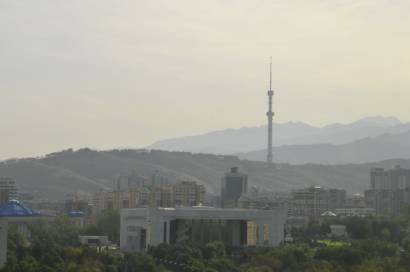
Today, even in a relatively affluent European countries, where the formula
"warned forearmed" in relation to the environment - these are the
realities of everyday life, because of air pollution people lose an average of
nine months of life. Almaty is extremely needed constant monitoring of air
pollution that will give the necessary information to begin preventive action.
However, according to the Kazakh activists of the movement "Green
Salvation", Kazakh citizens defenseless before the environmental problem.
Collected by government agencies today information is not complete and
operational. Independent examination of the quality of water, soil, air,
non-state actors have a license, most people can not pay, because it is very
expensive. At the local level due to lack of funding the competent authorities
are not able to identify all kinds of pollutants in soil, water, air.
Therefore, they have to be limited to collecting only the information which is
provided by polluters, which does not allow an objective picture of
environmental pollution.
The official noted that the main problem of environmental pollution Almaty
remains, although a slight improvement in 2009 compared to 2008 was observed
(some are inclined to attribute it to the effects of the crisis, in particular,
on the frozen construction in the city, has a definite value and input
operational transport interchanges, reducing the likelihood of congestion - the
results of measurements on the interchanges concentration of harmful substances
reduced by an average of 11%).
Main emissions account for vehicles - registered in Almaty 525 thousand. Cars
emitting up to 190 thousand tons of harmful substances into the atmosphere.
Nonresident transport an average of 200 thousand units per day. Authorities are
trying to tighten control over the technical condition of machines and their
level of toxicity. In 2009, following the results of inspection were not
allowed to operate 5,000 cars.
Қолданылған
адебиеттер:
1. sante.kz
› Пресс-Центр
3. Алматы ақшамы 09.06.14ж
Түйіндеме
Жалпы
дүние жүзіндегі эқологиялық
мәселелер.Біздің қалаыздағы экологиялық ластану
проблемалары және оның алдын алу шаралары туралы.
Резюме
Экологические
проблемы в мире. Проблемы экологических загризнении в нашем городе и приминение
меры.