Economic sciences/2. Agricultural economics
C.e.s.
Beisenbayev ZH.T., master
Nogayeva YE.A.
Al-Farabi
Kazakh National University, Kazakhstan
Innovative development of
cluster method in foreign countries
Native economic long-term strategy the increase of its
competitiveness in traditional and new scientific intensive
sectors, the quality growth of human capital in forefront high tech industry,
escalate of labour productivity and innovative factors the main source of
economic development. The decisions of these tasks requires the creation of new
system ,connections of government,
business, science, education, in the effective use of innovative development
tools, the role of cluster method is significant.
It isn`t fresh start to increase the competitiveness of
national economic through cluster strategy. In crisis period, if traditional
diversification methods couldn`t confront it in necessary extent, use of
business cluster organization model as the tool of modernization of economy.
Strengthen the competitiveness and acceleration of innovation of the
connections between cluster tendencies-it`s economic phenomenon which can
confront the global competitiveness and correspond the requirements of national
regional development.
President Barack Obama in his first speech in front of
American Congress noted the importance
of realization of innovative strategy for national development, mentioned the
need of support for Dynamic
partnership tendencies, connections between large and small companies,
financial institutions, on the basis of regional rate cluster strategy which
gives full dynamic to country economy [1].
Decluster strategy has been considering as an important
innovative tool of region development.
Vice-president of European Commission responsible for Business and
Manufacturing Gunter Verxdjen said: “We need a large number of world class
cluster in the European Union. They play an important role in innovative
development and creating new work places in our companies. Therefore, we offer
forward all forces of support the cluster policy at all levels, preserving the
competitive environment within constructed agglomeration” [2].
Cluster method is the most important thing in certain regions
or industries, as well as new technology, which will improve the
competitiveness of administration.
Micheal Pirtermen introduced the concept of “cluster” to
economic literature. He considers the
cluster as groups of companies,
specialized suppliers, service providers, firms in the relevant areas that was collected by their geographical
features, as well as the companies which competes in specific branch of concerned their service, also the
organizations which the work with (for instance, universities, standardization
agencies and trade associations) [3].
In addition, in cluster the groups of companies which adjacent to each other
geographically close and the organizations that relates to them must work in certain
sphere, characterized by community of services and complement of each – other.
World experience shows that over the
past two decades was in the process of formation of clusters. According to experts, currently 50% of the economy of the leading countries
clusterelised (picture 1)
Half of the enterprises in the United
States operates within the clusters, and the output exceeded 60% of gross
domestic product.More than 38% of the labor force in the EU, are attracting
more than 2000 clusters
[3]. Completely contained in the cluster,
Danish, Finnish, Norwegian and Swedish industry.Economic policy is based on the
cluster Finland 2,000 years has been in the forefront of global
competitiveness.Thanks to the high performance clusters, the state of the
world, having only 0.5% of the forest resources, taking 10% of the world
exports of wood products, and provides 25% of the paper holder. 30% of the global export market of mobile telecommunications services to
40%
[4, 24p].
43% of people employed in the industry
in the cluster and Italy accounted for more than 30% of national
exports.Germany (chemical and mechanical engineering), France (food industry,
cosmetics) cluster structures is doing a good job.
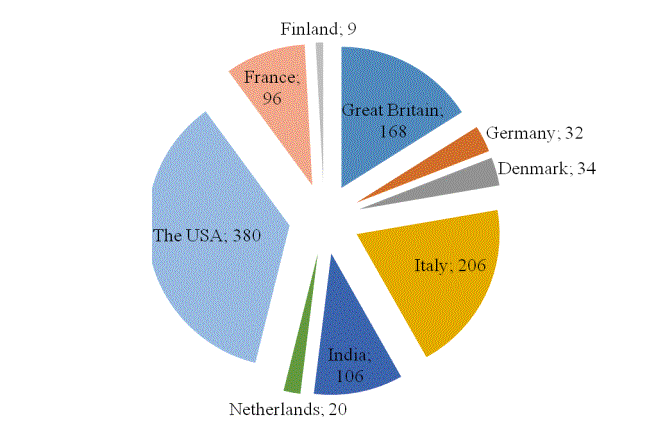
Picture 1 – Number of clusters in the leading countries
China and South-East Asia, especially
in Singapore (in the field of petrochemicals), Japan (engineering), and other
countries are in the process of formation of clusters.To date, over 3.5 million
employees 30 firms in China and sales 200mlrd year $
60 at the level of a specific cluster zones.
Improve competitiveness through cluster
initiative is a key element of the strategy of development of many countries. 20 of the past 10 years, more than 500 cluster initiatives implemented in
the country analysis shows that the high competitiveness of individual states
based on the competitive strengths of the locomotive-clusters.Sweden competitiveness of the pulp and paper sector, wood processing and paper
production, conveyor lines and other combinations (for example: the production
of industrial and consumer packs) have been in the field of science-intensive
devices.
Denmark has developed innovative technologies for
agribusiness and food industry.German car manufacturers and car producers have
a stake in this highly developed industries producing components Germany
location.The Italian branch of a combination: Refining metal-cutting tools,
fashion design, leather and footwear, wood furniture. China
export-oriented textile industry, sporting goods, clothing, toys, dishes and
other factories to create the content of competitive clusters was 15 years old
and require large amounts of investment.
90 years of the last century with the
Industrial Development UNIDO Private Sector Development branch of the European
governments and the European cluster development programs in cooperation with
the private sector and the introduction of a network of small businesses in
preparing a set of tips to help show the importance of the development of the
European economy for producing clusters.
References:
1. Jonathan Sallet and Ed Paisley
Innovation Clusters Create Competitive Communities. Huff Post Social News
September 21, 2009.
2. Powerful dusters: Main
Drivers of Europe's Competitiveness. Brussels, 17і1 October 2008
<http://ec.europa.eu/enterprise/innovation/index_en.htm>
3. Портер М. Конкуренция (trans.author). М.: Изд. дом «Вильямс», 2003.
4. Oulu Region — The Direction
for Expertise. Oulu:
Painotalo Suomenmaa, 2003.