Экономические науки/16. Макроэкономика
Candidate of Economic Sciences,
associate professor Kakizhanova Tolkyn
Master degree Yskakova Gulnur
Kazakh
National University named after al-Farabi
Unemployment and its dynamics in Kazakhstan
Labor market is one of the most important markets,
defining the economic stability of any state. Any Government seeks to find
effective ways of developing the labor market and reduce unemployment. It is
well known that any economic policy aimed at reduced unemployment should
contribute to an increase of the level of employment, or reduced the rate of
dismissal. Thus, the Government changes the natural rate of unemployment in the
country. The labor market in Kazakhstan is characterized by its unique
features. On average, the unemployment rate in Kazakhstan is 6-7%. This level
is considered acceptable and normal in the world economy. The Government of
Kazakhstan on the basis of annual Missives of the President develops special
programs to create more jobs. Unemployment exists in all countries. Low
unemployment is considered to be 2-4% rate from 4% to 6% suffered more than 7%,
indicates stagnation of the economy.
The labor
market in Kazakhstan is balanced in 2014. (see Table 1)
Table 1: The dynamics of unemployment in Kazakhstan
|
Month |
dynamics |
Unemployment million. people |
Unemployment, % |
For the
quarter (on average,%) |
|
January |
↑ |
4.64 |
5.1 |
5.1 |
|
February |
↓ |
4.63 |
5.1 |
|
|
March |
↓ |
4.63 |
5.1 |
|
|
April |
↓ |
4.62 |
5.1 |
5,06 |
|
May |
↓ |
4,61 |
5.1 |
|
|
June |
↓ |
4.59 |
5 |
|
|
July |
↓ |
4.58 |
5 |
5 |
|
August |
↓ |
4.57 |
5 |
|
|
September |
↑ |
4.58 |
5 |
|
|
October |
↑ |
4.58 |
5 |
5 |
|
November |
↑ |
4.58 |
5 |
|
|
December |
↑ |
4.58 |
5 |
The employed population was
10.3 million. According to statistics Committr of RK, number of unemployment
rate was 5.5%.
But in 2014 the unemployment rate
deteriorate due to the difficult economic situation in the country, thus
forcing enterprises and companies to cut back workers.
GDP is directly related to
unemployment, because as soon as the GDP begins to fall, then this situation is
immediately reflected on the citizens through a contracting labor market, which
further leads to an increase of unemployment rate. (Figure 1).
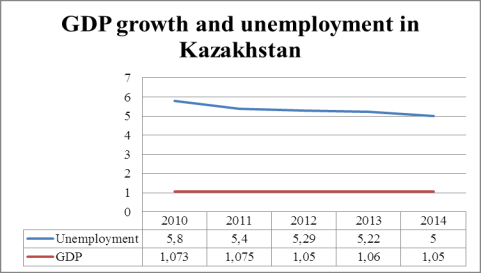
Fig. 1.
Compared with the situation in 2014, according to the results of the Statistics
Committee of unemployment rate in the country, provide following picture by
details for each subject RK: (see. Figure 2)
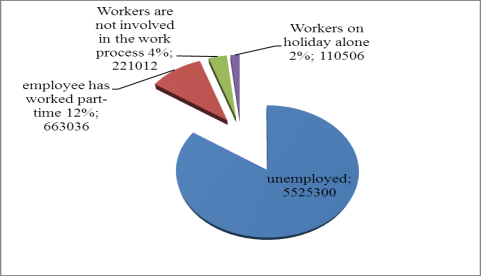
Fig. 2.
The number of unemployed people amounted to 5525300 people, which is 1.7%
less than in 2013. Also the rate of the total number of employees fell - 3348. Number
of people who are not involved in the workflow alsp deacreased - 41,066.
We present the unemployment rate in other countries for comparison. (see
Figure 3)
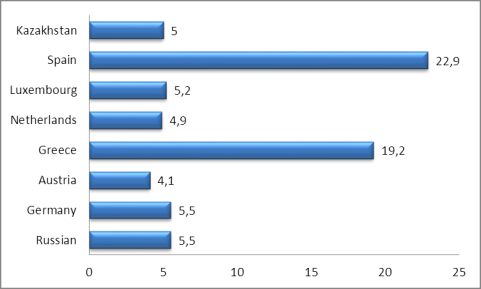
Fig. 3.
Unemployment
rates in almost all European countries is much higher than the normal value and
the overall state of the economy is suffering a lot more from this serious
problem.
Foreign
governments began to fight with unemployment by innovative approaches. For
example, Sweden have started to implement the program "Journey to the
work» (Job Journey) offering citizens looking for a workplace to go to other
countries. The main destination focus of this trip was the Norway. Wales came up
with to solving this problem even more creatively. Wellbeing Company and
Training Academy organized an action that allowed free access to all unemployed
tanning salon.
Unemployment
is a huge problem, from which the economy gets negative consequences not only
social but also major economic. The negative effects of chain will go one by
one, since the fall of the material well-being level of citizens will entail
lack of means to live, the demand for food will decrease. Citizens will not be
able to pay taxes, which will result in the consequences of falling GDP and it
is only a small part of the damage.
In
conclusion we can say that there are ways to eliminate or reduce its
unemployment rate to a minimum, if with minimal "losses”. If we use smart
approach.
References:
1. Jeffrey
D. Sachs 1. Larry Felipe B. Macroeconomics. Global approach: Trans. from
English. ANE at right. The Russian Federation. - M .: Publishing House of the
"Business", 1996.
2. J. Tobin. The global economy: who at
the helm? // Problems of the theory and practice of management, 1999. №1. P.48.
3. Safarov PM Reducing unemployment:
Current Issues and Public Policy // Creative Economy. - 2012. - № 2 (62). - C.
118-120. - http://www.creativeconomy.ru/articles/16754/
4. Ministry of National Economy of the
Republic of Kazakhstan Committee on Statistics, -
http://www.stat.gov.kz/faces/wcnav_externalId/homeNumbersLabor?_afrLoop=758149345950976#%40%3F_afrLoop%3D758149345950976%26_adf.ctrl-state%3Dtc7g7ep9k_64