Экономические науки/ 16.Макроэкономика
Prof. Kiseleva V. V.,
Evstigneeva L. M.
National Research University Higher School
of Economics
Russia’s
place in global science
Socio-economic
development of countries, their economic and political position in the world
arena are determined largely by scientific, technological and innovative
development. Many of the developing countries tend to for a lack of innovative
capacity through implementation of effective scientific policy, often based on
derived practical experience from abroad. Forms of knowledge transfer in modern
conditions are diversifying, but the most powerful stimulus to the contacts
development in the research is the country inclusion into the world of science
on the basis of codified knowledge (in the form of publications and patents).
That might act as a stimulus for new contacts; expand cooperation, including
foreign conferences, training, implementation of joint projects, and finally,
the migration process.
Geographical and
cultural proximity influences international scientific collaboration. The
widespread use of English and information and communication technologies has
helped to extend the scope of international research collaboration. While
Europe increases scientific collaboration in the European research area, the
rest of the world reaches out to emerging economies. Co-inventions are an
indicator of formal Research and Development (R&D) cooperation and knowledge
exchange among inventors located in different countries. International
co-inventorship is affected by countries' skills endowment and conditions of
relevance. International co-invention typically involves multinational
corporations with units in several countries and joint research ventures
between firms and institutions of various types (e.g. universities, public
research organisations). While co invention with the BRIICS continues to
increase, it remains limited as only about 1.7% of European patents and around
2.5% of US patents are со-invented with partners in BRIICS economies.
International
scientific publications co-authorship is calculated as the share of articles
featuring authors joined with foreign institutions in total articles produced
by domestic institutions. Co inventions evaluate as the share of patent
applications with at least one co-inventor located abroad in total patents
invented domestically. Luxemburg shows outstanding results in both directions;
more than 70% of publications involve co authorship with abroad institutions.
For Russia, the level of scientific co authorship is slightly more than
international patent co invention, which just exceeds 20%. Virtually all
countries fall below the 45o line (figure 1); this indicates that
they have more international scientific co-authorships than patent
co-inventions [4].
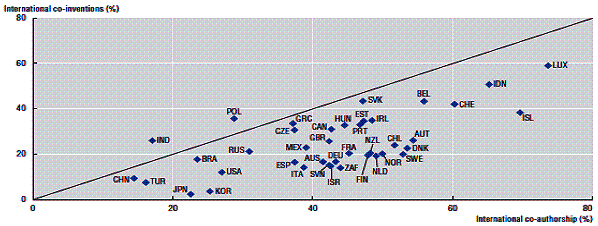
Figure 1. International collaboration in science and
innovation, 2011
Source: OECD Patent Data Base, 2013
The scientific
personnel mobility determined by many factors, including social, institutional,
and even demographic. In modern conditions, science has increasingly focused on
the society needs. It is directly included in the production process and
becomes a driver of economic development. It follows that the possibility of
exchange of knowledge do not depend on the physical distance between countries,
but from the "economic" distance, which is primarily determined by
the mutual interest for some kind of knowledge, i.e. the knowledge supply and
demand.
In turn, the global
scientific community demand on science is determined by government policy. Most
developed countries are now completing structural shift to scientific
disciplines, aimed at improving human well-being, including health-related
science, ecology, and information technology. At the same time, the current
state of the world's scientific potential characterized by a steady path
dependency. Therefore, large military sector research, inherited from the cold
war, has been preserved and continue to be restoring in the leading countries.
In table 1 figures are calculated based on articles citations data in the
leading scientific journals of the world in 22 scientific fields. They
characterize variations in citation in the directions of the average for all
directions for 10 years from 2004 to 2014. In the left column research areas
are listed which are cited more often than the average article in all
directions, in the right direction, areas which are cited less frequently. This
table demonsrates the long-term trend of scientific production demand in the
world. Quoting "hot" articles characterizes the demand on the part of
the works, which corresponds to 1% of "new" scientific achievements
that attracts the maximum attention of scientists. Countries’ place in the
scientific contacts reflected by quoting and their contribution to the dynamics
of scientific research could be illustrated by the figure 2.
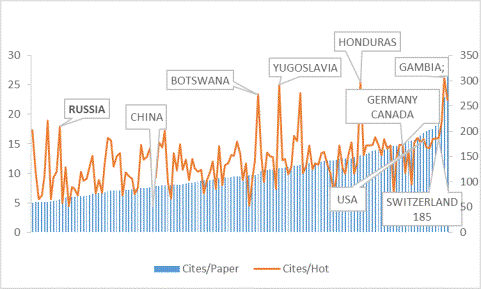
Figure 2. Cites/Paper and Cites/Hot Paper by Countries
– 2013
Source: InCites « Essential Science Indicator» Thomson
Reuter
First, most highly
cited articles often appear in countries that do not belong to recognised
leaders. In the number of links to hot articles, Gambia is in the same row with
Switzerland, and Germany and Canada do with Honduras. Moreover, the demand on
hot articles from developing countries is significantly higher than from
science-leader countries. The article focuses on Russian scientific potential,
but it should be noted that the reasons for getting articles in the number of
hot so diverse that this issue requires special analysis. This diversity leads
to the risk of mechanical borrowing of best practices in the transformation of
the organization of science for countries coming to the knowledge economy [3,
p. 10]. Russia is not consider to be in the number of science leaders,
primarily because of the fact that institutional characteristics of scientific
potential impede the mobility of its scientific staff [2, p. 1620-1630]. Furthermore, according to official statistics
more than 80% of research activities are devoted to natural and technical
Sciences, out of which more than 60% focuses on technical. Compared to this
figure with the data in table 1, it is clear that the grate number of studies
are held in those fields of science, the demand for which in the global science
is falling. At the same time citation index of Russian scientists’ articles in
the areas that are of interest to the global scientific community corresponds
to the level of advanced countries (e.g. immunology – 9 links to the article,
pharmacology – 6, neuroscience – 5) [1].
Consequently,traditionally
the high level of research in Russia corresponds to the industries interest in
which of the science world is reducing. Russian scientific journals with impact
factor greater than 1 are devoted primarily to
physical, chemical and mathematical Sciences. Third, high demand for Russian
science is limited by a number of factors, due to traditions, organization, and
institutional features of Russian science. However, according to Russian
Federal Statistics Service, the only type of agreement by which the balance of
foreign trade technology payments has a positive balance is scientific R&D.
Thus, it still can be argued that the demand for Russian science is maintained
at a high level.
Bibliography:
1. ISI Essential
Science Indicators official website Available at: http://thomsonreuters.com/essential-science-indicators/
2. Klochikhin Е.
Russia innovation policy: Stubborn hath-dependencies and new approaches.
Research Policy41 (2012) 1620-1630
3. Kotsemir М.,
Meissner D. Conceptualizing the
innovation process – trends and outlook basic research program working papers
series: science, technology and innovation, 2013
4. OECD (2013) Data
Base, Science indexes 2013