PROSPECTS
OF DEVELOPMENT OF THE RENMINBI IN INTERNATIONAL TRANSACTIONS
Doctor of Economic Sciences
Tarasova G.M., Grishanova A.V., doctor of Economic Sciences Shmyreva A.I.
Novosibirsk
state University of Economics and management "NINH"
ABSTRACT
The article considers the
peculiarities of development of the national currency of the PRC Renminbi, the
potential use of the Yuan and its prospects.
Keywords:Renminbi,
offshore RMB, a clearing centre, direct conversion, the internationalization of
the Renminbi.
Prospects for
strengthening the international position of the Renminbi is determined by the
orientation of China on the development of the real sector [3].The national
currency of China is quite stable on this index, the country ranks fourth in
the world [2]. China is a leader in the size of international reserves 3.86
trillion dollars in 2013, almost three times their volume in Japan.
China, like Japan, has become a major buyer of US treasuries and
European Union countries. The use of the Yuan began in the international
accounts of border trade on the basis of the first agreement in 1997 and then
spread to trade with eight neighboring countries. So, with Myanmar 95%, Vietnam
- 75%, Laos - 40% of payments made using the Yuan. In 2011 an agreement was
signed between Russia and China on mutual use of their currencies.
The main obstacle to the
internationalization of the Renminbi is the lack of free convertibility and
infrastructure saturation of international turnover laneway mass. In connection
with this new phenomenon was the rate of China on the use of the offshore
Renminbi (CNH) when conducting foreign trade operations through the global financial
center of Hong Kong.
Recently, China has
intensified its activities in the development of the interstate economic
relations with the use of the national currency, the Yuan. First of all, it
refers to the recently signed exchange agreements with Canada and Qatar, and
provides for the doubling of the volume of the joint turnover. Traditionally,
Canadian exporters use when trading with China the us dollar as the currency
for international settlements, however this is to some extent increased costs.
In accordance with the agreed amount of the swap agreements between China and
Canada amounted to 200 billion Yuan, characteristically, that currencies of the
two countries will be used not only in trade but also investment.
The Central banks of China and
Malaysia announced the establishment of the clearing centre in Kuala Lumpur,
which will further increase the use of the Chinese Yuan in Southeast Asia.
Settlements in Yuan are crucial for the national system of China. The
development of this system is due primarily to the policy of independence and
autonomy in the organization of calculations carried out by governments and
Central banks of these countries (China Union Pay) [1].
There is a direct conversion
between the Singapore dollar and Chinese Yuan. Therefore, the Chinese Yuan is
spreading rapidly as a currency for trade, investment and savings around the
world. Thus, deposits in Yuan increased 55 times in South Korea last year.
The issues about the use of
the Chinese Yuan in Europe are discussed, so the European Central Bank is
considering the possibility of inclusion of the Chinese Yuan in its official
reserves. Now more than 10 thousand financial institutions are working with the
Chinese Yuan, while in 2011 - 900. Offshore operations with the Chinese Yuan are
estimated at 143 billion U.S. dollars. The share of Chinese exports and
imports, denominated in RMB, increased by almost six times in three years and
reached 12%.
According to SWIFT in December
2014, the share of the use of the Yuan in international payments increased to
2.17%, as presented in figure 1. Yuan was first included in the five leaders of
the international payment market, ahead of the Canadian dollar and the
Australian dollar. For 2014 the number of payments in RMB and doubled its share
in the calculations tripled. The people's Bank of China in 2014 signed an
agreement to open an offshore clearing centers trade the Yuan outside China.
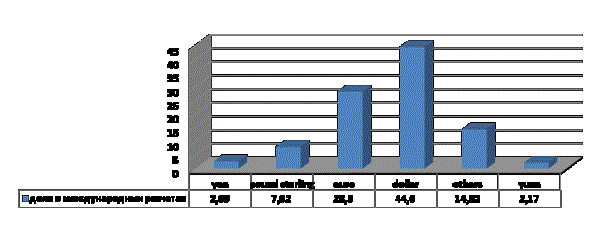
Figure1.
- The share of freely convertible currencies in international payments.
To increase cash flow in the
Yuan were about 30 agreements on direct currency swaps. Now, a quarter of
foreign trade transactions with China are in the Yuan. In 2010 only 3% of
transactions were conducted in the national currency of China.
The development of direct
trading between the Yuan and the Euro will contribute to the formation of a
direct exchange rate between two currencies to facilitate the use of the Yuan
and the Euro in bilateral trade and investment, to promote financial
cooperation.
List of references:
1.Grishanova A.V. Background
of the national payment system in Russia // Banking systems and financial
markets in terms of economic asymmetry of Economy: Materials IV Banking Forum /
ed. G.M. Tarasova; Novosib. state University of Economics and management. -
Novosibirsk, 2014. - p.177
2. Tarasova G.M. Banking
systems of the world: the United States, Russia, China // Banking systems and
financial markets in terms of economic asymmetry of Economy: materials IV
Banking Forum / ed. G.M. Tarasova; Novosib. state University of Economics and
management - Novosibirsk, 2014. - P.80
3. Shmyreva A.I. Banking
systems of the world: the United States, Russia, China // Banking systems and
financial markets in terms of economic asymmetry of Economy: materials IV
Banking Forum / ed. G.M. Tarasova; Novosib. state. University of Economics and
management - Novosibirsk, 2014. - P.80