Dossanova A.
PhD, Senior Teacher, Al-Farabi Kazakh National University,
Kazakhstan, Almaty
Konyrbekova T.
Senior
Teacher, Al-Farabi Kazakh National University, Kazakhstan, Almaty
LINGUA CULTURAL
DESCRIPTION OF CONCEPTS «BILIM/KNOWLEDGE» IN
KAZAKH ENGLISH LANGUAGES
Annotation:.The article deals with
notional, constructive description of the word bilim, knowledge
and its lexical- semantic meanings in Kazakh English languages, its lingua
cultural description revealed by proverbs and saying,phraseological units. Nowadays
it is very important to get desired job and by acquired knowledge. There
are different resources and subjects for development education sphere in
Kazakhstan, the third part of the state budget is spent for it. Many programs and education grants which helps
develop competitiveness among
youth.
Kazakh mono linguаl dictionary gives the
following explanation of the word knowledge (bilim).
Knowledge
substance. 1. It is a combination of
information and judgments, notions in a system of human being. 2. A notion of a thing received
by studying and learning. 3. A notion
belonging to the definite profession or qualification. 4. Combination of means and ways
of completing any kind of activity. 5. Combination of special information on definite field (system). Bilim it’s not just pedagogical and abstract notion, it is also
combination of units referring philosophical, social field.
What
is knowledge and its importance and content,correlation between being educated and
uneducated. In order to find an answer to these questions we did social
linguistic questionnaire (70 respondents between 17- 40 ages took part in the
questionnaire , 2014).
Analyzing all answers we tried to show common features of the answers to
the question what is knowledge/bilim in this picture.
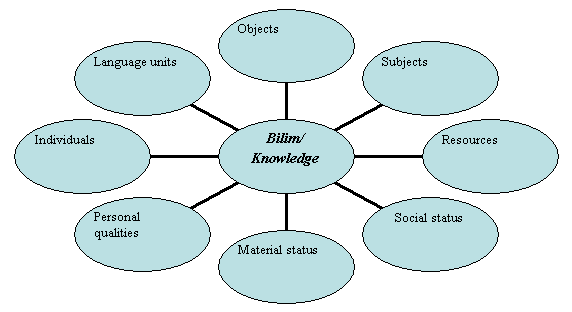

Picture 1 – Bilim/Knowledge and its reflection in the mind
Lexical
semantic groups of bylym/knowledge concepts. Assosiative mind of lexical unit bilim/knowledge is given in the picture 2.The picture shows that
knowledge in the Kazakh notion takes
great role and it has many sematic groups. Knowledge in Kazakh cognition has
not only formed combination of information and data, but it is combination of
philosophical notions.
According to the result
of the questionarie 80 cognitive areas of the «bilim» have been considered. We gathered them into 6 lexical groups.
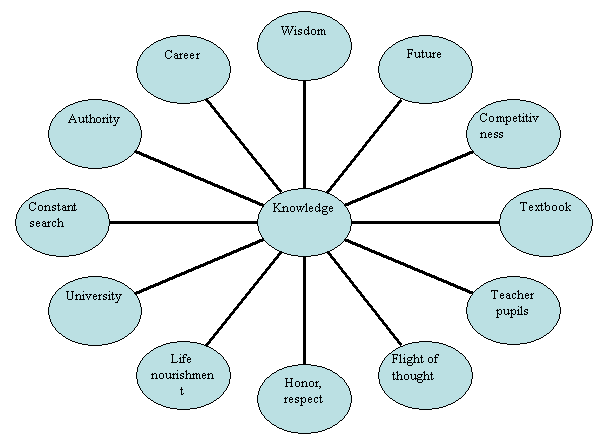

Picture
2- − Bilim/Knowledge and its reflection
in the mind
Table 1 – Respondents
notions referring to the concept knowledge
|
Philosophical |
Subjects/ Objects |
Material status |
As a process |
Personal/human qualities |
|
|
Teacher |
Degree |
To be |
Conscious |
|
|
Tutor |
Career |
Flight of thought |
Humane |
|
Human’s
wisdom |
University |
Money |
Many
searching |
Person
who thinks wisely |
|
Instrument
which helps to cope with difficulties |
School |
Power |
Study |
Patience |
|
life
nourishment |
Colleges |
To live
wealthy |
To react
quickly |
Organized |
|
|
Education
courses |
Wealth |
To use
terms so often |
good
relation |
|
Piece of
bread |
Library |
A person
on the top |
To be
able to put an aim |
Competence
|
|
Quality |
Book |
Position |
Concrete
answer |
Good up
bringing |
|
Happiness
|
Desk |
High
salary |
|
Talant |
|
Society
view |
Tabs I phone |
Travelling
around the world |
Knowing
some languages |
Cultural |
|
Own
opinion |
Technology |
Authority |
Wunderkind
|
Politeness |
|
concrete
opinion |
Techniques
|
|
To work
hard |
Cleverness |
|
Bright
future |
Internet |
|
To be active |
|
|
Good way |
Student |
|
To be good
sample for everyone |
|
|
View to
the life |
Learner |
|
|
|
|
Open
minded |
Education
programs |
|
|
|
|
Constant information |
Grant |
|
|
|
Combination of notion and cognition of the concept
bilim/кnowlege reflected in the mind proved that they can be divided
into some semantic groups. Concept bilim/кnowlege being basic concept
their types, importance in the human life, function, its subjects and objects,
mechanisms, knowledge formation environment, documents, normative acts,
advantage of being educated for the society and these frames into the
following groups.
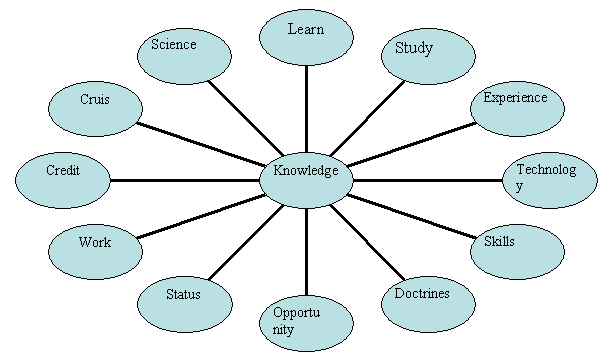

Picture 3 – Knowlege in English peoples’ minds
The role of concept knowledge in the English
cognition. The role of concept knowledge in the society can
be grouped by the following ways: Knowledge –білім; Information – akparat;
Learning – oku; Еrudition
– eruditsia; Notion–
tusinik; Scholarship – shakirtaky;
STUDY – oku,
Teach –okitu.
According to the collected materials, the main thing among them, of course STUDY.
М.А. Shalagina’s work «Concept
study in the English language picture»:
History of England can be traced
from the time of settlement of the English in England - Saxons or even earlier,
from the time of Roman rule. For many centuries education occupy a secondary
role in the lives of ordinary people. However, in the time of Edward VI Tudor
appeared grammatical system of free schools, where everyone could learn letter despite a number of
serious problems faced by the reformers in the development of the British
educational system, this system has been gradually improved: there were new
schools and universities, to create conditions to train people from different
walks of life, expanded lists of disciplines. It is not surprising that a large
number of English vocabulary related to the formation and sayings about
education occupy a significant place in this language proverbs fund "» – she said [2].
As a result of the work with
dictionaries the word bilym/oku
are close by the meaning with the word «study».
The word «study» in English was
registered in 12
century. «Study»
as a noun from the word to study as a verb was formed from the French word estudie (in middle ages from stadium in latin) entered English
language.
By investigating proverbs and
sayings in English we saw the importance and necessity in their cognition. Proverbs and
saying concerning knowledge are used in different context.
Knowledge is something that gets information about
certain sphere, phenomena or process: Live and learn/Bilim-inemen kudyk kazgandai; Experience is a good teacher/ Tazhribe
– ustazdan
artik; Learning makes wise, ignorance otherwise/ Oku – kun, okimau – tunek; Learning is
better that fortune/Bilim – bailiktan artik.
Knowledge is something on the basis that is
gained by private experience or by other peoples’ experience: We learn by our own mistakes/ auzi kuigen urlep isher; Experience schools all careless fools/Tazhiribe barligin da
uiretedi,
kop bilgennen surama, kop korgennen sura, Learn on
your neighbour`s skaith/ Korshinin kateligin
kaitalama.
Knowledge is something
unnecessary between certain group of people:
Don`t teach fishes to swim/ Balikti zhuzuge uiretpe; Don`t teach your grandmother to suck eggs/ Zhumirka tauikti uiretpeidi; Experience keeps
a dear school but fools learn in no other/ Zhindiga daua zhok.
Knowledge is as a complex
process that needs great power: Failure teachers
success/ Kinalasin
– uirenesin; There is no royal road
to learning/ Gylym
jolu – kiyn jol; No man is born wise and learned/ Sheber bolip tuilmaidi, sheberlikke
uirenedi; Learn to walk before you run/ Zhugirmes burin duris znugurudi uiren.
To be
knowledgable іis like relationship between teacher and pupil:Like teacher, like pupil/Ustazi zhaksinin ustanimi
zhaksi: Wit once bought is worth twice taught /Gylum
– zhastan, Kina tastan.
We can see from these examples that, words knowledge/study /to
teach/ are
close to each other and they have great meaning in English people’s cognition.
All researches concerning the
reflection of the concepts Bylym/knowledge are considered as the function of concept system.
According to our opinion the main thing that
shows concept image of the world is a concept system. Concept system consists of inner and out constructions. Inner constructions introduce concept: frame, script, mind picture, scheme, outer constructions – word, phraseology, metaphor,
sentence, word
combination and etc. In the formation concept
systeminner consrtuctions in the mind are grouped into the certain cognitive
model. By dividing concepts into lexical-semantic groups, it is possible to
recognize them.
On the basis of the language world picture and lingua cultural data nature of
the concept «bilim/knowledge
in Kazakh and English languages we found out that knowledge
is the main value for human in in a society. Having made analysis of the
semantic peculiarities of the words bilim in Kazakh and knowledge in English we’ve found out similarities and
national peculiarities and semantic structures of the word bilim in Kazakh and
English languages.
Used literature:
1.
Kazak tilinin tusindirme sozdig. 4-t.– Almaty: Gylym, 1979
2.
shalagina М.А. Concept «ucheba» in proverb world picture
poslovichnoi kartine mira angliskogo iazyka // Filologicheskie nauki v
Rossi I za rubezhom: materials of the
international conference ( St.Petersburg, february 2012). – SPb.: renome,
2012. — p. 178-180.
3.
500 English proverbs and sayings. Almaty: «Koshpendiler» baspasi, 2003.
4.
Оxford dictionaries http://www.oxforddictionaries.com/