Saitova N.А., associate professor of
Political Science department, al-Farabi KazNU, Republic of Kazakhstan
statement of the culture of tolerance:
kazakhstan experience
With gaining of independence Kazakhstan
has entered into the new historical stage of development which is characterized
by deep transformations in all spheres of public life within the revival of
national and religious self-consciousness. The strive of Kazakhstan to provide
the peaceful neighborhood of the representatives of different nationalities and
confessions, to preserve stability in society finds reflection in flexible
policy of the state. The main prerogative of this policy is the culture of
tolerance.
It
is not incidentally, that head of state N. A. Nazarbayev determines the strengthening
of civil peace and harmony, conducting of interfaith dialogue of
representatives of various religions, strengthening the ideological and
political consensus of political system and society through the expansion of
the sphere of the integrating values and reducing the sphere of separating
values as political condition of successful implementation of reforms at the
new stage of Kazakhstan way.
Today we can state high tolerance of the Kazakhstan society. What
factors are the cornerstone of
tolerance of the Kazakhstan society? According to the leading experts
investigating this subject there are some factors that pave the way to its
establishment.
The first factor is the history community, deep-seat soviet internationalism, which joined the all people living on the Kazakh
earth.
The second factor is with gaining of
independence of the country the general choice of citizens of Kazakhstan is the
dynamic movement of society toward the way of democracy and progress.
The
third factor is the mentality of the title ethnos of the country. Kazakhs,
being the successors of nomadic culture, throughout the millennia have showed
the adaptation opportunities under constantly changing external conditions.
Besides, the Great silk way lying through the territory of Kazakhstan was the
binding bridge of interaction of civilizations of the West and East. It made
ancestors of Kazakhs tolerant in relation to representatives of other cultures
and religions. And today, taking into
consideration its internal conditions of multicultural society and a
geographical arrangement on a joint between the East and the West, is also
vital to Kazakhstan to promote the ideas of intercultural dialogue.
The fourth factor is - the values, common
for all Kazakhstan ethnos, among which the
independence, honoring the seniors, respect for a family, care of
children, cordial hospitality, neighborliness. The statement of tolerance in
the Kazakhstan society is closely connected to the statement of democratic
values which are the most important motivation of political behavior of social
communities, elite, leaders. These are the rights, freedom of the person,
democratic principles and a form of a political system and development of
society, participation of Kazakhstan citizens in policy, expression and
realization of their interests, etc. The President N. A. Nazarbayev has told
that: "If we want to become respected and competitive country, we have to
be the united and solid nation that will be integrated by the general values,
with the harmonious language environment, the nation which is directed in the
future, but not in the past» [1].
Currently,
in the country it is provided a unique opportunity for representatives of
various ethnos to keep the cultural heritage, originality, traditions, language
. Effective standard and legal and conceptual bases of an interethnic consent
are created. The constitution of Kazakhstan guarantees the protection of
interests of all citizens irrespective of ethnic, racial, religious or other
origin. Its norms pave the foundation for the trust and mutual respect between
all ethnic groups" [2]. It is important to note also the fact, that
representatives of various ethnos and nationalities actively work in the sphere
of public administration.
The main all-system properties of social
and economic and political development of the country for a long prospect are
presented in the Message of the
President of Kazakhstan to the people of Kazakhstan "Kazakhstan way-2050:
The common purpose, common interests, the common future". A main objective
is to - create the society of prosperity on the basis of the strong state,
developed economy and opportunities of general work, entry of Kazakhstan into
thirty of most developed countries of the world [3].
Integrative potential is put in such ideas
as the Homeland community, a community purpose, a community of interests,
participation of all population in the destiny of the country, uniqueness,
originality of the Homeland in the world community, etc. in the patriotic act
"The Eternal Land".
The political meaning of given approach
is great, as it contributes to joining of different nationalities, in to
education of feeling of belonging in them to the common state, it will mobilize
them for performance of the common social and economic tasks arising before
them.
The general principles of creation of the
prospering Kazakhstan as common deal of all inhabitants of the Republic,
regardless of their ethnic origin, are defined in the Doctrine of national
unity.
It should be noted that, if at the
beginning of the 90th of the XX century in Kazakhstan it was dominated an
approach to formation of national idea on an ethnic basis, from the middle of
the 90th it is observed the transition to civil values. For instance, the
design of five principles offered by Nursultan Nazarbayev in January, 2001 at a
meeting with the public in Astana might be presented as an example. The first
principle of equality of all components of the Kazakhstan people is reduced to
the observance of ethnic and language equality and, as a result, satisfaction
of their needs for social and economic, political, spiritual equality in
compliance with provisions of the Constitution of the country. The second
principle is conformed with situation and a role of the title nation with which
the formation and development of the Kazakh statehood is connected. The third
composed national idea, according to N. A. Nazarbayev is the "religious
identity of the people" because "God is Common, and the ways to Him
is different". The fourth principle is related to the education of
law-abiding of Kazakhstan citizens. The further development of small and medium
business is defined as the fifth principle of national idea. We believe that
nobody will deny that all proclaimed principles express national interests and
are urged to consolidate the society, to inhale the confidence in people, to
give them the chance to realize the creative potential of unity [4].
At
the same time, we think that real composed elements of such peculiar "idea
frame" capable to provide consensus communication between adherents of
various ideological beliefs, world outlook orientations, ethnic and religious
origin supplement with the high principles of freedom, the law, a consent and justice. They are results of
centuries-old searches of world social thought, the basis for dialogue and
synthesis of ideological preferences of various ethnos..
The
valuable basis, the foundation and source of qualitatively new type of the
political culture adequate to democratic transformations is the public,
national unity, first of all, an international consent. It is very important in
multiethnic environment, because it does not allow the assimilation of the
ethnos, exclusion it from society, incorrect using ones in favor of others,
also to determine the basic values of social development.
It
is very important that it was attempted to give an accurate definition to the
concept of "national unity" in the Doctrine which, possessing the
certain universal characteristics becomes, at the same time, bears in itself
the unique Kazakhstan features. The national unity is understood as integrity
of existence of ethnic communities as a part of the common state.
The
doctrine on its way to achieve the main objective which is the creation of the
common civil nation, allocates the
achievement of high level of self-identification of citizens of the
country with the Republic of Kazakhstan, formation of effective system of
interaction of state agencies and civil institutes in the sphere of the
interethnic relations, development of a state language, preservation and
development of ethno-cultural, language identity of the people, and also fight
against extremism, radicalism and human rights violations [5].
The results shown by Kazakhstan in the
sphere of economy, social and political development are certainly based on interethnic peace and harmony which from the
date of gaining the independence became a cornerstone of reforms and progress.
In multiethnic Kazakhstan neither economic reform, nor social growth, deep
democratization of political system, and in general the development was
impossible at suspense of issues
related to the interethnic relations.
The history convincingly proved that
where the political nation acts as an ideal state there is formed the huge
economic potential, and the social progress is clearly visible. In this regard
the ethnic and cultural diversity of Kazakhstan is absolutely fairly considered
as a strategic resource of development of the country, a condition of its entry
on equal terms into community of the most developed states.
It is remarkable that
today, Kazakhstan is one of the first countries which in a difficult times of
global contradictions managed to make idea of a spiritual consent as a real
force. Despite the difficulties of the first years of independent existence,
Kazakhstan became in 1992 the venue of the I World congress of a spiritual
consent. Since then the October,18 is noted as Day of a spiritual consent in
Kazakhstan.
The
Assembly of the People of Kazakhstan (APK) created in 1995 became one of the
main tools of an international and interfaith consent. There are 818 ethno-cultural
associations, 46 ethnos have the ethno-cultural centers in its structure. In
2008 it was adopted the Law "On Assembly of the People of Kazakhstan"
that does not have analogs in the world.
In 2007 within the constitutional reform the
Assembly acquired the right to elect nine deputies of Mazhilis of Parliament.
This right should be considered as the constitutional mechanism not only of
the representations of interests of
ethnic groups in Parliament, but also as the statement of culture of tolerance
in power structures.
Kazakhstan builds democratic model which
is called integration in world practice. It is based on the understanding of
the importance of both ethnic, and civil identity. All post soviet states which
made nationalist trend as a basis of development at the beginning of
independence have endured the bloody conflicts, manifestations of hatred and
hostility, the consequences of which have not eroded this day. On the contrary,
Kazakhstan initially headed for a harmonious combination of all interests, the
rights and duties of citizens regardless of an ethnic origin. The principle was
accurately designated as: "unity – in variety.».
The trust gives rise to trust. For the
last years, all the possible real and hypothetical fears of ethnoses of our
country for preservation of the originality have been removed. The created
conditions for preservation of their languages, cultures, traditions provided
high level of gratitude and reciprocal trust to the Kazakh people. As a result,
the role of the Kazakh people as integrator, the thesis about the unity of the
people, but not the nations have not met the slightest rejection from ethnic
groups in the country [6].
The Kazakhstan institute of social and economic
information and forecasting (KISEIP) together with PF "Fund of the First
President of the Republic of Kazakhstan" within 3 years have conducted the monitoring sociological
researches devoted to the most contemporary problems of life of the republic.
Survey of the population was conducted in 6 regions of Kazakhstan: The southern
Kazakhstan, West Kazakhstan, East Kazakhstan, Karaganda areas, and also in the
cities of Almaty and Astana. Sample volume is the 1 400 respondents. Selection
was quote. Quotas are set according to the population of regions, settlement
type (area, and also the city village), a nationality, a sex and age.
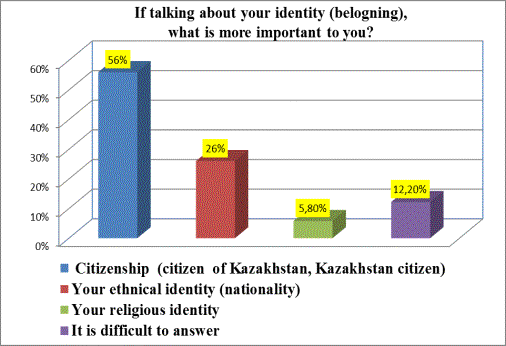
The residents of Kazakhstan were
offered to define their identity and to build its hierarchy. So, nationality
stands in the first place, as 56% of respondents or the most part of the
population of the country is on the first place consider themselves as the
Kazakhstan citizens [7].
Historically,
being the part of cultural continent of Islam, Kazakhstan does not interfere
the development of all world and traditional religions. At the same time the
President has underlined that tolerance for Kazakhs is not an academic, but
practical [8].
As the world experiment shows, that one
of the acute issues in the context of formation of the tolerant relations in
multicultural society it is the problem of language equality. In Kazakhstan society
the policy of an embodiment of the concept of trinity of languages is a
condition of strengthening of the tolerant relations. After all, along with the
acquiring the languages, traditional for our country, - Kazakh and Russian by
the citizens, the attention is paid to language acquisition of the
international communication — English which will allow to come to the new level
of the international interaction in all spheres. Especially, such policy,
actually, according to its content demands an integrated approach and
coordinates with processes of socio-political and economic modernization of the
country in general.
The state policy of not interference in
inter-confessional activity of different religious communities and directing
them to the positive dialogue and mutual understanding deserved an
international recognition.
The results of the sociological survey
conducted by PF "Center for Ethno-political and Humanitarian
Researches" by request of the Ministry of information and culture of RK within
the "Organization and Conducting Complex Research on Issues of
Strengthening the Tolerant Consciousness in the Kazakhstan Society"
project showed that about 40% of respondents, actually, consider the new
religious trends with mistrust, and approximately the same proportion are
indifferent to them.
In this regard, it is necessary to
emphasize that according to the research results society is not satisfied with
the work of mass media and educational institutions in the questions of
training and covering of religious subject. In order to form the more active
participation of social institutes in objective, correct and rather full
covering of questions of religious subject in society is required.
As for socialization, at which the
benevolent attitude towards representatives of other religions is set,
according to the opinion of 60% of respondents the family is considered as a
peculiar base of valuable orientations. It is necessary to note that tolerance
in its broad sense as the synonym of goodwill, sincerity is, first of all, brought up, in a family, and
in its narrow sense, as the neutral or positive attitude towards
representatives of other ethnic and confessional groups, with more active
participation of other social institutes.
Poll revealed the high level of
satisfaction of the population with efforts of the President of the country on
strengthening of an ethno-confessional consent – 93%, that is twice higher than other institutes of the
power on average. It is substantiated not only by political policy of the Head
of state, but also symbolical value of its figure – for many his actions are
peculiar indicators of the relation of the state, a political regime in general
to confessional variety.
The international and interfaith consent is the cornstone
put by the Leader of Nation in the foundation of our domestic policy. This fact
was confirmed also by the results of Conference of high level on tolerance and
non-discrimination in Astana. Not incidentally, that in the world there started
the talks about "Spirit of Astana" as about the created political and
philosophical phenomenon, model of existence of societies and states in the XXI
century, a symbol of general aspiration to the world order based on the
principles of trust, a consent, mutual respect and unity in variety to variety.
The results of the sociological
research "State and Prospects of Civil Society in the Republic of
Kazakhstan" conducted by the Kazakhstan institute of strategic researches
at the President of the Republic of Kazakhstan showed that, according to more
than a half of respondents (59,1%) believe that the citizens can make
Kazakhstan a prosperous country; nearly a half (49,7%) indicated the strong
power; a significant amount of respondents (75,1%) consider that it is possible
only within the powers only to the President. Readiness of society for the
self-organization is quite high – 73,6% of respondents are ready to unite with
citizens for the solution of public problems. On a question: Whether "You
agree with the following phrase "In Kazakhstan there are more consent and
unity, than disagreement and dissociation among the people" 55,8% of
respondents gave an affirmative answers [9].
It is the prove that, despite the
destruction of collectivist ideology, distribution of individualistic values in
public consciousness, the people, in general, have kept goodwill and readiness
for mutual aid.
State' efforts and the understanding of the people
led to the fact that today the Kazakhstan society steadily develops. In the
country dialogue platforms of cultures and religions are created and actively
evolving, the role of whom is very important in objective, correct and rather
full discussion of questions of religious subject in society, which is undoubtedly
necessary for the further statement of religious tolerance in public
consciousness.
In general,
the strategy of Kazakhstan in the sphere of tolerance is multifaceted. However,
in our view, the following steps are necessary:
- further development of pluralistic information space;
-the creation of the research centers, the edition of
magazines, serial publications and methodical literature on problems of
tolerance, the role and value of the cultural traditions and cross-cultural
dialogue devoted both to experts and to wider audience;
-rendering
the full support to the mass media setting
education of youth in the spirit of tolerance and patriotism as their
purpose;
- statement of common Kazakhstan civil and historical
and cultural values, maintenance of the Kazakhstan patriotism, statement of the
civil nation.
Thus, the principle of tolerance for
Kazakhstan is not only the norm of culture, but also the state principle. The
alternative to cooperation and equal partnership of all nations and nationalities
living in the country does not exist. The culture of tolerance became guarantee
of stability in the conditions of modernization of the Kazakhstan society.
At the
same time, the strengthening of ethno-religious contradictions in various parts
of the world, including in some neighboring countries might have a negative
impact on an interethnic and religious situation. Penetration of various forms
of extremism and radicalism into Kazakhstan from the outside presents the
potential danger. The local social and everyday problems in society might take
an ethnic coloring. These and other aspects demand a special attention, as from
the state, and whole society. Further cultural development of tolerance remains
a constant and important problem of the state and all civil institutes.
Literature
1. Nazarbayev N. A. Kazakhstan
on a threshold of new breakthrough forward in the development. Message of the
President of the Republic of Kazakhstan to the people of Kazakhstan. – Astana,
2006. – P.35.
2. Constitution of republic of Kazakhstan. 30 August
1995 year. Official text. – P.4.
3.
Nazarbayev N. A. Kazakhstan way-2050:
Common purpose, common interests, common future. Strategy 2050. The Message of President of RK to the
People of Kazakhstan «// http://www.akorda.kz
4. National Idea: Friendship,
Brotherhood, Equality. – Kazakhstan thruth. - 20 January 2001 y.
5.
The doctrine of national unity.- The legal newspaper.- 28 October 2009 y. – P.1-2.
6.
Demidov A., Sharipov R. Integration of society into the post-totalitarian
period. - Social sciences and present. - 1992. - № 3. - P.156-163.
7. Mukhamedzhanov B. G.,
Zhusupova A. Kazakhstan in the estimates of inhabitants and experts.
Scientific-popular publishing house - Almaty: PF "Fund of the
First President of the Republic of Kazakhstan», 2011. - P.49.
8. Religion: The tolerance rules. The formation of
culture of tolerance and religious tolerance became the acute issue of new century
// Kazakhstan thruth. – 2006.-15 March. – P. 3-4.
9.
State and prospects of civil society in the Republic
of Kazakhstan (the results of sociological research). – Almaty: KISR
РК, 2010. – P.6-9.